
After experiencing two years of robust returns in 2023 and 2024, U.S. growth equity investors may have been lulled into thinking that the momentum would continue into 2025. That has not been the case. The volatility so far in 2025 has proved to be a rude awakening for investors, particularly those who believed that the so‑called “Magnificent 7” stocks would continue their march ever higher. In fact, the Magnificent 7 went from lifting the Russell 1000 Growth Index higher to now dragging down the performance of the overall index this year, through February 28, 2025.1
However, more muted returns for the Magnificent 7 may be welcome news for active managers, who have often struggled to outperform a heavily concentrated, historically top‑heavy Russell 1000 Growth Index in recent years.
Below, we discuss both the rise of the Magnificent 7, along with the potential for a more favorable playing field for active managers as these once high‑flying stocks seemingly fall back to earth. As we argue below, the supremacy of the Magnificent 7 may end up representing a distinct moment in time rather than a long-term structural change in the U.S. equity market.
The Birth of the Magnificent 7
In May 2023, a Wall Street strategist created the name “Magnificent 7” to refer to a group of seven mega‑cap, technology‑focused companies comprised of Alphabet, Amazon, Apple, Meta, Microsoft, Nvidia, and Tesla.2 The clever moniker, alluding to a classic Western film, rose in prominence as these stocks delivered strong returns in 2023 and 2024.
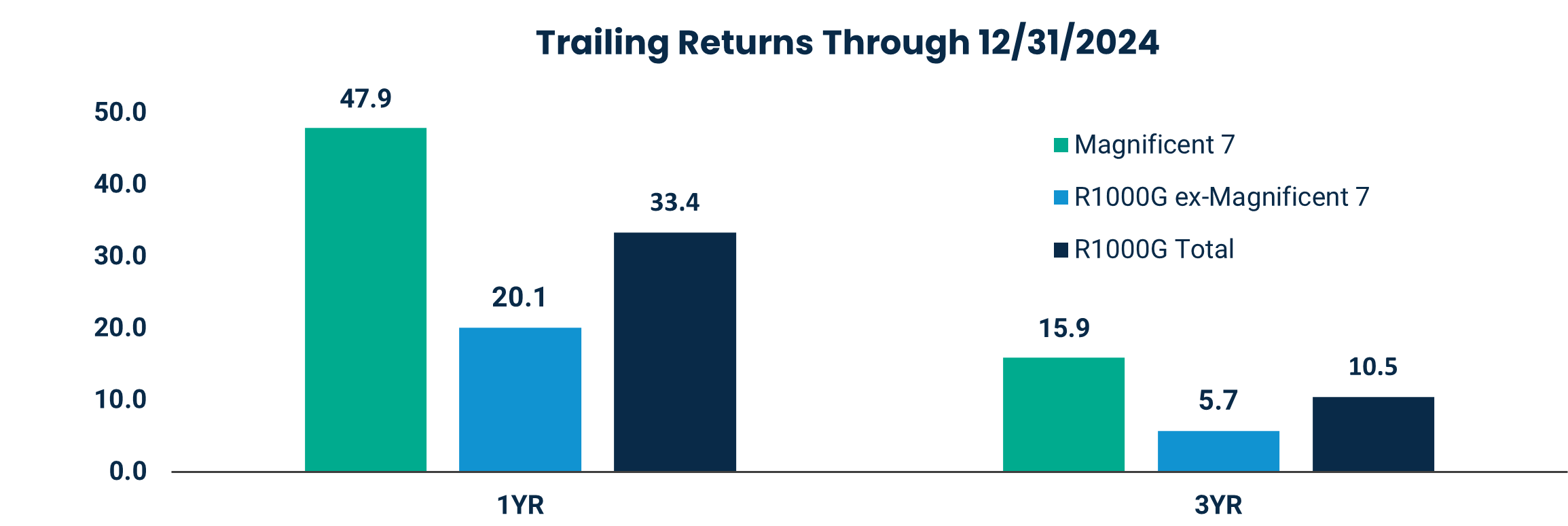
Source: FactSet. R1000G = Russell 1000 Growth Index. Three-year returns are annualized. Performance data shown represents past performance and is no guarantee of future results.
In some ways, that period of strong performance obscured more pedestrian returns from many other areas of the market. Overall, for the past one‑year period ended December 31, 2024, the Russell 1000 Growth Index returned 33.4%, while the index returned 10.5% for the three‑year period on an annualized basis.3 But separating the performance of the Magnificent 7 from the other 993 Russell 1000 Growth Index constituents shows just how much these seven companies lifted the performance of the overall index.
As the seven stocks outpaced the other constituents of the Russell 1000 Growth Index over time, their weighting as a proportion of the overall index grew significantly. At the end of 2022, the Magnificent 7 constituted a little more than a third of the weight of the Russell 1000 Growth Index. By the end of 2024, that weighting had jumped to nearly 56%.
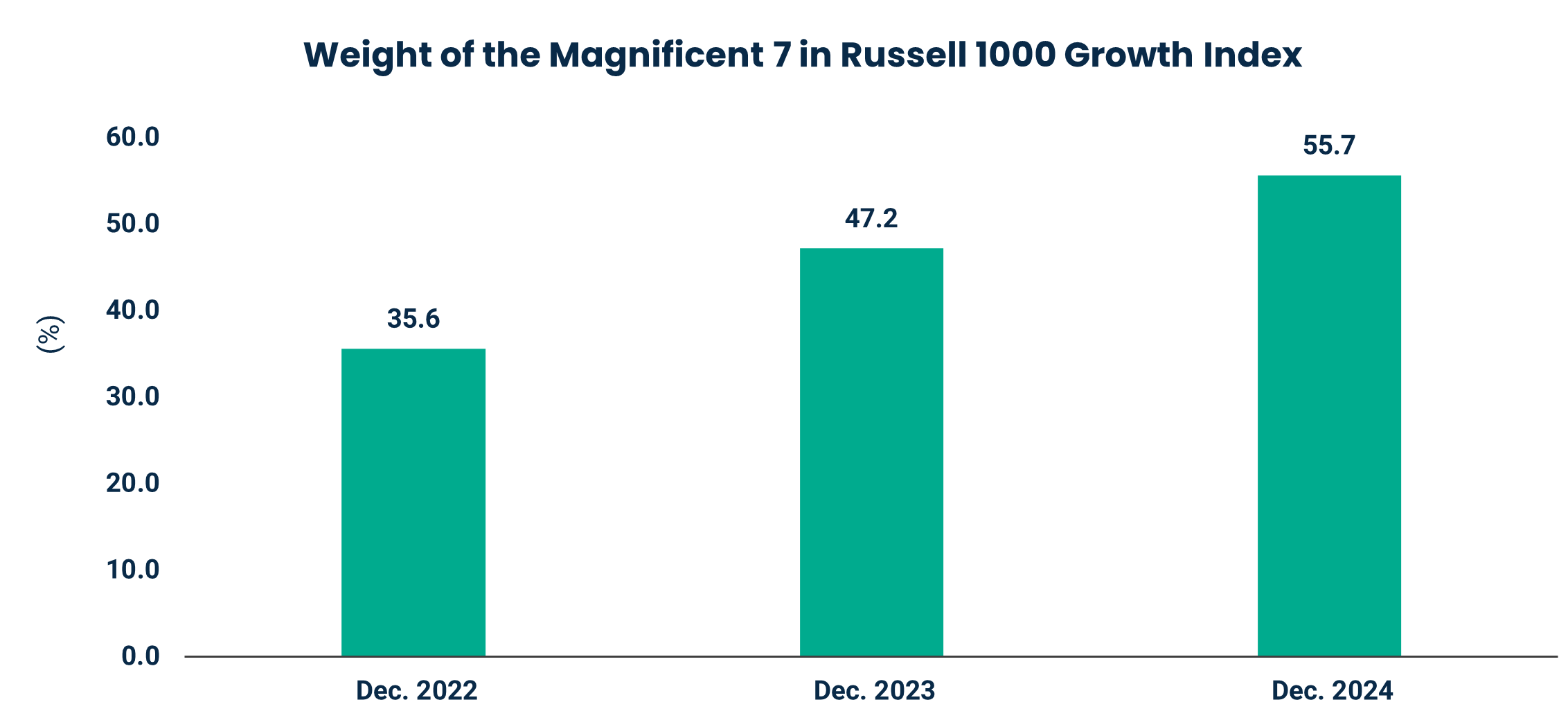
Source: FactSet. Performance data shown represents past performance and is no guarantee of future results.
The robust performance of these few stocks—and their increasing influence on the overall index returns—benefited passively managed index funds the past two years. At the same time, this environment made it difficult for active managers to outpace the performance of the Russell 1000 Growth Index. According to Morningstar, only 26% of managers in its Large Growth category were able to outpace the Russell 1000 Growth Index in 2024.4
This makes intuitive sense. Active managers, by definition, make decisions to overweight or underweight stocks compared to the benchmark. For active managers, the elevated weights of the Magnificent 7 often led to underweight positions for this cohort to fund other opportunities in their portfolios. As these seven stocks rose ever higher, being underweight them created challenging headwinds for active managers. But that could be changing.
The Magnificent 7 Comes Back to Earth
In contrast to the past two years, the Magnificent 7 stocks have lost much of their shine so far in 2025. Unlike in 2023 and 2024, the other constituents of the Russell 1000 Growth Index have outpaced the Magnificent 7 through February 28, 2025.5 And unlike in 2023 and 2024, the Magnificent 7 has detracted from the overall returns of the Russell 1000 Growth Index, pushing overall returns into negative territory.
In 2023 and 2024, respectively, only 9% and 11% of stocks within the Russell 1000 Growth Index outperformed the Magnificent 7. However, so far in 2025, 70% of Russell 1000 Growth constituents outpaced the Magnificent 7, similar to the 75% of stocks that outperformed the Magnificent 7 in 2022.6 While it’s too early to know definitively if these trends will continue further into 2025, it appears that 2023 and 2024 may have been a distinct moment rather than the start of continued dominance by a small number of stocks.
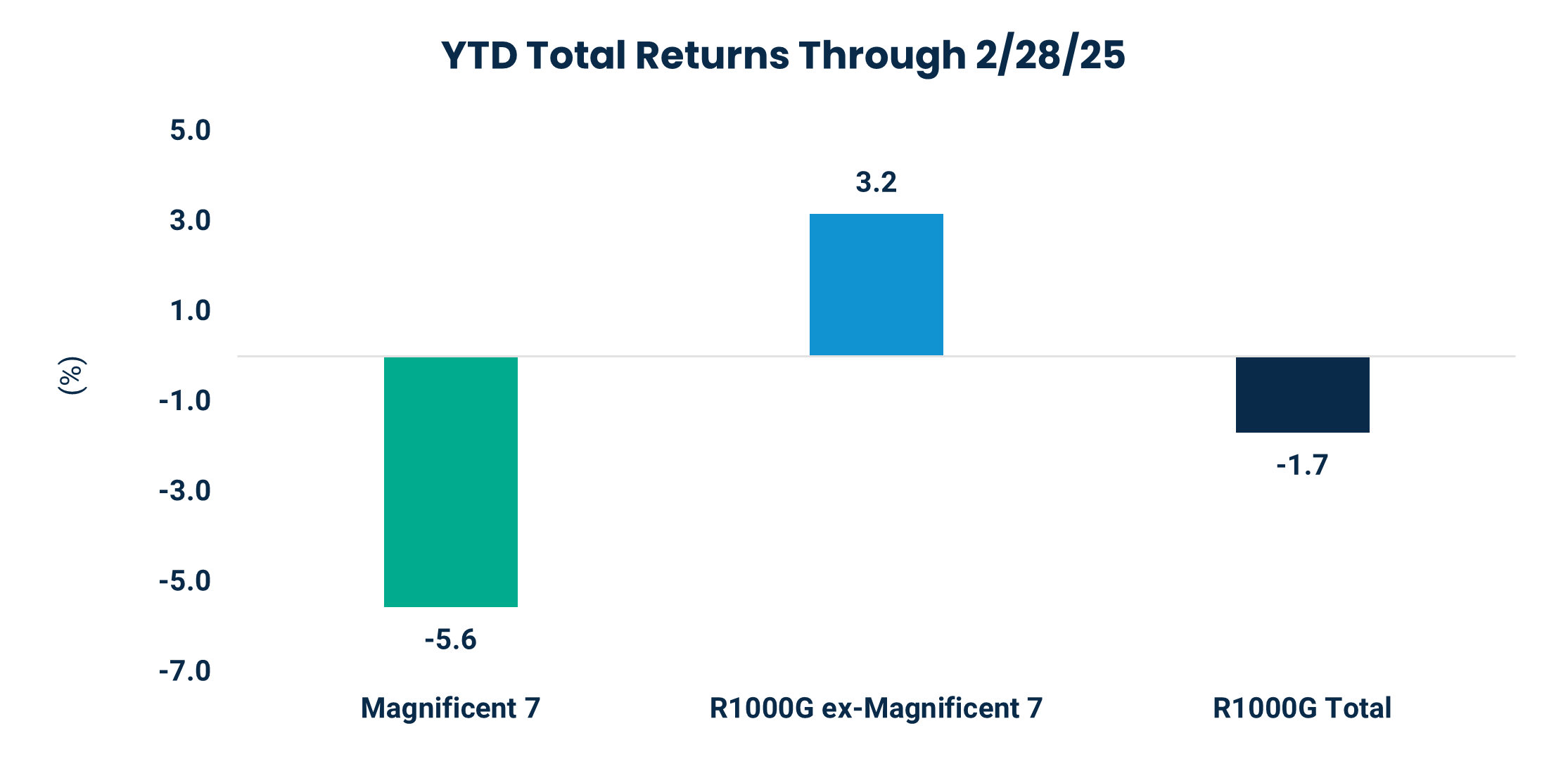
Source: FactSet. R1000G = Russell 1000 Growth Index. Performance data shown represents past performance and is no guarantee of future results.
It's also important to note that despite many similarities among the companies, the Magnificent 7 is not a monolithic category. As shown in the chart on the following page, the performance of the Magnificent 7 has diverged through the end of February 2025.
Meta was the only stock that has generated a positive return for the year‑to‑date (YTD) period through February 28, 2025. All six of the others have lagged, with Tesla being the most prominent laggard. Tesla’s stock has fallen significantly so far in 2025, likely driven by lower sales numbers and at potentially by Elon Musk’s association with the controversial Department of Government Efficiency (DOGE).7
The other members of the Magnificent 7 each face both macroeconomic and company‑specific headwinds and tailwinds as well. In this environment, the components of the Magnificent 7 could act more like “regular” stocks, potentially creating opportunities for bottom‑up stock pickers in this cohort and beyond.
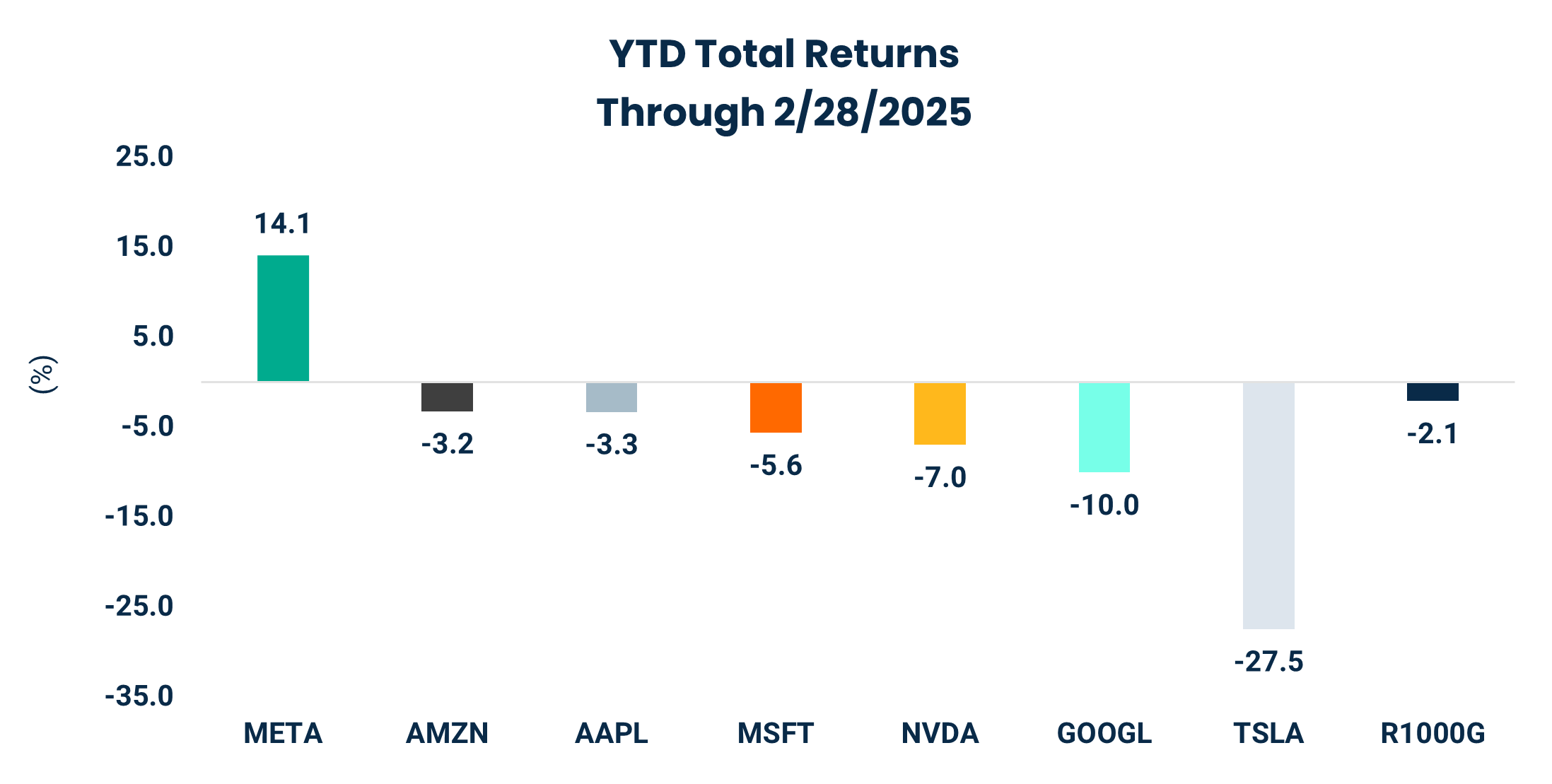
Source: FactSet. META = Meta Platforms, Inc. AMZN = Amazon.com, Inc. AAPL = Apple Inc. MSFT = Microsoft Corporation. NVDA = NVIDIA Corporation. GOOGL = Alphabet Inc. TSLA = Tesla, Inc. R1000G = Russell 1000 Growth Index. Performance data shown represents past performance and is no guarantee of future results.
Looking Ahead: Increasing Opportunities for Active Managers
The Magnificent 7’s significant outperformance over the past several years has driven index concentration to historic levels, providing a headwind for active managers seeking to outpace the Russell 1000 Growth Index. While we don’t know where the Magnificent 7 and broader growth markets will go from here, the YTD period has provided a glimpse into what the flipside of increasing index concentration could look like.
A broadening market in which stocks besides the Magnificent 7 drive returns—combined with more dispersion and volatility—will likely present more opportunities for active managers to prove their value. While the past two years have presented challenges for active managers, the path ahead could be more promising, even as the largest mega‑caps may struggle. Or put another way, while the Magnificent 7 mega-caps may continue to exert outsized influence, their dominance may be coming to an end.
So, how should financial advisors and investors think about this potentially transformative moment? While the current environment may seem more promising for active management than in the past several years, it’s vital to remember that not all active managers are the same. Lower index concentration may allow more opportunities for active managers to prove their value, but they will need to navigate a new, likely more volatile landscape where the Magnificent 7 may prove to be less than magnificent. Is your growth equity manager ready for that scenario?
As Warren Buffett famously said, “You only find out who’s been swimming naked when the tide goes out.”8 In the months ahead, we may get a chance to do just that.
Important Information
1 Source: FactSet
2 Source: Reuters
3 Source: FactSet
4 Source: Morningstar
5 Source: FactSet
6 Source: FactSet
7 Source: Barron’s
8 Source: Berkshire Hathaway 2001 Chairman’s Letter
Investing entails risks and there can be no assurance that any investment will achieve profits or avoid incurring losses.
Stock markets are volatile and equity values can decline significantly in response to adverse issuer, political, regulatory, market and economic conditions. At times, a growth investing style may be out of favor with investors which could cause growth securities to underperform value or other equity securities.
The Russell 1000® Growth Index is an unmanaged index generally representative of the U.S market for larger capitalization growth stocks. The Russell 1000® Index is an unmanaged index generally representative of the large‑cap segment of the U.S. equity universe. The Russell 1000® Growth Index, the Russell 1000® Index and Russell® are trademarks of Frank Russell Company. These unmanaged indexes do not reflect fees and expenses and are not available for direct investment.
The views expressed herein may not be reflective of current opinions, are subject to change without prior notice, and should not be considered investment advice or a recommendation to purchase a particular security.
Copyright © 2025 Harbor Capital Advisors, Inc. All rights reserved.
4369416