


The counterintuitive case for why people matter more, not less.
As artificial intelligence automates more work, the companies that invest most heavily in their people may be better positioned than those that simply invest in the technology.
The thesis initially appears counterintuitive. AI's promise, after all, seeks to reduce dependence on fallible, expensive humans. Yet Irrational Capital believes that twenty years of data tracking the relationship between how companies treat employees and how their stocks perform appears to tell a different story, one that they believe becomes even more pronounced during periods of massive disruption. They observed it during COVID‑19. They are observing the early signals now as AI spreads through the workforce. And if the pattern holds, it may play out again on a scale that may reshape entire sectors.
Irrational Capital has spent the better part of a decade measuring something most investors treat as unmeasurable: the quality of the relationship between employers and employees. Not the most straightforward or easy to measure elements like compensation packages, benefits or training budgets, but the more complex dimensions: trust, autonomy, whether people feel valued or disposable and more. They found that these intangibles seek to predict future stock returns with remarkable consistency and strength. They also found that these findings have been verified by independent research.1
The question we are now examining (and potentially collectively wrestling with) is whether AI breaks this pattern or seeks to amplify it?
1 J.P. Morgan, 2021 through 2025.
Why Soft Factors May Drive Hard Returns
Consider what can actually influence a company's stock price over time. Revenue growth and margins matter, obviously. But beneath those headline numbers lies something more fundamental: the organization's capacity to execute, adapt, and innovate when circumstances could change.
That capacity resides in the relationship between a company and its workforce. Irrational Capital calls it the Human Capital Factor®, or HCF: a quantitative score built from employee sentiment across dozens of characteristics. Some are extrinsic and easy to access and count (pay, benefits, titles, the mechanics of employment). These matter, but Irrational Capital believes not as much as one might expect. The found the real predictive power comes from intrinsic factors.
Do people trust leadership? Do they feel they have autonomy? Do they believe in a shared future with the company, or are they biding their time until a better opportunity comes their way?
The Human Capital Factor encompasses a broad array of intrinsic elements including:
- Trust in leadership and the organization's direction
- Autonomy over how work gets accomplished
- Belief in a shared future rather than a zero-sum relationship
- Recognition and credit for contributions
- Feeling valued and appreciated as individuals, not merely resources
- Security that cooperation will not lead to obsolescence
- Loyalty flowing in both directions
- Fair treatment in decisions large and small
- Psychological safety to experiment, fail, and learn
- Lack of bureaucracy — being free to innovate and perform
When HCF scores are high, Irrational Capital has historically seen that companies do not merely have engaged employees, they have organizations capable of moving decisively when circumstances shift. When scores are low, there tends to be brittleness disguised as stability. Everything appears stable until it is not.
Irrational Capital partnered with Harbor Capital to launch the Harbor Human Capital U.S. Large Cap ETF (ticker: HAPI) in 2022. HAPI is a U.S. large‑cap equity ETF that aims to draw from the same investment universe as the S&P 500 Index. HAPI overweights companies with strong Human Capital Factor scores and underweights those with weak ones. Since its 2022 launch, it has outperformed the broader index. Irrational Capital believes this is not theoretical; HAPI provides investors with a way to invest in Human Capital as an additional factor that may contribute to long‑term equity performance."
Average Annual Returns as of 3/31/26
Performance data shown represents past performance and is no guarantee of future results. Past performance is net of management fees and expenses and reflects reinvested dividends and distributions. Past performance reflects the beneficial effect of any expense waivers or reimbursements, without which returns would have been lower. Investment returns and principal value will fluctuate and when redeemed may be worth more or less than their original cost. Returns for periods less than one year are not annualized. Current performance may be higher or lower and is available through the most recent month end at harborcapital.com or by calling 800-422-1050.
Shares are bought and sold at market price not net asset value (NAV). Market price returns are based upon the closing composite market price and do not represent the returns you would receive if you traded shares at other times. This information should not be considered as a recommendation to purchase or sell a particular security.
The weightings, and holdings mentioned may change at any time and may not represent current or future investments. The Harbor Human Capital Factor U.S. Large Cap ETF Gross Expense Ratio is 0.35%
Human Capital Factor Large Cap Index Methodology
As of 4/29/2026, the Harbor Human Capital U.S. Large Cap ETF (HAPI) held 5.10% of its portfolio in Microsoft Corporation and did not hold any position in Starbucks Corporation. Holdings are subject to change at any time and may not represent current or future investments. For a complete list of fund holdings, please visit https://www.harborcapital.com/etf/hapi/
What AI Appears to Change (and What It May Not)
Irrational Capital analyzed over 2 million employee reviews from S&P 500 Index companies between 2015 and 2025, tracking how frequently people mentioned AI in their feedback2. The frequency of AI mentions for the broader market has nearly tripled since ChatGPT’s launch, and the signal among certain companies centered on AI transformation has skyrocketed close to 15‑fold in just 3 years. Irrational Capital believes AI may no longer be only background noise but could be becoming the primary driver of employee experience.
Irrational Capital did not receive prompted responses. No one asked employees about AI. The employees raised it themselves. Irrational Capital believes that matters, because it signals a shift from AI as abstract future technology to AI as an immediate workplace reality. They see people are thinking about it, discussing it, and crucially, forming opinions about what it may mean for their careers.
When Irrational Capital examined how people were discussing AI, the picture became more revealing. They constructed an Opportunity/Threat Ratio which sought to compare mentions of AI as innovation or growth (opportunity language) versus job loss or automation (threat language). The ratio varied substantially by sector, and the variation revealed three distinct patterns of adoption.
HIGH-INNOVATION SECTORS
Technology • Finance • Semiconductors • Telecom
Demonstrated balanced sentiment. These employees were already working with AI before ChatGPT gained widespread attention. Those employees are now beyond the hype phase. Irrational Capital believes they perceive opportunities and risks clearly, because they have experienced both.
MEDIUM-INNOVATION SECTORS
Healthcare • Consumer Goods • Manufacturing
Experienced what Irrational Capital characterizes as the "early‑adopter optimism spike". Pre‑ChatGPT, AI was theoretical. Post‑ChatGPT, the first wave of employees engaged with AI tools perceived mostly upside: productivity gains, efficiency improvements. They believe that created unusually positive sentiment. But as exposure broadened and more employees gained direct experience, Irrational Capital saw realism emerged and threats became visible.
LOW-INNOVATION SECTORS
Utilities • Real Estate • Commodities
Barely mentioned AI before 2022. When ChatGPT launched, Irrational Capital saw the initial response was threat‑focused: This technology might replace me. Only gradually did the conversation shift toward opportunity as people learned what AI could and could not accomplish.
Irrational Capital believes the pattern is not uniform by any means: some workforces are enthusiastic, others are apprehensive, some are moving rapidly, and others are proceeding cautiously. That unevenness is precisely why they believe Human Capital matters (and matters especially in times of transition and potential turbulence).
2 Please see Methodology in Important Information section of this article.
The Paradox of Psychological Safety
In Irrational Capital's view, the most critical dimension of Human Capital during AI integration is psychological safety.
Consider an accountant training an AI system to perform tasks she currently handles. She faces a fundamental choice. She may provide her best work (share the shortcuts, explain the judgment calls, help it learn the subtleties) or she can withhold that expertise. The difference between these two outcomes depends almost entirely on whether she believes her employer has her interests at heart.
Here is the paradox as Irrational Capital sees it: workers are far more likely to enthusiastically adopt AI and contribute to its successful integration when they feel secure in their roles, not threatened by AI disruption. They find in organizations where employees trust management, feel aligned with company goals, and believe in a shared future, they are paradoxically more willing to take risks, experiment with new tools, and innovate. They do not perceive AI training as undermining their own job security. They view it as contributing to collective success from which associates may benefit. Conversely, Irrational Capital has found in organizations with weak Human Capital, where trust is low and employees feel expendable, AI adoption becomes an exercise in self‑preservation.
Employees comply with directives but withhold the discretionary effort that transforms adequate technology into exceptional results. They answer questions but do not volunteer insights. They participate but do not commit. That difference, compounded across an organization, determines whether AI delivers transformational value or mediocre outcomes.
Vulnerable vs. Protected Roles
Irrational Capital segmented proprietary employee review data by job function, dividing the workforce into two categories: vulnerable roles (routine, easily automated) and protected roles (complex, creative, interpersonal). They view vulnerable roles as showing slower growth in AI mentions but declining sentiment. These employees perceive AI as approaching, and they perceive it as a threat. They view protected roles as showing accelerating AI adoption with sustained opportunity focus. These employees, they believe, are engaging with AI tools, identifying value, and viewing AI as an enhancement rather than a replacement.
Irrational Capital believes the divergence appears to be logical. They believe if your job is repetitive and rule‑based, AI probably could replace significant portions of it, and you understand that reality. If your job requires judgment, creativity, and human connection, AI becomes a tool that enhances your effectiveness.
The question for companies is whether they may be able to help vulnerable employees transition into protected roles through reskilling, redeployment, and creation of new positions. That, they believe, could require investment, patience, and a conviction that people merit development. They think it also requires trust. Employees may not participate earnestly in reskilling programs if they believe such programs are merely a preliminary step before termination.
The COVID‑19 Precedent
Irrational Capital has observed this dynamic before. In 2020, COVID‑19 forced almost every company into a massive, unplanned transition with remote work, supply chain disruption, revenue collapse, and rapid strategic pivots. Some companies navigated it effectively. Others struggled significantly. Irrational Capital examined which companies entered the pandemic with high HCF scores and which entered with low scores, then tracked performance through the crisis and recovery. On average, they found the results were clear. High‑HCF companies tended to outperform their peers materially and measurably. They saw their stock prices often held up better during the initial shock and recovered quicker afterward.
Irrational Capital focused on two examples that they believe illustrate the pattern.
Irrational Capital's employee sentiment data tells an interesting story about Microsoft. Around 2014, when new leadership arrived, HCF scores began a sustained climb, consistent with what outside observers have described as a shift from a 'know‑it‑all' culture to a 'learn‑it‑all' culture. As those scores improved, the company capitalized on cloud computing and AI, and when COVID‑19 arrived, the organization pivoted effectively. In Irrational Capital's view, the connection between rising HCF scores and operational resilience during that period was not coincidental.
01 Microsoft — "Know‑It‑All" to “Learn‑It‑All"
A cultural transformation that translated into resilience.
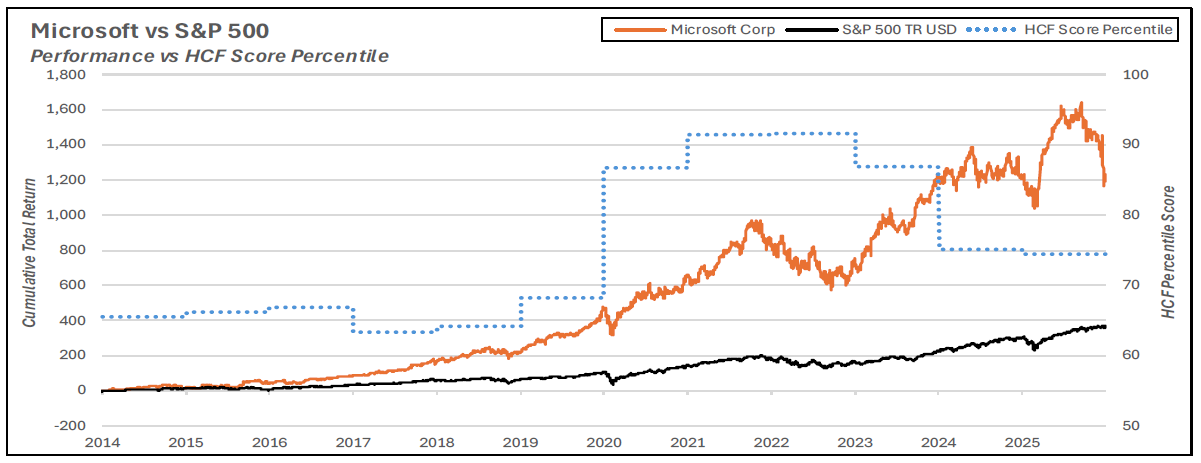
Irrational Capital saw that when COVID‑19 arrived, the organization pivoted effectively where strong culture translated into resilience, which they also believe translated into outperformance.
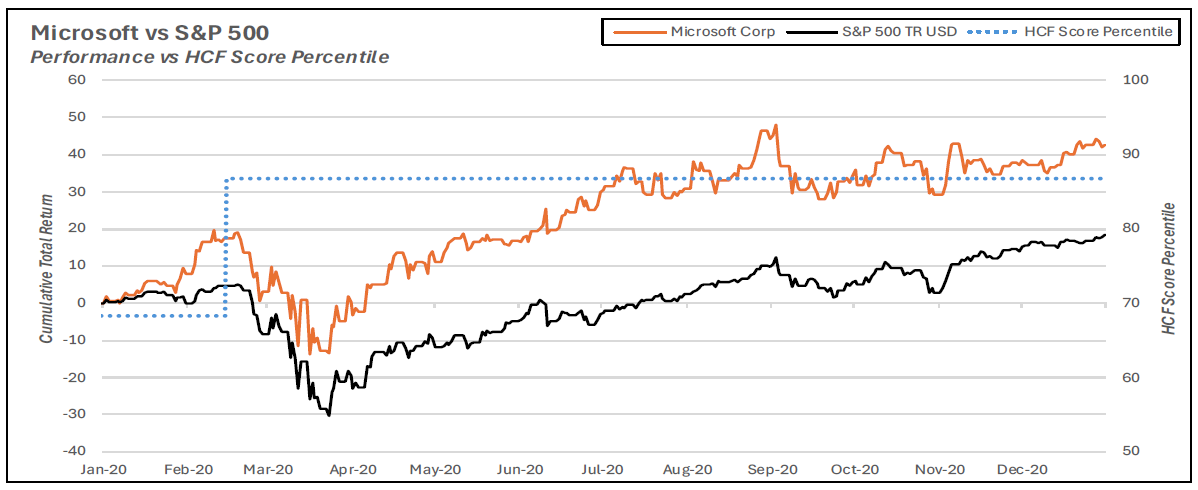
Past performance is not indicative of future results. Source: Morningstar Direct, March 2026. The HCF Score Percentile is Irrational Capital's proprietary data, not sourced from Morningstar Direct. The performance data (total returns) comes from Morningstar Direct. Total cumulative return was calculated for the selected company and charted against the total cumulative return of the S&P 500 for the same period. The time periods shown are a 12-year window and the 2020 fiscal year (COVID period). Top vs. Bottom HCF chart: The chart shows cumulative total return of the top quintile of HCF scorers, equal-weighted (approximately 100 companies per year), versus the bottom quintile, equal-weighted (approximately 150 companies), drawn from the S&P 500 universe.
02 Starbucks — A Founder‑Centric Culture
Intermittent CEO returns. Declining HCF scores.
Contrast that with Starbucks. A founder‑centric culture, intermittent CEO returns, declining HCF scores.
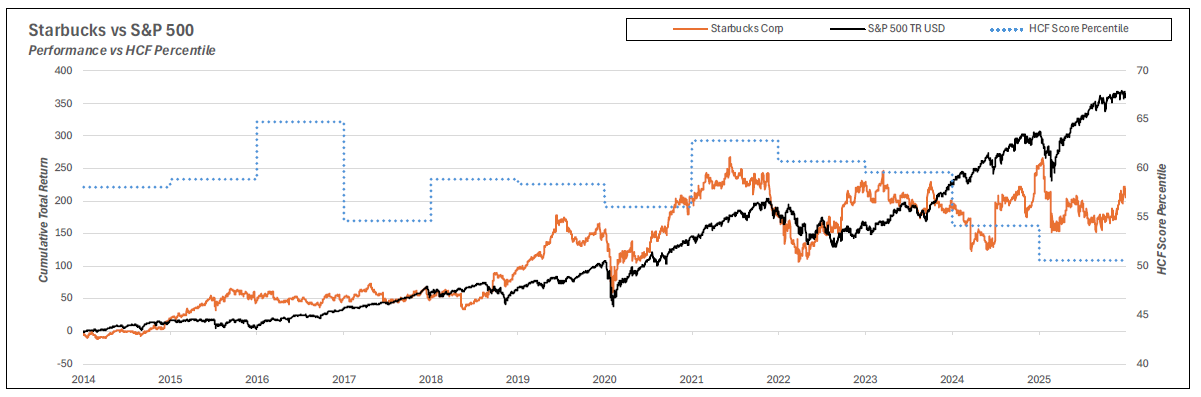
Irrational Capital believes that during COVID‑19, a management‑versus‑worker dynamic emerged. Front‑line employees (the people serving customers) felt disconnected from leadership, per‑store revenue suffered, and the stock underperformed.
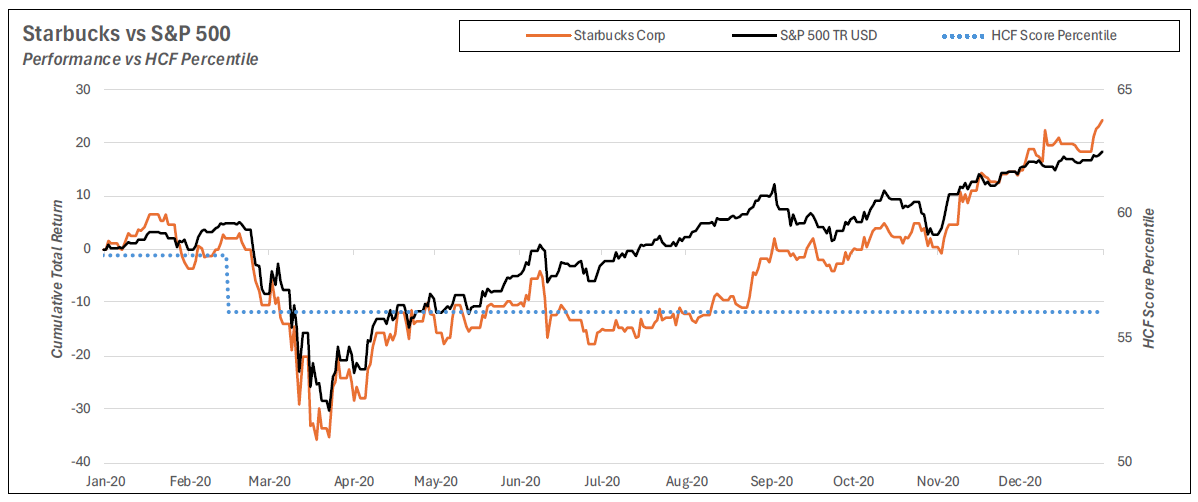
Past performance is not indicative of future results. Source: Morningstar Direct, March 2026. The HCF Score Percentile is Irrational Capital’s proprietary data and is not sourced from Morningstar Direct. Performance data (total returns) is sourced from Morningstar Direct. Total cumulative return was calculated for the selected company and compared to the total cumulative return of the S&P 500 Index over the same period. The time periods shown include a 12-year window and the 2020 fiscal year (COVID period). Human Capital Factor (HCF) score percentiles are derived from a proprietary, rules-based methodology developed by Irrational Capital using employee sentiment data and other organizational inputs. Percentile rankings reflect a company’s relative position within a defined universe at a given point in time. The methodology involves subjective judgments and relies on proprietary and third-party data, which may be incomplete or inaccurate. The relationship shown between HCF scores and stock performance reflects historical observations and does not imply causation. Top vs. Bottom HCF chart: The chart shows cumulative total return of the top quintile of HCF scorers, equal-weighted (approximately 100 companies per year), versus the bottom quintile, equal-weighted (approximately 150 companies), drawn from the S&P 500 Index universe.
Irrational Capital believes COVID‑19 was a transition period, just as AI adoption appears to be a transition period. They think both demand more from employees: more flexibility, more trust, and more willingness to adapt. They feel organizations that entered COVID‑19 with strong Human Capital had the trust reservoir to draw upon, and organizations that began with weak Human Capital found themselves requesting commitment they had not earned.
They believe the AI transition could function similarly. Companies with high HCF scores today may possess a significant advantage. It’s Irrational Capital’s view that Microsoft is requesting that employees help integrate AI from a position to be more in line with established trust. They believe companies with low scores appear to be asking employees to train their own replacements while offering limited reason to believe cooperation could be rewarded.
Irrational Capital’s Thesis: HCF Could Determine AI Success
Here is Irrational Capital’s core thesis: Over the next several years, as companies seek to integrate AI across their organizations, those with higher HCF scores (and thus stronger relationships with their employees) may be more successful in adoption and, consequently, may be more financially successful. Success may not be determined primarily by sector, technology budget, or speed of adoption. It could be determined by Human Capital engagement and alignment.
Why? Because Irrational Capital believes AI does not arrive fully functional. You cannot install it as a software update and expect professional‑caliber output. They believe it requires extensive training, iteration, refinement, adoption, determination of use, alignment, and trust. If AI seems to be the high‑power engine of this new era, intrinsic human capital appears to be the steering wheel. It seems no longer merely a 'nice‑to‑have' cultural attribute; it seems a strategic necessity. Alignment, trust, engagement, emotional connection appear to be the critical connective tissue that may transform individual empowerment into sustained institutional productivity, ensuring that velocity does not come at the cost of direction.
What Irrational Capital Believes Leaders Should Do (And Why They May Resist)
If you accept that Human Capital could help determine AI success, the prescription is straightforward: invest in it. Invest substantially and with the same rigor you may apply to any technological deployment.
Yet according to Irrational Capital, leaders often do not do this, at least not proportionate to the need. Why? Because Human Capital investments have historically been difficult to justify in quarterly earnings presentations. Historically, it has been very challenging, if not impossible to point to a training program or a culture initiative and attempt to draw a direct line to next quarter's revenue. Technology investments, by contrast, appear concrete. You purchase licenses, deploy systems, measure adoption rates. The causality appears clearer.
Announcing major AI investments signals to markets that a company may be forward‑thinking and technologically sophisticated. Announcing investments in employee trust or psychological safety risks appearing soft or behind the curve. The signaling value appears asymmetric, even if the underlying economics favor Human Capital.
However, Irrational Capital believes technology alone may not be able to flourish in an environment lacking trust, support, and thoughtful integration. Companies may need to recognize that the full promise of AI could be realized only when it is integrated with strong Human Capital. They believe almost everything begins (and ends) with people. Most know this intellectually, and Irrational Capital believes the HCF backs this intuitive belief with financial results.
What Irrational Capital Believes Investors Should Consider Doing
When assessing a company's AI strategy, do not limit the inquiry to the technology stack or the deployment timeline. Examine how employees regard it. Are employees engaged in the process? Do they trust leadership? Are they being reskilled or transitioned out? A company may possess the most sophisticated AI tools available and could still fail at integration if its workforce doesn’t appear to be committed to making it succeed.
Irrational Capital believes Human Capital is not a ‘check the box’ thought experiment. They believe it is a fundamental indicator for judging which organizations may weather technological disruption. They feel companies with high HCF scores entering the AI transition may possess structural advantages and could adopt more rapidly, integrate more effectively, and capture more value. They feel companies with low scores may struggle, not because they lack technology, but because they could lack the organizational capacity to deploy it effectively.
The Human Capital Factor Large Cap Total Return Index is a rules‑based construction built off the HCF framework. While the Index doesn’t prove a thesis by making the thesis investable, Irrational Capital views it as a more tangible way allocators may seek to construct portfolios weighted toward high‑HCF companies and try to anticipate outperformance, particularly during periods of transition and disruption. Their early data on AI adoption further supports connection to the thesis. The question seems whether investors may act on this insight before the pattern becomes widely recognized.
Irrational Capital believes during periods of substantial change and disruption that how companies treat their people could reveal their ability to weather transitions as disruptive as AI, or indeed other major transformations. The potential of AI integration, both in terms of efficiency and qualitative improvement appears genuinely significant. But Irrational Capital sees that if firms steward the talent within their organizations, they may perceive a deeper narrative: whether they could navigate the coming challenges effectively, or whether they may find themselves undermined by the very changes they hoped to harness.
The Irony of the AI Age
Irrational Capital believes there is profound irony here. They share that AI was anticipated to make companies less dependent on people. Instead, AI may reveal precisely how much success could depend on them. AI technology is powerful, but they believe it may remain inert without human expertise to shape it, human judgment to refine it, and human trust to deploy it effectively.
Irrational Capital believes we are entering a transitional period, and it may not be smooth. Different sectors, different roles, and different companies could likely experience AI differently. Some may perceive opportunity; others may perceive threat. The turbulence could persist for years, not months. Eventually, Irrational Capital thinks we may reach a post‑transitional period when AI integration becomes routine. But Irrational Capital believes the companies that could emerge strongest from the transition may be those that entered with and maintained the deepest reserves of Human Capital.
Irrational Capital believes almost everything revolves around a company’s workforce, their people. AI does not change that fundamental belief: it merely makes the belief more impactful.
Important Information
Investing involves risk, principal loss is possible. Unlike mutual funds, ETFs may trade at a premium or discount to their net asset value.
The Human Capital Factor®, developed by Irrational Capital, seeks to identify and score companies on their management of human capital based on proprietary data and research, creating a systematic link between the workforce and potential equity performance.
The securities shown in this case study are provided for illustrative purposes only and may not have been included in the referenced index during the time period presented. The composition of the index is subject to change, and there is no assurance that any security identified was or will be included in the index at any particular time. It is not possible to invest directly in an index.
Methodology: This analysis is based on Irrational Capital's proprietary research. The study examined over 2 million unprompted employee reviews from S&P 500 Index companies between 2015 and 2025. AI‑related mentions were identified through keyword matching across terms including "AI," "artificial intelligence," "machine learning," "automation," "ChatGPT," and related terminology. Sentiment was classified using transformer‑based natural language processing models. The Opportunity/Threat Ratio referenced in the article compares mentions framing AI positively (e.g., "opportunity," "growth," "innovation") versus negatively (e.g., "job loss," "replace," "displacement").
This section noted is based on Irrational Capital's proprietary analysis of over 2 million unprompted employee reviews from S&P 500 Index companies collected between 2015 and 2025. Reviews were not solicited or prompted to address AI. AI‑related mentions were identified through keyword matching across terms including "AI," "artificial intelligence," "machine learning," "automation," and "ChatGPT," among others. Sentiment classification was performed using transformer‑based natural language processing models. The Opportunity/Threat Ratio compares the frequency of mentions framing AI in positive terms (e.g., "opportunity," "growth," "innovation," "enhance") versus negative terms (e.g., "job loss," "replace," "displacement," "fear"). Sector‑level and job‑function‑level breakdowns reflect the same methodology applied to subsets of the review data.
Past performance is not indicative of future results.
HAPI: There is no guarantee that the investment objective of the Fund will be achieved. Stock markets are volatile and equity values can decline significantly in response to adverse issuer, political, regulatory, market and economic conditions. The Fund may not exactly track the performance of the Index with perfect accuracy at all times. Tracking error may occur because of pricing differences, timing and costs incurred by the fund or during times of heightened market volatility. The Fund relies on the Index provider's methodology in assessing whether a company may be considered a corporate culture leader. There is no guarantee that the construction methodology will accurately assess a company to include or exclude it from the index which could have an adverse effect on the Fund's returns. The Fund's assets may be concentrated in a particular sector or industries to the extent the Index is concentrated and is subject to the risk that economic, political, or other market conditions that have a negative effect on that sector or industry will negatively impact the value of the Fund. The Harbor Human Capital Factor U.S, Large Cap ETF seeks to provide investment results that correspond, before fees and expenses, to the performance of The Human Capital Large Cap Index.
The Human Capital Factor Large Cap Index consists of a modified market‑weighted portfolio of the equity securities of U.S. companies identified by Irrational Capital LLC (“Irrational Capital”) as those it believes to possess strong corporate culture based on its proprietary scoring methodology. Constituents eligible are chosen from Solactive GBS United States 500 Index (the “index universe”) at the time of Index reconstitution. The Solactive GBS United States 500 Index intends to track the performance of the largest 500 companies from the US stock market. The S&P 500 Index, or Standard & Poor's 500 Index, is a market‑capitalization‑weighted index of 500 leading publicly traded companies in the U.S. The indices listed are unmanaged and does not reflect fees and expenses and is not available for direct investment. This unmanaged index does not reflect fees and expenses and is not available for direct investment.
The Human Capital Factor®, developed by Irrational Capital, seeks to identify and score companies on their management of human capital based on proprietary data and research, creating a systematic link between the workforce and potential equity performance.
This material may contain forward‑looking information that is not purely historical in nature. Such information may include, among other things, projections and forecasts. There is no guarantee that any of these views will come to pass. This material is for informational purposes and is not intended to be relied upon as a forecast, research or investment advice and is not a recommendation, offer or solicitation to buy or sell any securities or adopt any investment strategy.
The information and opinions contained in this material are derived from proprietary and non‑proprietary sources deemed by Harbor Capital Advisors, Inc. to be reliable and are not necessarily all‑inclusive and are not guaranteed as to accuracy. Case studies were provided by Irrational Capital. Harbor Capital Advisors, Inc. is not affiliated with Irrational Capital.
Copyright © 2026 Harbor Capital Advisors, Inc. All rights reserved.