


AI is no longer a theme within the economy. It is changing how we measure growth, construct portfolios and define sectors.
AI DISCLOSURE
The following document was written from scratch by Kristof Gleich, and used model ChatGPT Sol 5.6 Extra High to help format and tweak certain phrasing around some sentence structure. Trust me, it is a much better read because of this extra help but retains my personal and imperfect thought structure.
Recently, I've been asked a lot about my views on AI. The questions tend to come through several lenses at once: my lens as a CIO, my lens as an everyday AI user, and my lens as a business leader trying to navigate a technological disruption moving at lightning speed ‑ while encouraging colleagues to lean into its benefits rather than be intimidated by them.
Working through those questions has led me to three related conclusions that I wanted to share, because they increasingly shape how we are navigating this environment. First, I believe we're in the AI Economy. Second, I believe AI can increasingly be thought of as an asset class. Third, ecosystems may be the AI‑era equivalent of sectors.
The simplest version of my argument is this: AI is no longer merely something happening within the economy. It is beginning to change the economy's units of measurement, its transmission mechanisms, and its investable structure.
We're in the AI Economy
AI is more than a trend, a secular trend, a theme, a mega‑theme or even a structural change. I prefer to say something more direct: we're in the AI Economy now, and there is no going back. That does not mean every company will become an AI company, every job will be automated, or every investment attached to AI will work. It means the underlying operating environment has changed enough that the old language alone no longer describes it particularly well.
When I say "AI Economy," I mean that things are now fundamentally different from how they were before. We must learn new technology, new tools and new terminology and, frankly, speak a completely different language. It can be incredibly frustrating. There are days when I feel as if I am moving backwards rather than forwards. But that frustration itself may be a clue: when the language, tools and basic units of an economy change this quickly, we are not likely dealing with a passing theme. I believe we are dealing with a new operating system.
One reason I believe this comes from a foundational, first‑principles perspective (remember, I am not an economist). When the nature of a system changes, the measurements that helped us understand its prior state may become incomplete. They do not necessarily become useless, but they often need to be supplemented by new variables that capture what is now economically scarce, valuable and productive.
The most obvious example is tokens. A few years ago, I am sure you, like me, had never heard tokens discussed as a serious economic unit and probably had no reason to know what they meant. Today, tokens are beginning to function like a currency of the AI Economy: a standardized way to measure the computational work required to train, operate and use AI systems. The point is not that tokens replace dollars. The point is that we need a new unit to understand how intelligence is produced and consumed at scale.
Measuring a different economy
That same logic applies to macroeconomic measurement. I think we could do with updating how we measure what is really happening in the economy today. Below is the widely followed relationship between the ISM manufacturing Purchasing Managers’ Index (PMI) and the S&P 500's rolling 12‑month return. It has been used as an economic and market gauge for as long as I can remember, and it predates me by some margin.
For many years, the relationship told an intuitive story: improving manufacturing momentum often coincided with improving market returns, while deterioration in the PMI tended to signal a more difficult environment. But something interesting happened in late 2022 and early 2023. The relationship appeared to break down. Traditional manufacturing momentum remained subdued, while the market began responding to a very different set of forces.
Figure 1. The long‑standing relationship between the manufacturing PMI and S&P 500 rolling 12‑month returns appears to break down around the launch of ChatGPT.
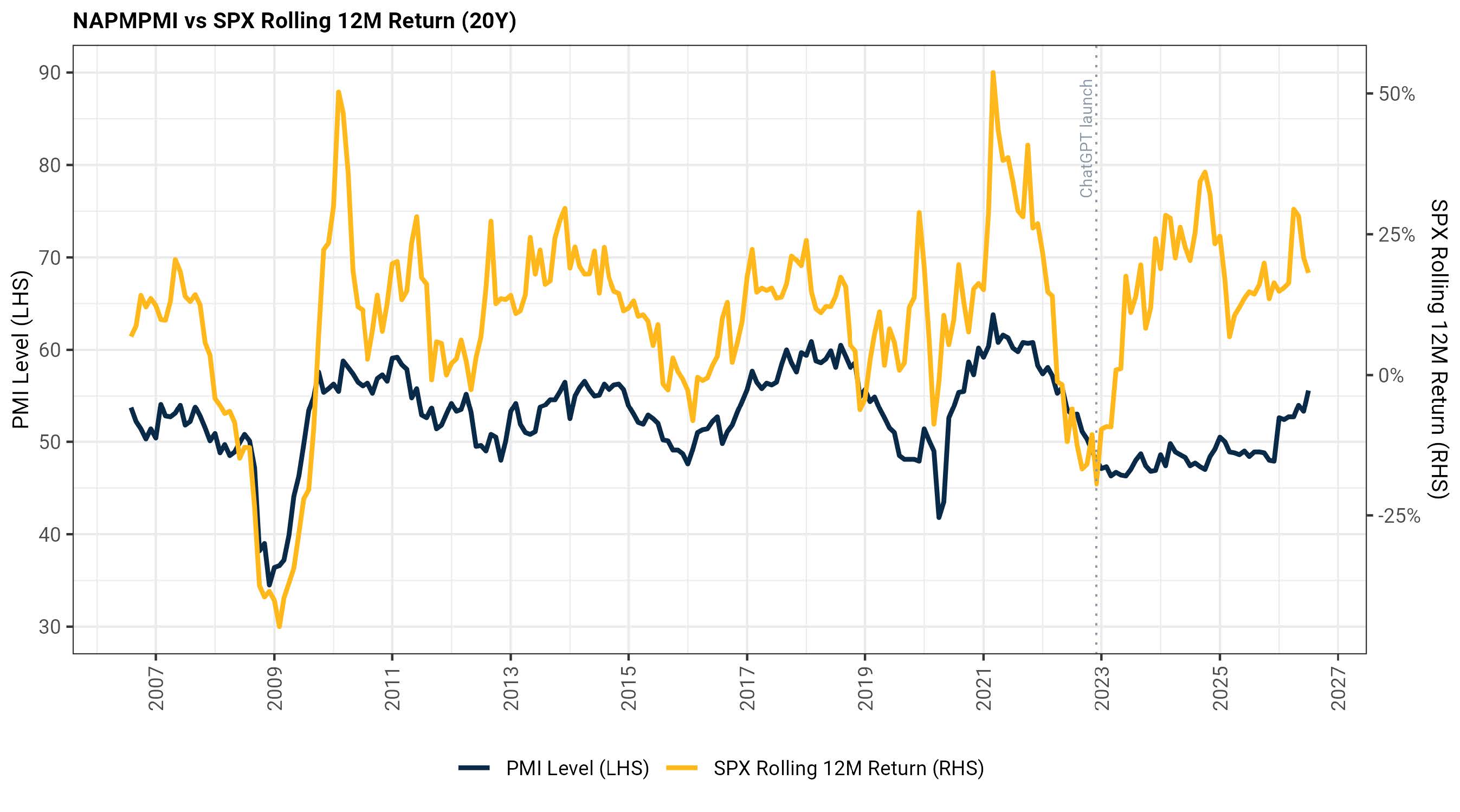
Source: Institute for Supply Management (Manufacturing PMI) and S&P 500 total return, via Bloomberg; Harbor Capital Advisors calculations. Monthly through August 2026. Trailing 12-month returns. The historical relationship shown is descriptive, not predictive, and has varied materially across periods. Performance data shown represents past performance and is no guarantee of future results. As of August 31, 2026.
I am not suggesting that one chart proves a new economic regime, or that the traditional PMI no longer matters. It still tells us something important about industrial activity. My point is narrower and, I think, more useful: if the fundamental nature of the economy has changed, then the set of indicators we use to interpret it should change too. We need to do some creative thinking about what is driving demand, supply and investment now, then find a disciplined way to measure those forces.
My excellent colleague James Kelly – Harbor’s Head of Investment Risk & Data Science ‑ did exactly that, working in collaboration with our Investment Research and Multi‑Asset Solutions teams to create a framework we refer to as the Harbor AI Momentum Indicator (HAMI). The framework measures three subcomponents of the AI Economy: Supply & Efficiency, Demand & Adoption, and Investment & Buildout. Looking at the three together gives us an alternative aggregate view of where this economy may be today.
Table 1. Under the hood of the Harbor AI Momentum Indicator: the three components, their weights and the indicators included in each.
None of those series is perfect on its own. Nor should we expect a single release to tell the whole story. I believe the value comes from combining several imperfect but economically connected signals into a framework: one that asks whether AI capability appears to be improving, whether the technology appears to be diffusing, and whether the physical and financial investment required to support it can actually be made.
If we look at how the three components add up, and then stitch the resulting AI Momentum Indicator onto the former PMI series beginning in 2022, we get a different picture of the economy and the market. The relationship is not magically perfect, but it looks far more intelligible than it did using the traditional series alone.
Figure 2. Supplementing the traditional PMI with the AI Growth PMI from 2022 appears to restore more of the prior relationship with S&P 500 rolling 12‑month returns.
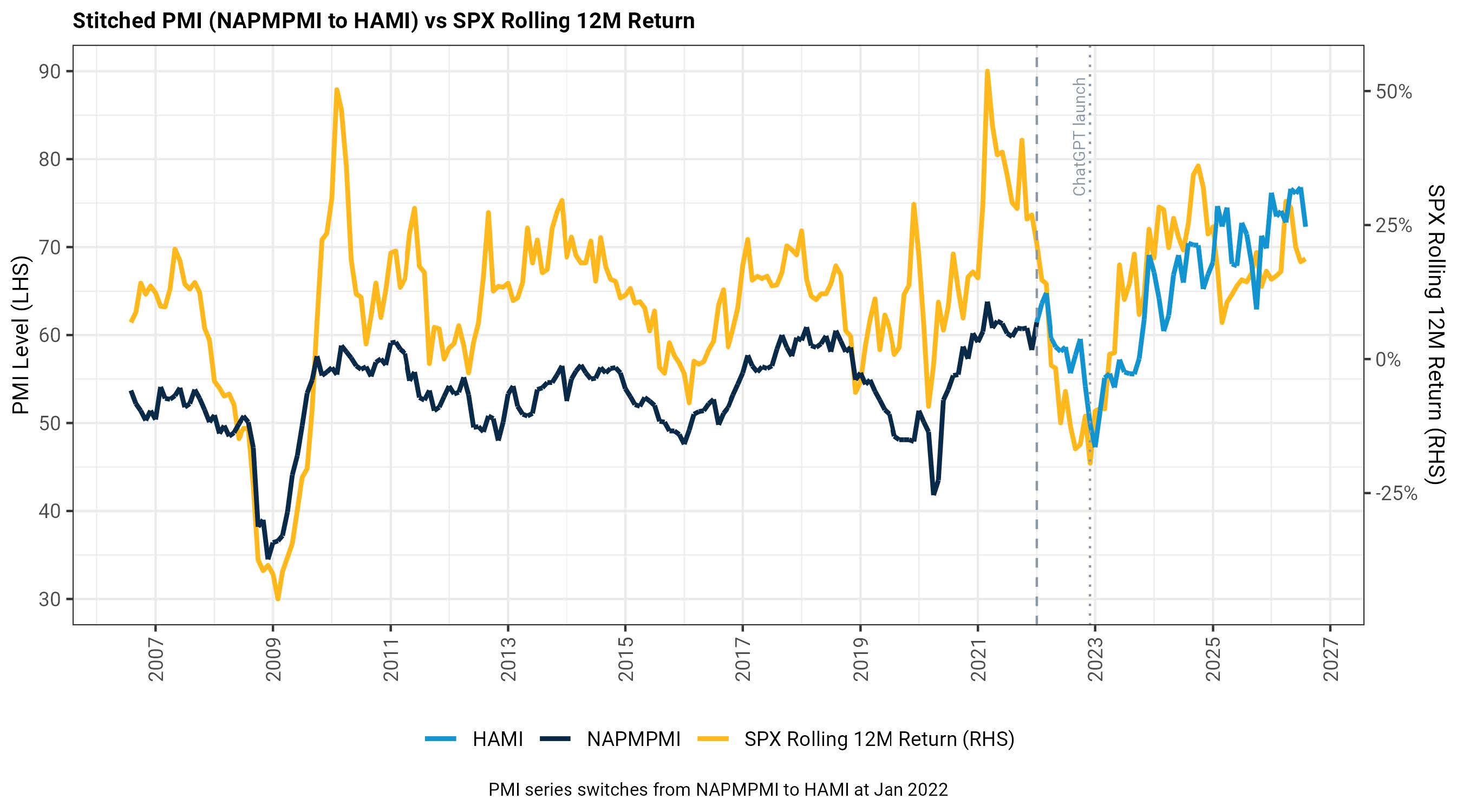
Source: Institute for Supply Management through the AI-Indicator start; Harbor AI Momentum Indicator thereafter; S&P 500 total return via Bloomberg; Harbor Capital Advisors calculations. Monthly through August 2026. The two series measure different activity and are joined for illustration only; the HAMI segment is back-calculated with hindsight, so any fit to returns over that segment is in-sample. Performance data shown represents past performance which is no guarantee of future results. As of August 31, 2026.
Looking only at the Harbor AI Momentum Indicator is also revealing. The launch of ChatGPT appears to have been a genuine inflection point: the headline reading rose from approximately 50 around that time to 72.3 in August 2026. In the language of a diffusion index, that is a very strong expansion. The latest reading should be interpreted with appropriate caution because ten of the eleven inputs are carried forward from earlier months and will be revised as new data arrive. Even so, the series offers one way to understand why earnings and markets tied to the AI buildout have remained so powerful when some traditional macro indicators have looked far less impressive.
Figure 3. The Harbor AI Momentum PMI rose from approximately 48 around the launch of ChatGPT to 81.8 in July 2026, signaling strong expansion in the AI Economy.
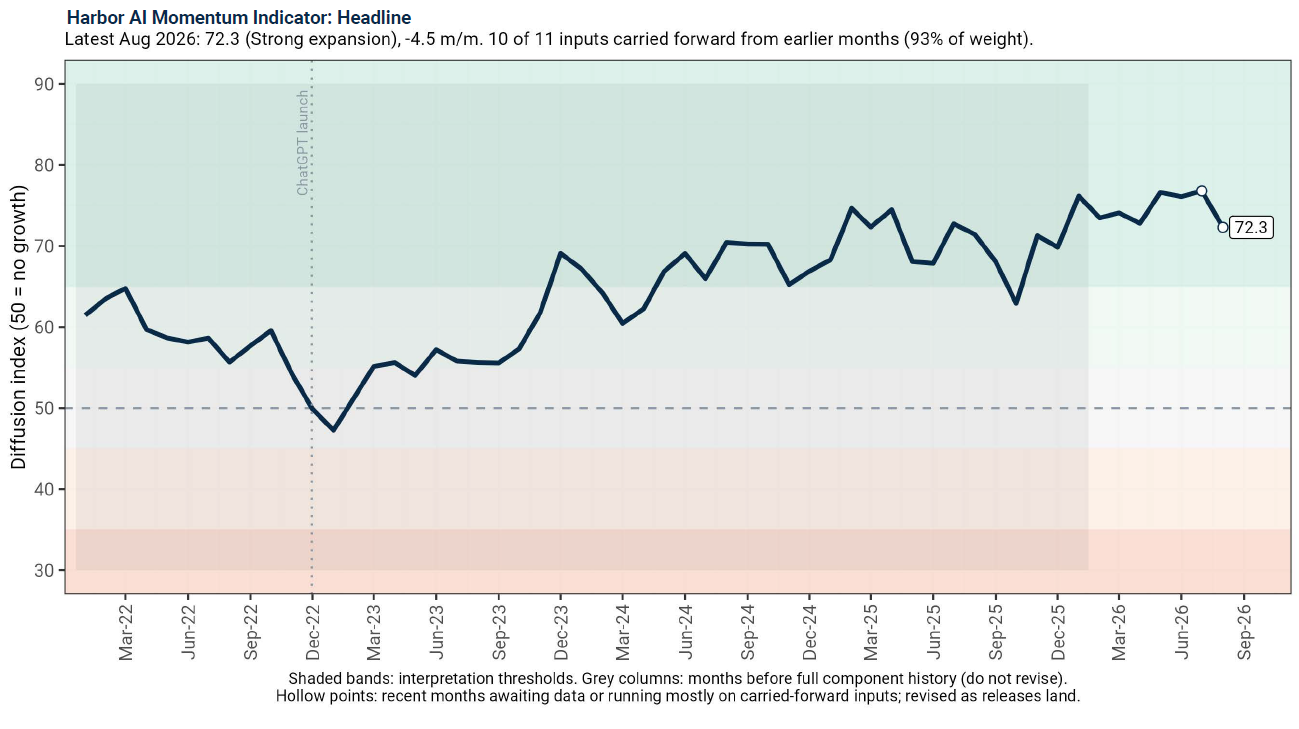
Source: Harbor Capital Advisors, using data from the Federal Reserve, BEA, Census Bureau, BLS, Bank of Korea, Statistics Korea, Taiwan MOF and DGBAS, Bank of Japan, Epoch AI, METR, and company filings, via Bloomberg and FRED. Monthly, January 2022 through August 2026; the August 2026 reading is provisional (roughly 93% of component weight carried forward from July) and history is back-calculated with current methodology. HAMI is a proprietary composite; construction reflects Harbor's judgment. Not a forecast. Performance data shown represents past performance and is no guarantee of future results. As of August 31, 2026.
When the micro becomes the macro
There are plenty of anecdotal observations that reinforce my conviction that the AI Economy is different. Consider Jackson Hole, which is taking place as I write this. Jackson Hole is the mecca of central banking. I have always wanted to go to this Glastonbury for bankers festival (dear reader please feel free to invite me to the 50th anniversary edition in 2027) for reasons I cannot entirely explain.
And yet, in late August 2026, Jackson Hole does not feel like the most important economic event of the week. In my view, the quarterly results of one company ‑ Nvidia ‑ may be far more consequential for the immediate economic narrative than the annual gathering of the world's best and brightest central bankers. This is not to say monetary policy no longer matters. It is to say that an extraordinary amount of capital spending, supply chain activity, earnings growth and investor confidence now turns on a company sitting at a critical junction of the AI system. If that is not evidence of a different economy, I do not know what is. The micro has become the macro.
A modern industrial coordinator
Another image I cannot get out of my mind is Jensen Huang as a modern analogue (not an exact equivalent) of J.P. Morgan during the Gilded Age. When Morgan operated from 23 Wall Street, people watched his every move: his latest deal, whom he was financing, whom he was partnering with, whom he crossed the street with on his way to the New York Stock Exchange, whom he would help win and whom he would allow to fail.
Morgan's central role in American finance predated the Federal Reserve and, at times, included parts of the coordinating function that we now associate with central bankers. He understood that the new industrial economy required more than individual businesses acting independently. It required capital, standards, networks, confidence and, occasionally, a central figure capable of aligning them.
The parallel is imperfect, of course, and it should not be pushed too far. But Jensen Huang occupies a similarly unusual position within today's AI Economy. Nvidia sits at the intersection of technology road maps, datacenter investment, model development, power demand and corporate strategy. Markets watch not only what the company sells, but what its leadership says is possible next. That is a much larger role than simply running a successful semiconductor company, and it says something important about the structure of this new economy.

Image: J.P. Morgan, photographed by Edward Steichen, 1903, via Wikimedia Commons. Public domain. Cropped from original.
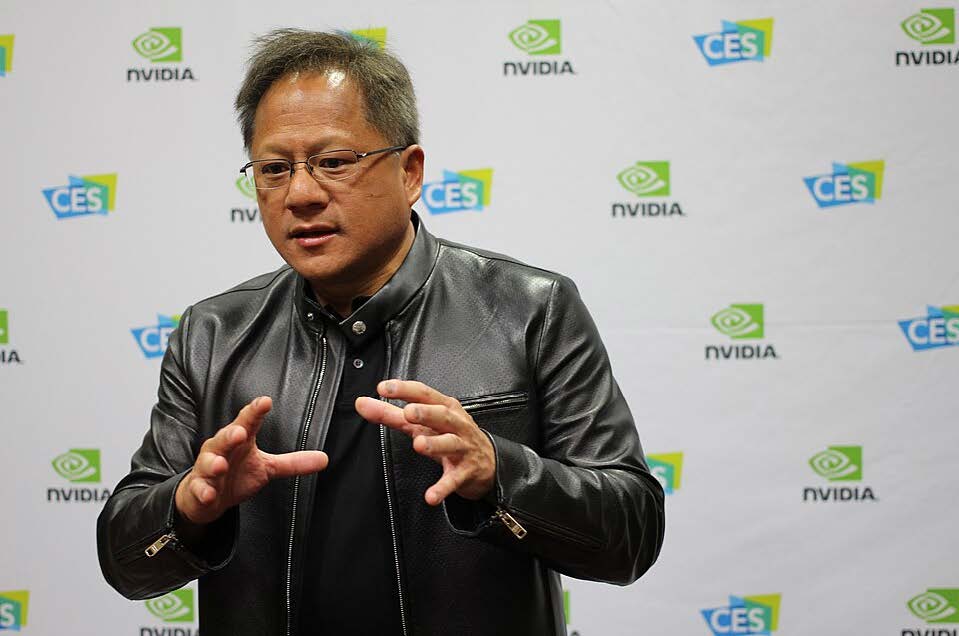
Photo by Maurizio Pesce, via Wikimedia Commons, licensed under CC BY 2.0. Cropped from original.
Figure 4. It's the AI Economy for Nvidia: quarterly revenue accelerated dramatically following the launch of ChatGPT.
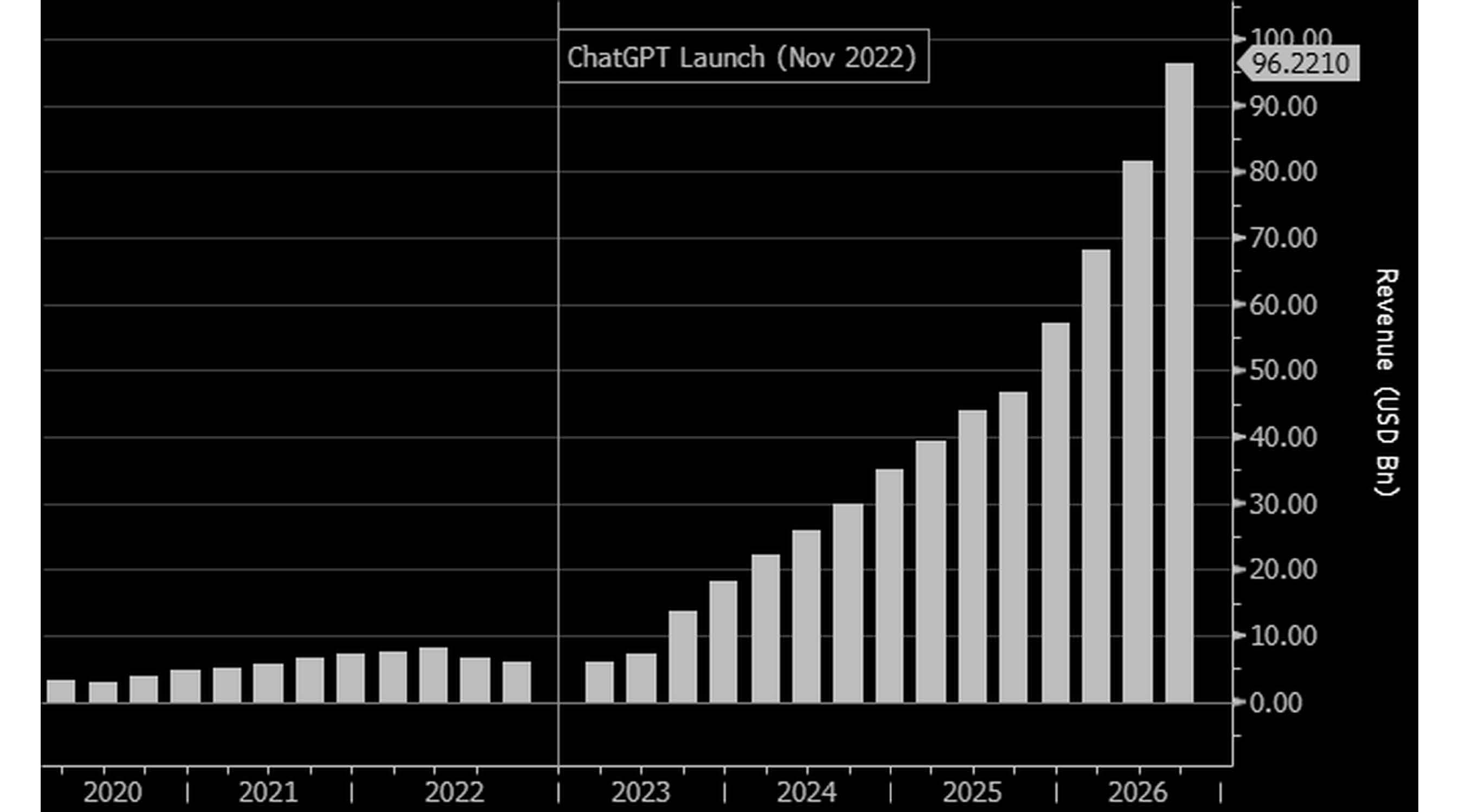
Source: Bloomberg, Harbor Capital as of 8/31/2026.
AI as an Asset Class
What do I mean when I describe AI as an asset class? I do not mean that AI fits neatly into a textbook taxonomy or that every security with an AI connection should be placed in one homogeneous bucket. From a portfolio construction perspective, an asset class is more useful than its technical definition. It is an investment exposure with distinctive characteristics, return drivers, and outcomes relative to the rest of a portfolio.
Equities, bonds, and commodities behave differently because each responds to a different set of underlying economic forces, and they respond differently to the economic cycle, the interest‑rate cycle, the inflation cycle, and the interplay among all three. My contention is that we now also have an AI economic cycle, and assets that respond to that cycle in ways that can be meaningfully different from their response to the traditional one.
To understand that cycle, we need to complement traditional measures of the economy with measures like the AI Economy PMIs described above. We then need to identify assets with more predictable and stable sensitivities ‑ or betas ‑ to those new measures. Those assets will not all sit in the same conventional sector. They may include equities, commodities and, potentially, parts of fixed income. What unites them may not be an index label; I believe it is their economic exposure to the same underlying system of compute, power, data, models, infrastructure and adoption.
More simply put, I think AI is now large enough, pervasive enough and important enough to require special attention, deliberate analysis and an explicit allocation decision. That does not automatically mean the allocation should be large, and it certainly does not mean valuation can be ignored. It means investors should decide consciously how much AI exposure they want, where in the ecosystem they want it, and which risks they are willing to accept, rather than simply inheriting whatever exposure a market‑cap‑weighted benchmark happens to provide inside a generic 60/40 portfolio.
AI is beginning to exhibit the properties that make this framing useful. Because the AI Economy is so large and pervasive, it is creating a distinct set of economic drivers for the assets connected to it. We are seeing cohorts ‑ or clusters ‑ of equities, as well as related commodities and some bonds, whose performance can diverge meaningfully from that of other equities and risk assets. Those clusters may ultimately deserve to be treated as a separate allocation.
That divergence is producing substantial dispersion within the market. In turn, the dispersion creates a return profile that is not simply another expression of broad equity beta. It increasingly resembles a distinct asset‑class exposure, with its own sources of growth, risk and differentiation. The label matters less than the portfolio behavior: if an exposure has different drivers, different sensitivities and a different role in a portfolio, investors should at least examine it on those terms.
Figure 5. Different equity cohorts are already showing meaningfully different return‑distribution profiles within the AI Economy.
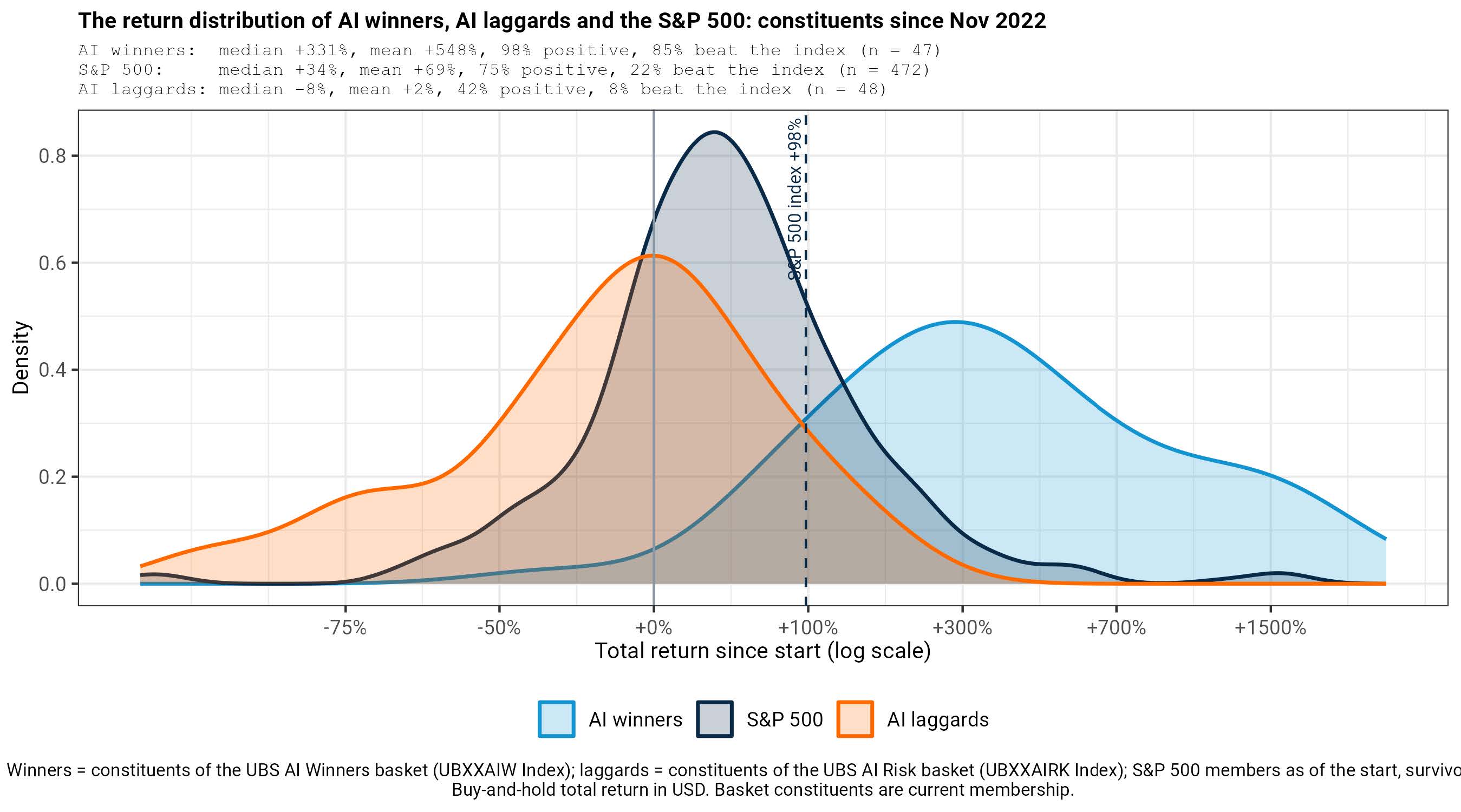
Source: Bloomberg total returns (gross dividends); basket compositions from UBS (AI Winners and AI Risk baskets); S&P 500 membership as of November 30, 2022; Harbor Capital Advisors calculations. Returns November 30, 2022 through August 31, 2026. Constituents fixed as of the start date; names without a full return history are excluded, introducing survivorship effects. Baskets are UBS classifications, not Harbor recommendations, and are not investable. Performance data shown represents past performance and is no guarantee of future results.
AI Ecosystems as the New Sectors
Lastly, I believe our definition of sectors needs updating for the AI Economy. My wise colleague John Halaby – Harbor’s Head of Distribution ‑ often talks about the need to work in clouds, not boxes, and I think he is 100% right. Many companies no longer belong comfortably in discrete industries. Put simply, they have transcended the classification scheme.
In an era of multiple trillion‑dollar companies, the interconnectivity among businesses is far more nuanced than a single sector label can capture. A company may simultaneously be a software platform, a cloud provider, a buyer of semiconductors, an owner of datacenters, a consumer of power, a distributor of AI tools and a source of financing for an entire developer ecosystem. Calling it one thing may be administratively convenient, but it can be economically misleading.
We therefore think about relationships among companies as a series of ecosystems defined by the economic linkages connecting clusters of businesses. Those linkages include who buys from whom, who depends on whose technology road map, who controls distribution, where the bottlenecks sit, where the capital is being spent and which companies benefit as intelligence becomes cheaper and more widely available.
Institutional investors have, of course, been ahead of this for years. Many of the world's most sophisticated and successful hedge fund managers have long used basket exposures to express themes and isolate economic relationships that cut across sectors. What appears to be changing now is the cost of doing that work. With more data, better technology, machine learning and artificial intelligence, the cost of identifying nuanced relationships has been falling rapidly. That should make ecosystem‑based investing increasingly accessible, and I expect adoption through popular investment vehicles such as ETFs to proliferate in the years ahead.
This is not an argument for throwing sector classifications away. They remain useful shorthand and an important part of how markets are organized. It is an argument for complementing them. Boxes are good for record‑keeping; clouds may be better for understanding where economic value could actually be being created and transferred.
The organizational implication
There is one final, related consequence. In the AI Economy, specialized knowledge is becoming available at extremely low cost to anyone willing to seek it out. The edges of expertise are becoming fuzzier. I have observed at work that more people now know more things about more topics, and they can learn them much more quickly. AI can expand an individual's bandwidth substantially.
That does not make genuine expertise less valuable. If anything, judgment, experience and the ability to ask good questions become more valuable when information is abundant. But it does mean the old organizational boundaries may be as incomplete as the old sector boundaries. If people can move across domains more fluidly, businesses will need to rethink how they organize talent, allocate decision rights and mobilize resources. The same shift from boxes to clouds may apply inside companies as well as inside portfolios.
A new frame for a new economy
So that is the framework I keep coming back to. We are in the AI Economy. I believe AI is beginning to behave like an asset class. And ecosystems may be the AI‑era equivalent of sectors. These are not three separate predictions; they are three consequences of the same underlying change.
If the economy's productive technology changes, our measurements need to change. If its return drivers change, our portfolio construction needs to change. If its economic linkages change, our classification systems need to change. None of this means abandoning the traditional tools. It means recognizing that tools built for the prior economy may need to be complemented by ones designed for the economy that now exists.
The AI Economy is not somewhere over the horizon. We are already in it. The investment challenge now is to describe it more accurately, measure it more intelligently, and allocate to it more deliberately.
Important Information
This material is intended solely for educational purposes, and should not be construed as investment advice, a recommendation, or an offer or solicitation to purchase or sell any securities. The opinions expressed are as of the date(s) indicated and are subject to change without notice. Reliance upon information in this material is at the sole discretion of the reader. Investing involves risks, including the risk of loss. This information is not intended to be complete or exhaustive and no representations or warranties, either express or implied, are made regarding the accuracy or completeness of the information contained herein. This material may contain estimates and forward‑looking statements, which may include forecasts, and do not represent a guarantee of future performance. Past performance does not guarantee future results. Investors should consult with a financial professional before making any investment decisions.
This material may contain forward‑looking information that is not purely historical in nature. Such information may include, among other things, projections and forecasts. There is no guarantee that any of these views will come to pass.
All trademarks mentioned herein are the property of their respective owners.
Copyright ©2026 Harbor Capital Advisors, Inc. All rights reserved.