
5 JUN 2025 Nick Peck

View the With Intelligence Article
Harbor Capital Advisors is actively seeking to expand its suite of products in several key areas.
Kristof Gleich, the president and CIO of the $64bn Chicago, Illinois‑based firm, recently told With Intelligence that although the firm is content with its current ETF lineup, there are areas of the ETF market that it feels is growing rapidly and that it’s observing closely.
“I would say the area that is growing the largest and that is most different to the mutual fund world that we are watching closely in ETFs is derivatives," Gleich said.
There are also several other strategies it is keeping an eye on for future ETF product development.
Furthermore, as it continues to add new ETFs to its suite, it intends to maintain a strong focus on building active products, aiming to become a leader in the space.
Additionally, as it continues to develop these new ETFs, it plans to maintain its collaboration with subadvisors, a practice it has consistently pursued in the past.
“We prefer working with boutiques, and we prefer working with firms that do fewer things but do them very well, and we prefer that they focus and hone their investment edge," Gleich said.
In addition to continuing to explore new ways to develop ETFs, Harbor is also expanding its product development efforts into other areas, including interval funds, due to their recent growth and increased adoption among advisors.
“We are looking and doing a lot of research at the moment into interval fund structures," Gleich said, noting although it is researching it heavily, it likely won’t look to release an interval fund until 2026.
In addition to ETFs and interval funds, the firm is also actively developing retail SMAs.
On the distribution and marketing side, the firm primarily focuses on many traditional tactics, including publishing a weekly document that shares its up‑to‑date thoughts on its products and market insights.
However, it has also begun introducing some non‑traditional marketing campaigns, such as becoming the official active ETF sponsor of Major League Pickleball.
“We’re trying to have some fun with it, and it’s a way of extending our brand to a newer audience that otherwise wouldn’t sing with it, and clients love it as well," Gleich said.
In addition to expanding its product lineup and developing compelling marketing strategies, the firm is also in the process of building a portfolio solutions business, where it will seek to work with FAs to provide them with custom portfolio solutions.
“This is an area of Harbor that we’re actively hiring for at the moment," Gleich said.
Overall, as Harbor continues to build on each of these initiatives and expand its active ETF suite, it remains focused on maintaining the strategies that have historically been successful in the past.
“What unifies all of our ETFs is a deeply held investment conviction that we think the funds could provide strong risk‑adjusted returns for our clients and we’re not just going to launch products because we think we can raise money," Gleich said.
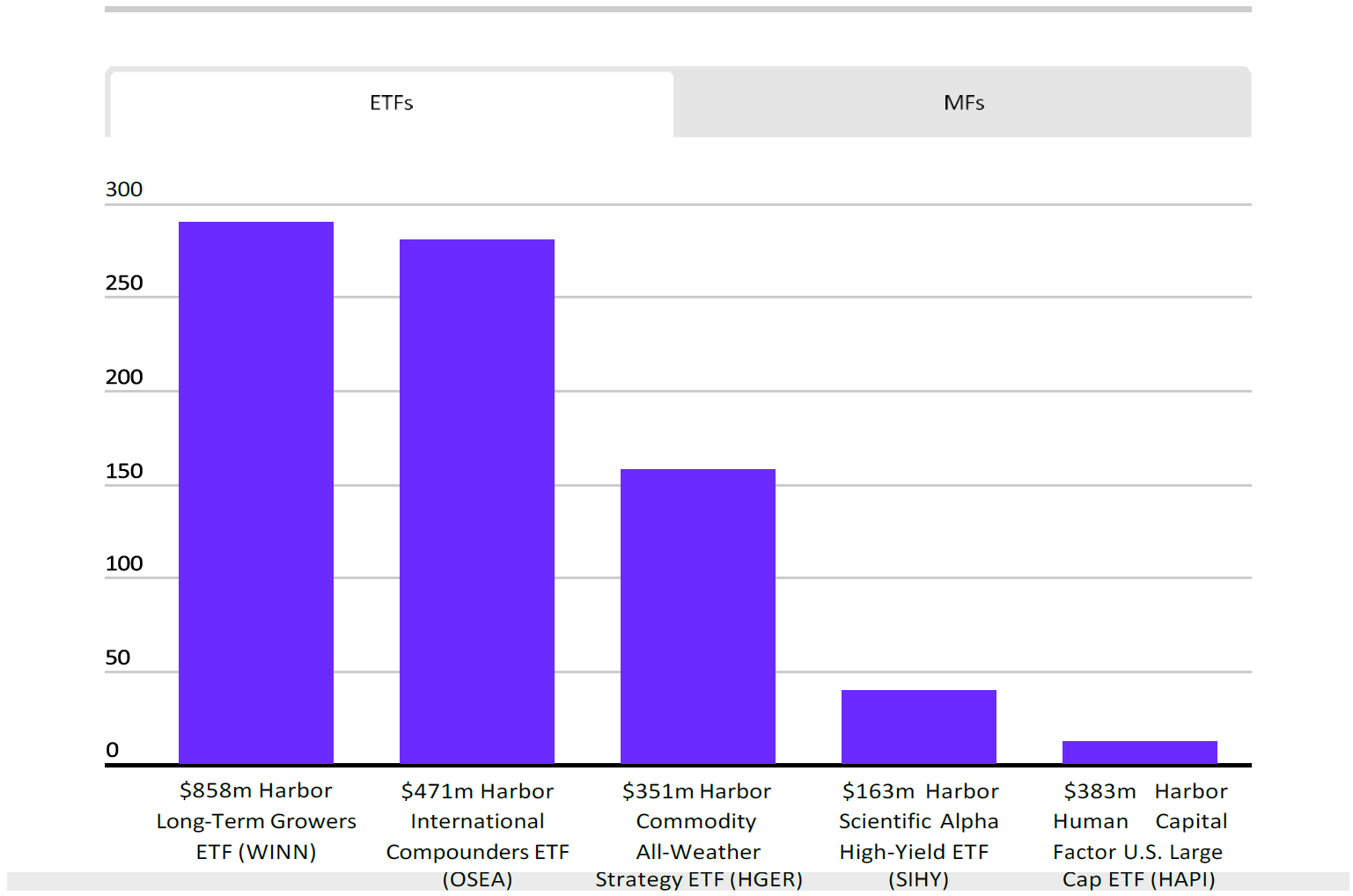
In the past year, Harbor’s over $3bn ETF suite has seen cumulative inflows of over $719m; however, its $46.1bn MF suite has seen cumulative outflows of over $2.6bn.
Top 5 Harbor Capital Advisors ETFs and MFs, by 1‑yr flows ($m)
As a result of changing market conditions, total net asset levels, expenses and other factors may change at any time during the current fiscal period and may differ from those shown.
Important Information
Reprinted with permission of [With Intelligence, June 2025] The opinions expressed in this reprint are intended to provide insight or education and are not intended as individual investment advice. We do not represent that this information is accurate and complete, and it should not be relied upon as such.
Effective February 3, 2026, the name of BlueCove Limited changed to Ares Systematic Credit Limited. Effective March 1, 2026, the name of Harbor Scientific Alpha High‑Yield ETF changed to Harbor Ares Systematic High Yield ETF. These changes do not affect the Fund’s investment objective, strategies, risks, fees, or portfolio management. Please see the Fund’s Prospectus for additional information.
The views expressed herein are those of named investment professionals at the time the comments were made. These views are subject to change at any time based upon market or other conditions, and the author/s disclaims any responsibility to update such views. These views may not be relied upon as investment advice and, because investment decisions are based on many factors, may not be relied upon as an indication of trading intent. The discussion herein is general in nature and is provided for informational purposes only. There is no guarantee as to its accuracy or completeness. Past performance is no guarantee of future results.
Risks
Investing involves risk, principal loss is possible. Unlike mutual funds, ETFs may trade at a premium or discount to their net asset value.
Shares are bought and sold at market price not net asset value (NAV). Market price returns are based upon the closing composite market price and do not represent the returns you would receive if you traded shares at other times.
HGER: Commodity Risk: The Fund has exposure to commodities through its and/or the Subsidiary’s investments in commodity‑linked derivative instruments. Authorized Participant Concentration/Trading Risk: Only authorized participants (“APs”) may engage in creation or redemption transactions directly with the Fund. Commodity‑Linked Derivatives Risk: The Fund’s investments in commodity‑linked derivative instruments (either directly or through the Subsidiary) and the tracking of an Index comprised of commodity futures may subject the Fund to significantly greater volatility than investments in traditional securities.
HAPI: There is no guarantee that the investment objective of the Fund will be achieved. Stock markets are volatile and equity values can decline significantly in response to adverse issuer, political, regulatory, market, and economic conditions. The Fund may not exactly track the performance of the Index with perfect accuracy at all times. Tracking error may occur because of pricing differences, timing and costs incurred by the fund or during times of heightened market volatility. The Fund relies on the Index provider's methodology in assessing whether a company may be considered a corporate culture leader. There is no guarantee that the construction methodology will accurately assess a company to include or exclude it from the index which could have an adverse effect on the Fund's returns. The Fund's assets may be concentrated in a particular sector or industries to the extent the Index is concentrated and is subject to the risk that economic, political, or other market conditions that have a negative effect on that sector or industry will negatively impact the value of the Fund.
Companies in the information technology sector can be significantly affected by short product cycles, obsolescence of existing technology, impairment or loss of intellectual property rights, falling prices and profits, competition from new market entrants, government regulation and other factors.
OSEA: Investing involves risk, principal loss is possible. Unlike mutual funds, ETFs may trade at a premium or discount to their net asset value. The ETF is new and has limited operating history to judge.
There is no guarantee that the investment objective of the Fund will be achieved. Stock markets are volatile and equity values can decline significantly in response to adverse issuer, political, regulatory, market and economic conditions. Investing in international and emerging markets poses special risks, including potentially greater price volatility due to social, political and economic factors, as well as currency exchange rate fluctuations. These risks are more severe for securities of issuers in emerging market regions. A non‑
diversified Fund may invest a greater percentage of its assets in securities of a single issuer, and/or invest in a relatively small number of issuers, it is more susceptible to risks associated with a single economic, political or regulatory occurrence than a more diversified portfolio.
SIHY: Investing involves risk, principal loss is possible. Unlike mutual funds, ETFs may trade at a premium or discount to their net asset value.
All investments involve risk including the possible loss of principal. Fixed income securities fluctuate in price in response to various factors, including changes in interest rates, changes in market conditions and issuer‑ specific events, and the value of your investment in the Fund may go down. There is a greater risk that the Fund will lose money because they invest in below‑ investment grade fixed income securities and unrated securities of similar credit quality (commonly referred to as “high‑yield securities” or “junk bonds”). These securities are considered speculative because they have a higher risk of issuer default, are subject to greater price volatility and may be illiquid. Because the Fund may invest in securities of foreign issuers, an investment in the Fund is subject to special risks in addition to those of U.S. securities. These risks include heightened political and economic risks, greater volatility, currency fluctuations, higher transaction costs, delayed settlement, possible foreign controls on investment, possible sanctions by government bodies of other countries and less stringent investor protection and disclosure standards of foreign markets.
WINN: There is no guarantee that the investment objective of the Fund will be achieved. Stock markets are volatile and equity values can decline significantly in response to adverse issuer, political, regulatory, market and economic conditions. Investing in international and emerging markets poses special risks, including potentially greater price volatility due to social, political and economic factors, as well as currency exchange rate fluctuations. These risks are more severe for securities of issuers in emerging market regions. A non‑ diversified Fund may invest a greater percentage of its assets in securities of a single issuer, and/or invest in a relatively small number of issuers, it is more susceptible to risks associated with a single economic, political or regulatory occurrence than a more diversified portfolio.
Harbor Capital is not affiliated with With Intelligence
BlueCove Limited is a third‑party subadvisor to the Harbor Scientific Alpha High‑Yield ETF.
Harbor Capital serves as the investment adviser to the Harbor Human Capital Factor U.S. Large Cap ETF. Quantix Commodities is a third‑party subadvisor to the Harbor All‑Weather Commodities Strategy ETF.
C WorldWide Asset Management is a third‑party subadvisor to the Harbor International Compounders ETF Jennison Associates is a third‑party subadvisor to the Harbor Long‑Term Growers ETF.
Copyright © (2026) Harbor Capital Advisors, Inc. All Rights Reserved.