


2026 has seen extraordinary returns so far in commodity markets. Many of the compelling reasons to invest in commodity strategies that we have presented in these newsletters have now come to fruition, in both alpha and beta implementations.
A primary theme in commodity markets this year has been Deglobalization, which Quantix believes has led to rising geopolitical friction and increasing weaponization of the commodity supply chain, both via government policy (sanctions and tariffs) and through outright attacks on energy infrastructure. This last point used to be off‑limits in conflicts but has quickly been adopted the world over and, as new combatants directly enter the fray, we believe this dynamic shows no signs of abating.
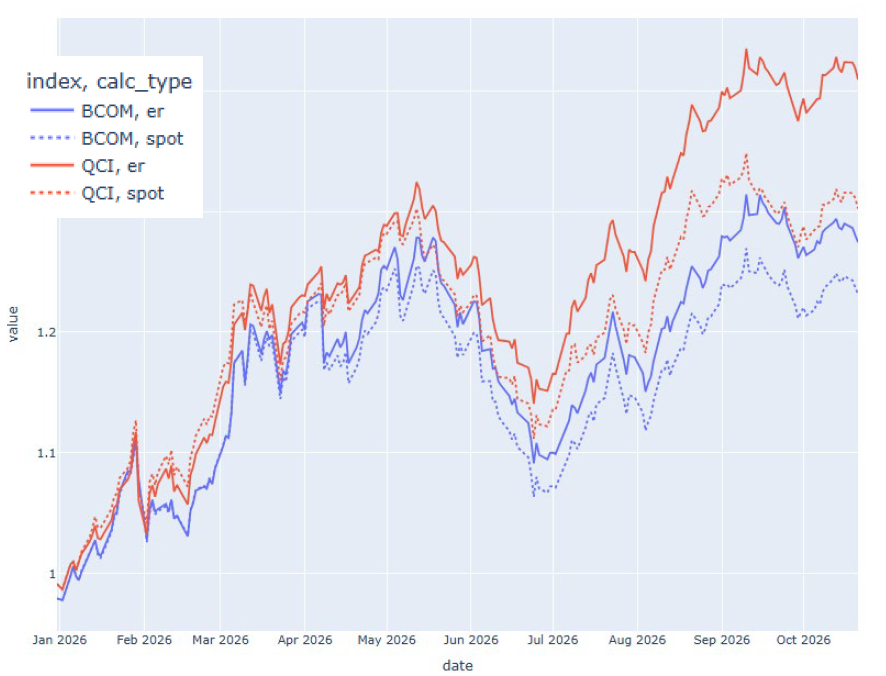
Source: Quantix Commodities LP. Data based on internal calculations. Date range: 31-Dec-25 through 21-Oct-26. Past performance is not indicative of future results.
The returns so far have been driven both by spot price appreciation as well as consistently high levels of positive roll yield. The Quantix Commodity Index Excess Return index (“QCIER”, solid red line), including the roll yield contribution, is up approximately +41% while QCI Spot (dotted red line) is up approx. +30%. This contrasts with the Bloomberg Commodity Index (“BCOM”, solid blue) which is up approx. +27% while BCOM Spot (dotted blue) is up approx. +23%
Yet despite this compelling investment thesis, the asset class still remains underrepresented in strategic asset allocations. Many investors continue to ask if they have “missed the move” and are fearful of buying the top (although they have been asking this question for over 12 months now). Those who have participated in the strong recent returns have asked whether it is time to take some chips off the table.
Qauntix’s answer is clear: we believe the opportunity set in commodities remains robust. The investment rationale they have previously outlined remains valid and we believe in the potential for further gains, continuing to validate the case for holding strategic alpha and beta allocations in the asset class.
In this newsletter Quantix outlines tactical views, reviewing the prevailing rationale by sector ‑ Energy, Natural Gas and Industrial Metals ‑ and why they believe commodities are an even more compelling, permanent and strategic allocation today than they were a year ago.
In short, Quantix believes this is a time for staying the course.
Energy: The Myth of “Normalization”
Energy remains the most disrupted sector in commodity markets. Recent press about the “normalization” of crude supply from the Middle East, with President Trump himself touting daily flow totals that were approaching pre‑conflict levels, is a misleading description in our opinion. The normalization of flows does not typically equate to normalization of price.
Flows achieved through force are highly inefficient and unsustainable, creating severe distortions in global oil dynamics. For example, freight rates recently reached $40/bbl partly as a result of these distortions, impacting global trade, and the United States is spending substantial military means in the Middle East to keep oil moving.
What has become apparent to Quantix is that a negotiated peace that is capable of truly normalizing oil flows is becoming increasingly unlikely as the list of combatants spreads. For example, the Houthis and Saudi Arabia have dramatically escalated their own conflict on top of the Iran/US conflict. The weaponization of supply chains, manifested in overt attacks on energy infrastructure, has become standard military strategy. The same approach has intensified in the Russia/Ukraine conflict, which is now more than four years in, demonstrating how challenging it is to negotiate an end to such conflicts. This is not a hopeful precedent for a settlement in the Middle East.
In Quantix’s view, instead of building toward a sustainable negotiated peace, policy measures have focused on mitigating the price effect with short‑term band‑aids rather than lasting solutions. Export bans and strategic reserve releases have kicked the proverbial can down the road, but the world is potentially reaching the end of the highway.
Running Out of Shock Absorbers
The depletion of petroleum inventories is now being acknowledged by the largest participants in the physical market. As reported earlier this month1, oil inventories “…in western countries have been exhausted as a result of the Iran war,” according to Russell Hardy, Chief Executive Officer of Vitol Group, the world’s largest independent oil trader. Speaking at the Energy Intelligence Forum in London, Hardy warned that fuel markets are likely to remain tight going into winter and said: “There aren’t any more inventories to drain in the West. We drained the available inventory.”
Hardy’s comments came a day after the CEO of Saudi Aramco, Amin H. Nasser, warned2 that less than 10% of the world’s 6 billion‑barrel oil stockpile is practically available because of various logistical challenges. Meanwhile, the G7 and their partners announced a further release of 100 million barrels of emergency oil reserves, after the U.S. administration pressed Europe to do more to quell soaring diesel prices. With these latest releases, the U.S. Strategic Petroleum Reserve now stands at its lowest level in 40 years.
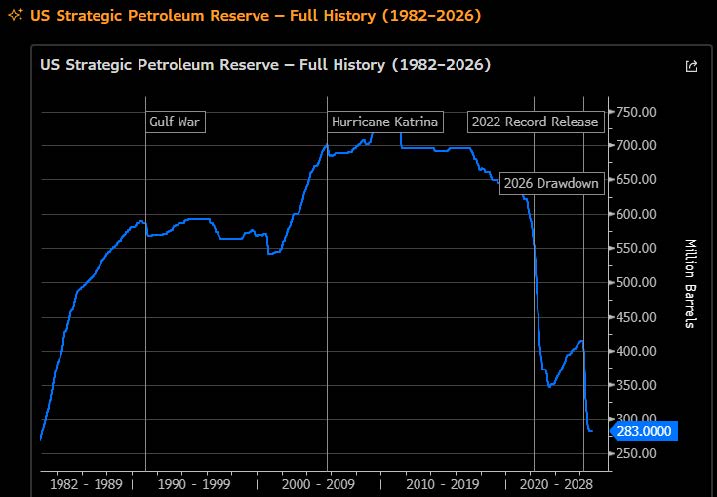
Source: Bloomberg. 1 Bloomberg, “Oil Inventories in the West Have Been Exhausted, Vitol CEO Says”, 06-Oct-26. 2 CNBC, “Saudi Aramco chief says replenishing global oil stockpiles could take two years”, 05-Oct-26. Past performance is not indicative of future results.
The global oil market is running out of shock absorbers. Nearly 3 billion barrels of expected supply have already been lost, more than 1 billion barrels of inventories have been drawn down, and Nasser has warned that the remaining commercial cushion is “scarily thin.” Even if the Strait of Hormuz fully reopens, rebuilding depleted stocks while meeting demand could take up to two years, requiring roughly 2 million barrels per day of extra supply for the next 18 months.
The message is clear: emergency reserves can buy time, but until the Strait of Hormuz is fully restored and confidence returns, and Quantix expects pressure on crude, refined products, freight and global supply chains to intensify.
At this point, Quantix believes the only realistic cap on energy prices is demand destruction, and given the supply picture, that could likely only be achieved through higher prices. Historically, this method of market balancing has been characterized by higher volatility, often involving prices overshooting.
Oil Volatility: An Opportunity to Own Vega
Interestingly, Quantix’s perspective is at odds with the current dynamics in the oil volatility market. Oil implied volatility has been steadily declining over the past few weeks, even as daily price ranges expand.
Part of the explanation may be that close‑to‑close volatility is masking much larger intraday ranges. The chart below shows the 20‑day average ratio of WTI’s daily high‑low range to its settle‑to‑settle change. This metric reached an all‑time high this year, surpassing the levels set in 2022 at the outset of the Russia/Ukraine conflict, and the 2026 year‑to‑date average is nearly double that of 2023‑2025. Quantix believes it is more likely that this metric more accurately reflects the greater uncertainty they expect to see in oil markets.
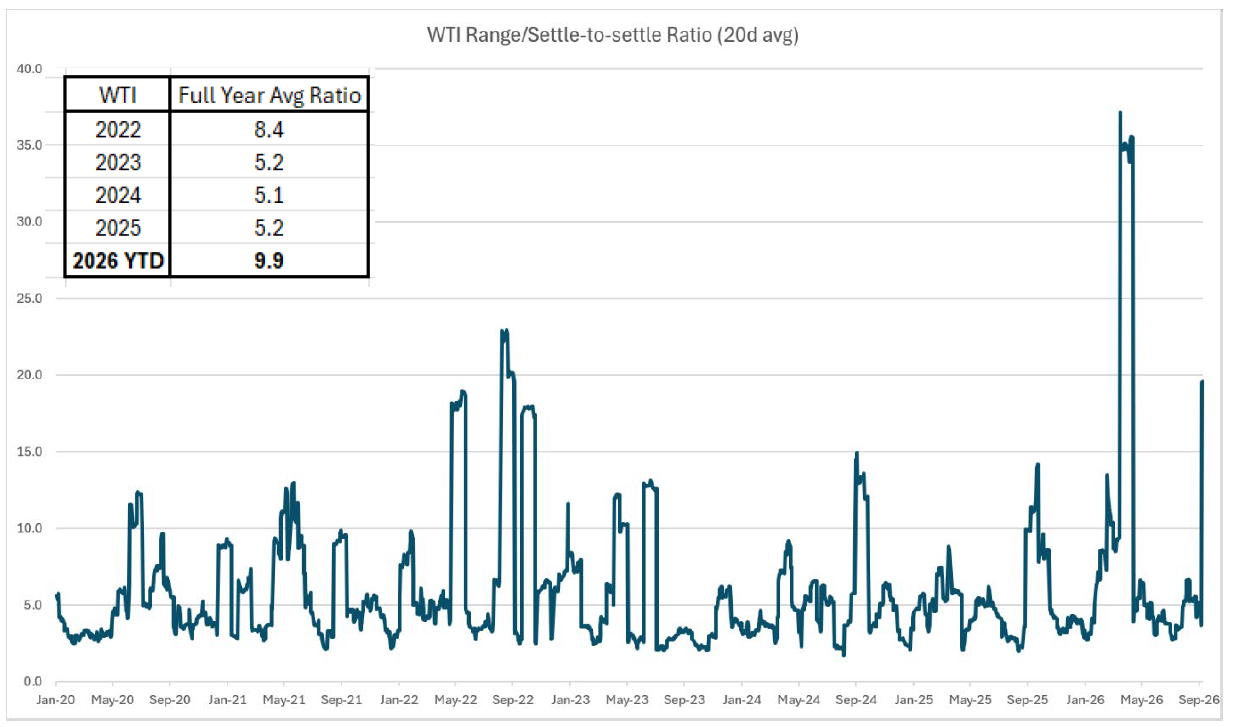
Source: Bloomberg, Calculations by Quantix Commodities. Oct. 2026; Past performance is not indicative of future results.
An additional driver of lower implied oil volatility is a notable shift in how speculators express their views through options. Historically, speculators would typically gain leveraged exposure to oil price moves through outright call or put purchases. More recently, it appears that this segment has favored tight put or call spreads to achieve a near “binary” payout in certain scenarios. These expressions involve much lower levels of outright volatility exposure and have kept a lid on implied volatility, which we believe presents an opportunity to own vega.
Natural Gas: Europe’s Winter Risk
Quantix has consistently argued that European natural gas (“TTF”) is the single commodity with the most asymmetric upside potential resulting from the conflict in the Middle East, and this has become evident in relative price moves within the energy sector since the start of the war.
While diesel and distillate prices have received much of the recent attention, spot TTF prices have nearly doubled since the start of 3Q26 and TTF has been the strongest performer across the whole energy complex since the start of March (chart below). With European inventories far below seasonal averages heading into winter, at 78% full versus a normal level of 90% full, and vital Qatari supply still constrained, Quantix believes prices could experience upward pressure in a cold European winter scenario.
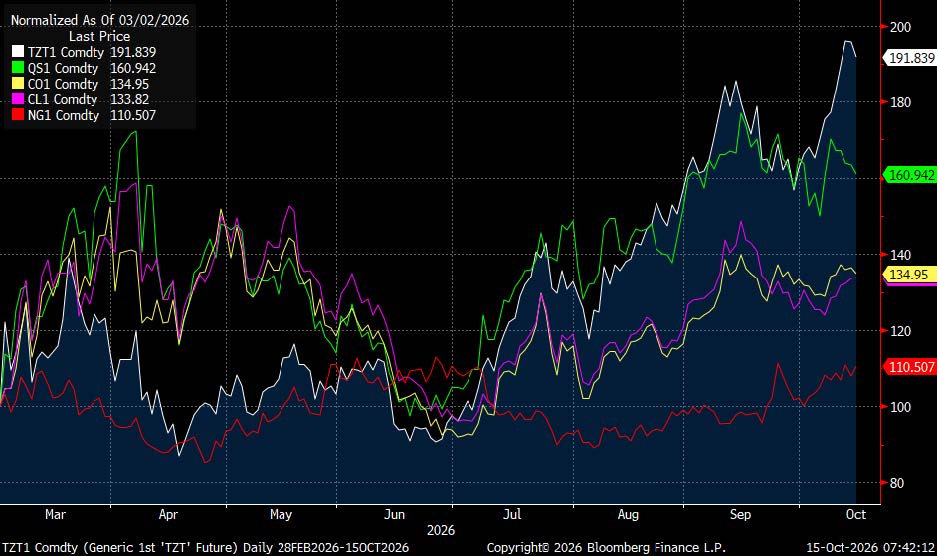
Source: Bloomberg, As of 15-Oct-26. TZT1 = prompt TTF contract, QS1 = prompt Gasoil contract, CO1 = prompt Brent Crude Oil contract, CL1 = prompt WTI Crude Oil contract, NG1 = prompt US Natural Gas contract. Past performance is not indicative of future results.
Industrials Metals: Copper’s Strategic Re‑Rating
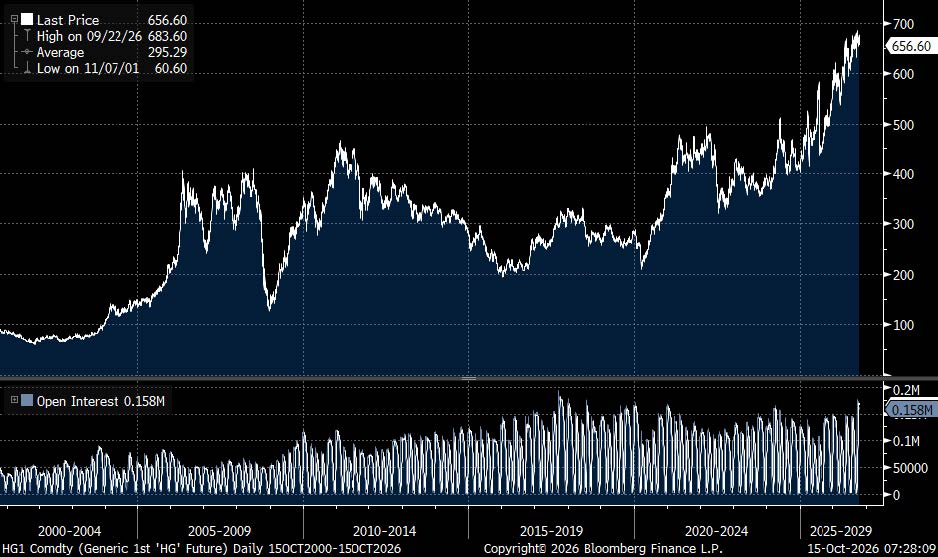
Source: Bloomberg, 15-Oct-26. Past performance is not indicative of future results.
Industrial Metals is becoming an increasingly interesting sector in Quantix’s view. Copper has recently set a new all‑time high, as seen on the chart above, as non‑U.S. inventories remain very tight and Chinese demand remains robust.
Quantix believes Copper is transitioning from a cyclical industrial metal into a strategically important resource. Artificial Intelligence (“AI”) infrastructure, electrification, grid investment, rearmament and government stockpiling are simultaneously accelerating demand, while mine supply remains constrained and increasingly vulnerable to geopolitical and climate disruptions.
According to UBS,3 the market is projected to remain in deficit through 2027 despite record‑high prices.
Contrary to the narrative of a slowing Chinese economy, Chinese demand is actually growing, as evidenced by the strongest backwardation in Shanghai Futures Exchange (“SHFE”) copper prices in over two years.
An Even More Compelling Strategic Allocation
Beyond the current tactical rationale, Quantix believes commodities continue to present a compelling permanent strategic allocation for investors. Quantix recently attended an investor conference where a major agenda topic was the death of the 60/40 portfolio model in an inflationary environment and what may be done to enhance it. The most recent CPI print underscores the persistent threat of inflation, with the U.S. Consumer Price Index (CPI) reaching +3.7% on an annual year‑on‑year basis in September.
Quantix has seen several pieces of research that have highlighted the increased and positive correlation between bonds and equities during periods of structurally higher inflation. The constant feedback that they receive from investors is that they appear to be searching for truly diversifying assets, such as commodities, to strengthen the resilience in their portfolios.
Given the recent performance of commodities relative to equities and bonds, Quantix believes the case for a larger strategic allocation to commodities has strengthened.
Unfortunately, the reality of investor portfolios falls far short of that. According to a Goldman Sachs report from 2025, of the roughly $261 trillion global investable portfolio, physical Gold is the only meaningful commodity holding, at approximately 6%. Consumable commodities, which are the main driver of inflation in the current scarcity environment, are under‑owned, not even making the list.
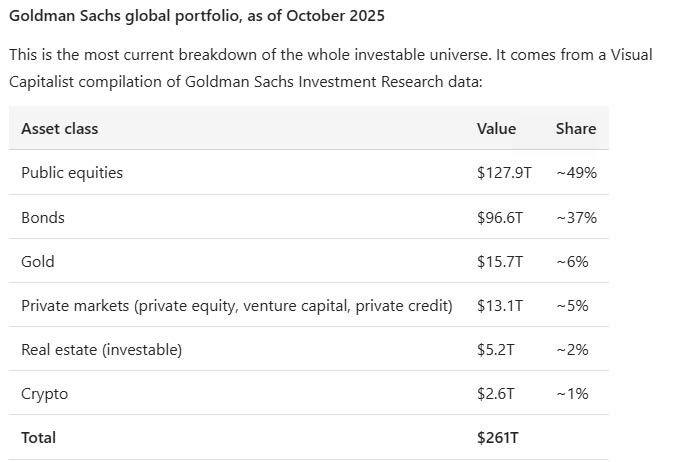
Source: Goldman Sachs Investment Research, Visual Capitalist. Oct. 2025; Past performance is not indicative of future results.
Physically holding consumable commodities is operationally prohibitive, but derivatives make the asset class accessible. However, Quantix estimates that current holdings via traditional benchmark products, such as BCOM and SPGSCI, total only approximately $210 billion. In our view, it is likely that the historically poor performance of these traditional benchmarks has largely contributed to low allocations to the asset class and if investors have a different portfolio tool, the conversation around the whole asset allocation can change.
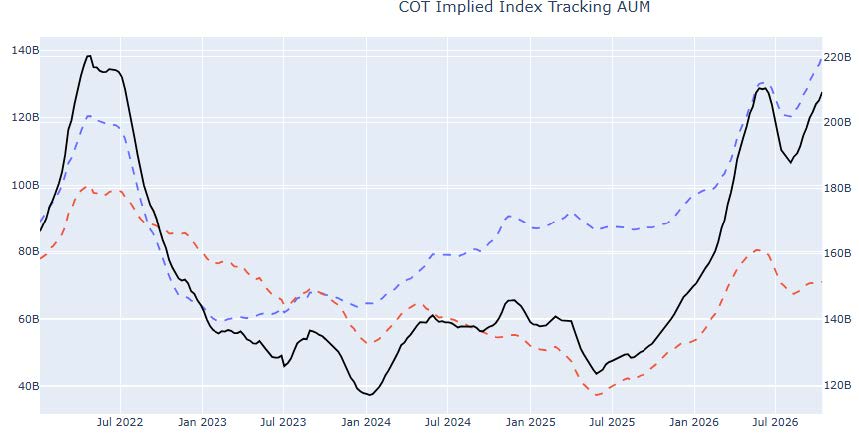
Source: CFTC Commitments of Traders, Calculations by Quantix Commodities; Aug. 2026 Past performance is not indicative of future results.
Dynamic Reweighting: From Debasement to Scarcity
One distinctive feature of Quantix’s strategic commodities framework that differentiates it from traditional approaches, such as those in BCOM and the SPGSCI, is dynamic reweighting. In the rules‑based index implementation of QCI, rebalances occur on a quarterly basis and are designed to ensure an appropriate basket for an evolving environment. The most significant weight shifts have typically occurred when the index methodology has detected a regime change between scarcity and debasement and changes the weight of Gold relative to the basket of consumable commodities.
It is worth highlighting that all three of the index methodology’s regime indicators: steepness of the U.S. yield curve, the ratio of prices of gold to those of copper, and the level of backwardation of the consumable commodities basket were pointing to debasement at the start of the year. In the most recent rebalance, two have moved back to point to scarcity. These indicators are consistent with Quantix’s own view of the macro environment.
According to the World Gold Council (chart below), central bank interest in de‑dollarization remains elevated and has rebounded from the selling immediately after the Iran war started. While this source of structural demand can continue to support Gold as a store of value over the long term, Quantix believes higher interest rates are likely to be a short‑term headwind for Gold, which further supports the framework’s current relative allocation toward consumable commodities.
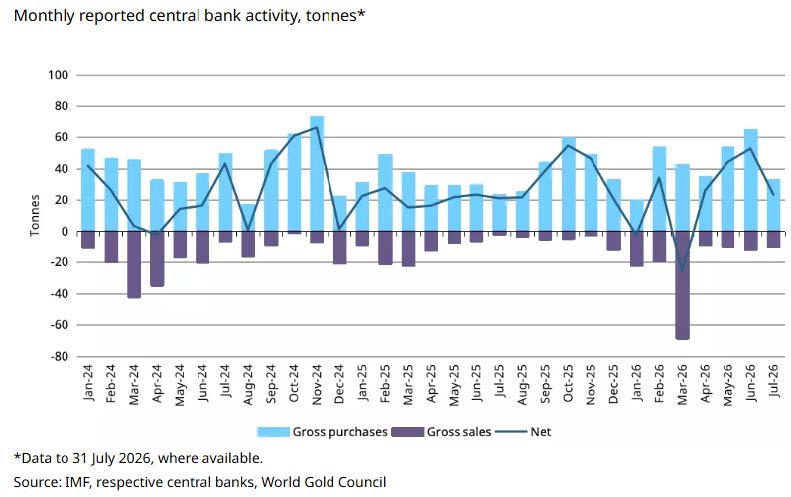
Past performance is not indicative of future results.
Outlook: Staying the Course
Quantix does not believe that tangible gains are a reason to sell existing commodities allocations or hold off on initiating new ones.
Continued exposure should be evaluated on the merits of the investment thesis, and for commodities they believe those merits remain compelling. The rationale to include commodities as part of a strategic asset allocation has not diminished with higher prices and the tactical justifications are both consistent in substance but also stronger in impact now than a year ago.
The mean‑reversion myth that has historically discouraged greater strategic investment in commodities is, in their view, more a function of exposure methodology than of commodity fundamentals. If investors conducted portfolio optimization analysis using a different index framework instead of BCOM to represent commodity exposure, we believe they would come to significantly different conclusions (with potentially significant overall portfolio benefits), and they expect this to happen going forward.
Whether an investor relies on a tactical or a strategic justification, the persistence of strongly positive roll yield remains a compelling factor. At current levels, spot prices would not even need to appreciate for commodities to potentially deliver positive investment returns.
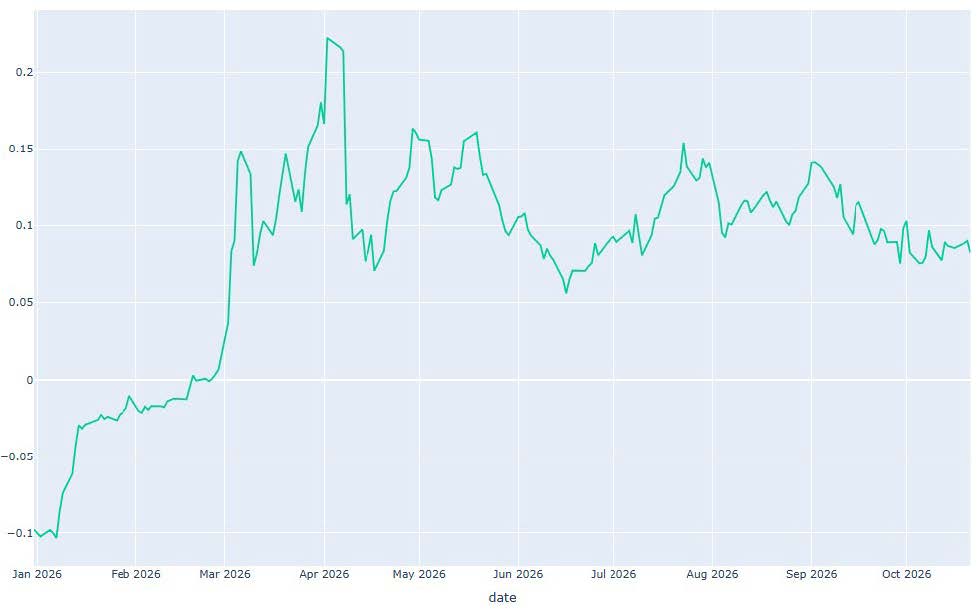
Source: Bloomberg, Quantix Commodities LP. Past performance is not indicative of future results.
This dynamic has already been a significant contributor to year‑to‑date returns, with QCI excess returns more than 30% higher than the price return of the underlying spot basket.
Finally, commodities have historically been a late‑cycle asset. While Quantix sees demand destruction as the ultimate end to this bull cycle, we believe those levels still lie a long way off. Equity markets are still seeking to achieve new all‑time highs, and commodity demand remains resilient.
Quantix believes we that a more definitive pullback is needed in equity performance and consumer sentiment before commodities roll over. In 2008, equities peaked nine months before commodities, which rallied an additional 40% over that period.
Some may argue that equity markets are too concentrated in AI. However, Quantix believes that concentration is simply an accurate reflection of the current economy, in which AI is ubiquitous. For now, the long‑term deflationary potential of AI is overwhelmed by massive hyperscaler spending and increased energy demand, a theme they explored in detail in their last newsletter, “Demand Shock.”
For investors who already hold commodities, Quantix believes investors should stay the course. For those who think they missed the move, they believe the case for an allocation today is as strong as it has ever been. With an appropriate strategic commodities framework such as that deployed at Quantix, they believe investors do not need to rely solely on spot prices rising further to benefit. Quantix remains committed to providing innovative solutions that allow investors to seek to both hedge and profit from these themes.
Important Information
While the information in this document, including information from third party sources that has not been independently verified by Quantix, is believed to be accurate, Quantix Commodities LP makes no express warranty as to its completeness or accuracy. The information in this material is only current as of the date indicated, and may be superseded by subsequent market events or for other reasons. Statements concerning financial market trends are based on current market conditions, which will fluctuate. Any statements of opinion constitute only current opinions of Quantix Commodities LP , which are subject to change and which Quantix Commodities LP does not undertake to update. Due to, among other things, the volatile nature of the markets, investment in the fund may only be suitable for certain investors.
Benchmark
The Bloomberg Commodity Index (“BCOM”) is designed to be a highly liquid and diversified benchmark for commodity investments via futures contracts. The S&P GSCI (Standard & Poor’s Global Commodity Index) is a broad‑based, production‑weighted composite index that measures the performance of the global commodities market. The S&P 500 Index is an unmanaged index generally representative of the U.S. market for large capitalization equities. The Quantix Commodity Index (“QCI”) is calculated on a total return basis, which combines the returns of the futures contracts with the returns on cash collateral invested in 13‑week U.S. Treasury Bills. The Quantix Commodity Index was developed by Quantix Commodities LP and is owned by Quantix Commodities Indices LLC. These indices are unmanaged and do not reflect fees and expenses and are not available for direct investment.
Risks
Investing entails risks and there can be no assurance that any investment will achieve profits or avoid incurring losses
Stock markets are volatile and equity values can decline significantly in response to adverse issuer, political, regulatory, market and economic conditions. Investing in fixed income securities carries risks, including interest rate, credit, and inflation risks. Rising interest rates may reduce their value, and issuers may default, resulting in potential loss of principal and interest. Liquidity risk can also make it difficult to sell at favorable prices, and economic changes or issuer creditworthiness can impact their value.
Commodities Risk: The value of commodities investments will generally be affected by overall market movements and factors specific to a particular industry or commodity including weather, embargoes, tariffs, or health, political, international and regulatory developments.
Diversification does not assure a profit or protect against loss in a declining market.
This material may contain forward‑looking information that is not purely historical in nature. Such information may include, among other things, projections and forecasts. There is no guarantee that any of these views will come to pass.
This material is for informational purposes and is not intended to be relied upon as a forecast, research or investment advice and is not a recommendation, offer or solicitation to buy or sell any securities or adopt any investment strategy.
Copyright © 2026 Harbor Capital Advisors, Inc. All rights reserved.