


.webp)
Dear Investor,
Quantix believes the second quarter of 2026 was defined by extraordinary volatility in commodity prices as markets struggled to price the uncertainty and fundamental impact of the war in Iran. After surging to year‑to‑date highs of over +30% in May, broad commodity indices retreated sharply in June on the news of an apparent ‑ although potentially short‑lived ‑ peace deal.
The largest Petroleum supply shock in history has led to price action in oil markets which many did not expect given the scale of the disruption. Front month WTI Crude Oil prices fell back below the USD70/bbl level on the last day of the second quarter, similar to the levels in the days before the first attacks.
However, Morgan Stanley estimates1 that Total Global Oil Stocks show a very different picture now than at the end of February. The historic inventory draws that have cushioned oil price increases have also significantly reduced the buffer to absorb any continued supply disruption.
Total Global Oil Stocks (Crude + Products) Inventories (mln bbls)
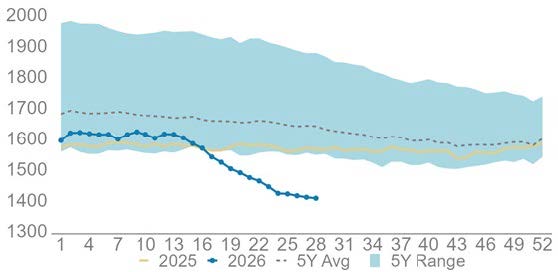
1Source: Morgan Stanley Research, “Oil Data Digest: Weekly Oil Stock Summary”, 20-Jul-26 EIA, PJK International, IE Singapore, PAJ, Genscape, FEDCom/Platts. Includes US SPR. Past performance is not indicative of future results.
While the market’s attention remains fixed on whether the supply shock has run its course, Quantix believes investors may be underappreciating a second, potentially more durable force now building on the horizon: a ‘Demand Shock’. The end of the supply disruption is by no means a given, as illustrated by the recent reescalation of tensions, but in our view, even a genuine and lasting peace would not resolve the demand‑side pressures now assembling across commodity markets.
Quantix sees this potential shock emerging from two powerful and reinforcing sources:
- Restocking. As the era of deglobalization reinforces the imperative for security of supply, both China and the West could be anxious to rebuild depleted reserves as a buffer against future supply insecurity. They have both significantly drawn down inventories during the conflict and the recent events discussed in this letter have yet again provided multiple examples of supply chain weaponization.
- The Artificial Intelligence (“AI”) boom. An accelerating, structural paradigm shift in energy demand driven by the build-out of AI infrastructure. This has supplemented and turbocharged the energy transition theme which was prevalent in the early part of the decade.
These two forces have come into sharper focus in the first half of 2026, but Quantix has seen that both have supported a consistent, structural tailwind for commodities throughout this decade.
There have been two notable energy supply shocks (Russia’s invasion of Ukraine in 2022 and the Iran War in 2026) so far this decade, and Quantix believes that geopolitical instability in a deglobalizing world may continue to present the potential for further shocks.
In this newsletter, Quantix discusses the persistence of the supply shock threat, the restocking dynamic already underway, and why they believe AI‑driven demand growth represents a defining, potential multi‑year return driver for commodity markets.
The weaponization of commodity supply chains has evolved from an isolated risk into a recurring tactic of modern conflict. In the Russia‑Ukraine theater, Ukraine has gained meaningful strategic leverage over Russia by systematically attacking Russian refineries, with drones now capable of crippling facilities far behind the border. Russia has recently adopted a diesel export ban while ARA product inventories are already at their lowest levels since 2014. Coupled with similar strikes across the Persian Gulf, the resulting refinery losses have proven more substantial and more durable than the disruption to crude supply itself. Refinery outages (blue lines in the chart below) have meant global runs are 5mbd below their seasonal norms, resulting in extremely tight product markets.
Refinery Outages ‑ Planned and Unplanned
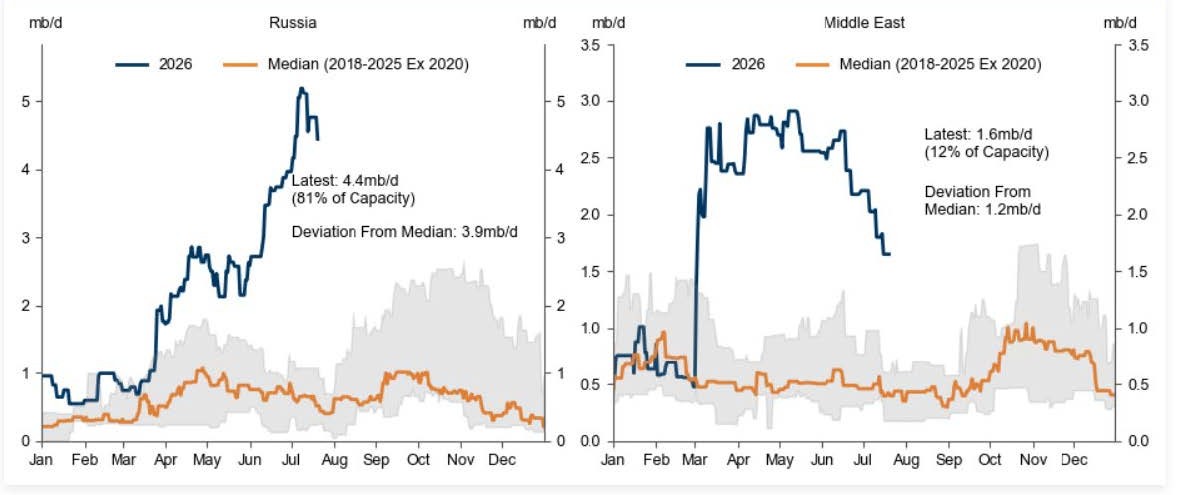
Source: Goldman Sachs Investment Research, “Oil Comment: Hedging Escalation With Diesel Length”, 20-Jul-26, IIR; Past performance is not indicative of future results.
The consequence of refinery attacks has been a sharp elevation in product margins resulting in far less “peace relief” for the consumer, who is exposed to refined products such as gasoline, diesel, and heating oil, rather than to crude oil.
Global Retail Refined Products Price
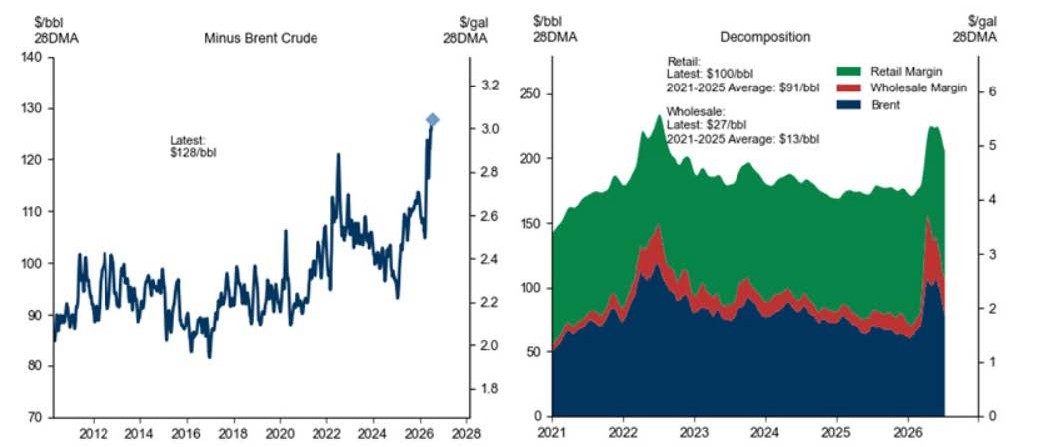
Source: Goldman Sachs Investment Research, “Oil Comment: Prices at the Pump: Persistently Pricey”, 09-Jul-26. GS defines wholesale margins as wholesale product prices minus Brent, and retail margins as retail prices minus wholesale prices. EIA, Government Sources, ICE, Platts; Past performance is not indicative of future results.
This distinction between what the headlines reference (the oil price) and what the consumer experiences (the refined products) is not incidental if one of the aims of an allocation is to hedge inflation. It is a deliberate and central feature of the Quantix long‑only framework deployed in our structural commodities framework, that structurally has favored the refined products over crude oil within the petroleum sector for exactly this reason.
Additionally concerning, the continued threat of supply shocks is not confined to energy markets. More recently, BofA highlighted that key Black Sea agricultural export ports have also come under attack and contributed to a sharp rally in wheat prices as Russia and Ukraine account for 30% of global wheat exports, which has led both wheat and corn to rally in July 2026 (chart, right).
Black Sea Escalation has Lifted Wheat and Corn Over the Past Two Weeks
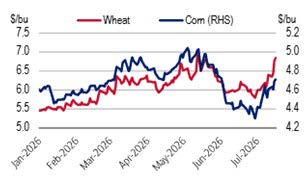
Source: BofA, “BofA Commodities Morning Note”, 17-Jul-26, Bloomberg; Past performance is not indicative of future results.
Commodity Restocking
The recent supply disruptions have left visible scars on global inventories. Western governments, including the United States, drew heavily on strategic reserves such as the SPR to dampen price spikes during the conflict. According to IEA data, OECD government stockpiles fell to their lowest levels since December 1990 during the quarter.
Of greater relevance is the massive oil inventory swing that likely occurred in China. There is no official government data on Chinese oil inventories, so market observers largely use import data to make inferences on Chinese oil demand/inventory levels. While Chinese crude imports fell 41% year‑on‑year in June to a near decade low, Quantix believes many analysts are misinterpreting this data as semi-permanent demand destruction.
In the 12‑18 months before the Iran War, China engaged in an ambitious stockpiling program under which the government issued directives for state‑owned and private oil companies to ramp up crude reserves, much of which was purchased at below market prices from sanctioned Russia and Iranian sources. Given the opaque nature of the program, precise data is not available, but experts estimate that Chinese oil reserves reached 1.5bn barrels, roughly twice the size of the US SPR if it were full.
Once oil prices spiked post the Strait of Hormuz closure, this reserve flow likely reversed in a substantial way. Since the conflict began, market analysts estimate the drawdown to be as large as 400m barrels. The large year‑on‑year swing in imports, therefore, is far more likely to be explained by the drop from inflated inventory building last year, rather than drawing down inventories this year, with actual consumptive demand remaining relatively stable. If consumption demand from a slowing economy were the driver, one would have expected to see similar downturns in Chinese copper and natural gas imports but that has not occurred.
Quantix believes this sets up a potential restocking impulse. In a deglobalizing world where security of supply has become a sovereign priority, we expect both China and Western governments to move aggressively to replenish and expand reserves; not merely to pre‑conflict levels but including a buffer commensurate with a more dangerous geopolitical environment. Restocking demand of this nature has been relatively price-insensitive and additive to underlying consumption. This is precisely the kind of dynamic that could extend a commodity cycle well beyond what conventional supply‑demand models anticipate. In fact, prior to the recent reescalation of tensions in July, Chinese oil flows were already showing signs of significant recovery.
Commodity restocking may not just be a potential bullish catalyst for consumable commodities. It also has implications for Gold as a store of value, with dedollarization driving Central bank buying.
Despite a few notable sellers in March, such as Turkey, JPM estimates overall central bank gold purchases of 40MT/month remain well above pre‑2022 levels (chart, right) and many bank researchers see the potential for Gold prices to be back above $5000/oz next year.
Monthly Central Bank Gold Flows (Metric Tonnes)
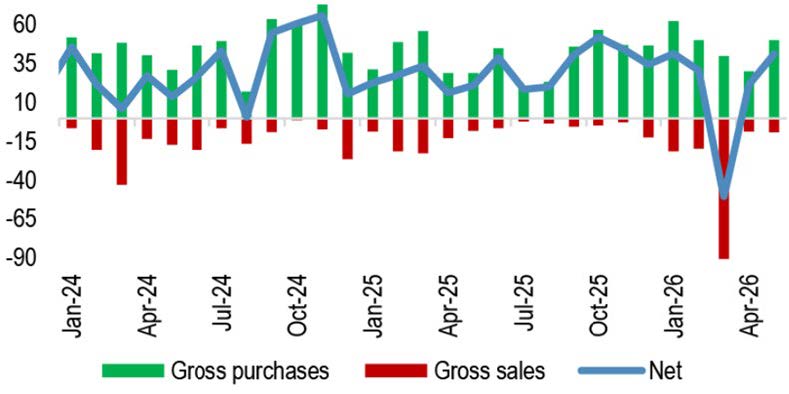
Source: JPMorgan, “JPM Commodities Morning Commentary”, 13-Jul-26; Past performance is not indicative of future results.
Artificial Intelligence “AI” and the Coming Demand Shock
If restocking is the near‑term catalyst, the structural heart of the coming demand shock is AI. As Quantix noted in their 2Q24 newsletter “The Impact of Artificial Intelligence on Commodity Markets”, this is an energy addition story rather than one of substitution: alternative energy sources will not replace the existing energy supply but must stack on top of it. The commodity intensity of this build‑out is profound and those most critical to the AI theme are:
Electricity: difficult to store, it must be generated, transmitted and consumed simultaneously
Natural gas: the marginal fuel for reliable, around‑the‑clock data‑center power
Copper: indispensable for grid expansion, data‑center wiring, and broad electrification
Silver: essential to solar generation and high‑performance electronics
Uranium: as nuclear re‑emerges as a preferred source of carbon‑free baseload power
Aluminum: for transmission infrastructure and equipment
Rare earth elements: for specialized hardware, magnets, and cooling systems
There is also an important second‑order implication to this theme. To the extent that AI improves productivity and efficiency across the economy, it may ultimately help ease supply constraints and moderate demand growth for non‑energy commodities such as agriculture, livestock, and softs.
However, energy‑producing and energy‑enabling commodities face the opposite pressure: AI’s appetite for power could translates directly into incremental, sustained demand for commodities at a potentially massive scale. The build‑out of data‑center capacity to train and run AI models is driving an unprecedented step‑change in electricity demand, even accounting for delays and cancellations.
Goldman Sachs estimates U.S. data center capacity to more than double in the two years to end 20273.
US Data Center Power Demand Capacity
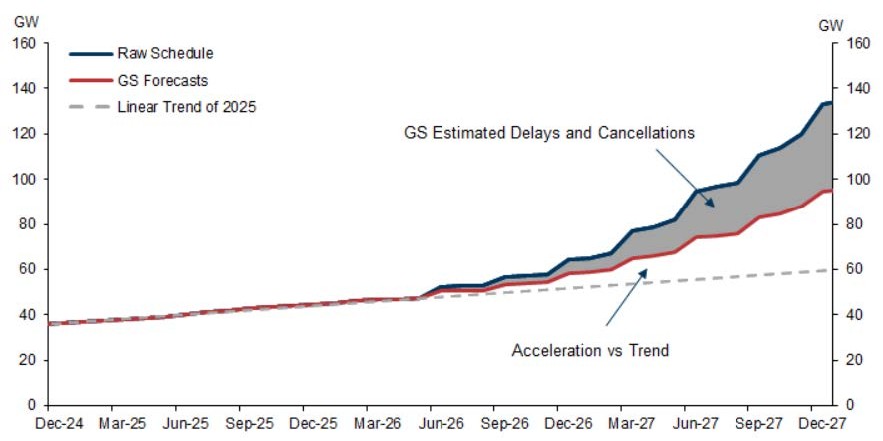
3Source: Goldman Sachs Investment Research, “POWER ANALYST: US Data Center Power Demand Likely to Surge”, 05-May-26, Aterio; Past performance is not indicative of future results.
In recent roadshows for SpaceX, Elon Musk discussed the implications of forthcoming AI energy requirements and described it as a major driver for his desire to seek non‑terrestrial forms of energy. He envisions lunar generated compute power of 1000 terawatts which is 300x greater (!) than current total global electricity demand.
While his vision and timeline may be beyond our investment horizons, Quantix believes demand for earthbound energy sources is likely to meaningfully accelerate in the short‑term and could contribute to increased demand for certain commodities.
Overall, Quantix sees the net AI effect as significantly constructive for most commodity prices.
Outlook
The convergence of the current supply shock and a building demand shock leaves Quantix more convinced than ever in the strategic case for a dedicated and higher commodity allocation. There is also a further, more subtle implication worth emphasizing; as AI begins to displace labor across the services economy, the historical link between inflation and wages may weaken. Commodities, which underpin the goods component of inflation and increasingly the energy that powers services, may become a more complete inflation hedge than before. In a world where the “services” component of inflation is itself increasingly a function of energy and compute, a commodity allocation captures a broader share of the inflation basket than traditional frameworks assume.
While some investors may be tempted to tactically trade the dislocations associated with extreme supply shocks, Quantix believes the structural trend to commodity prices merits a long‑term portfolio asset allocation. With an appropriate strategic commodities framework over some time periods, the asset class has historically outperformed some commodity benchmarks.
Quantix remains committed to providing investors with innovative solutions designed to help investors manage commodity related risks while seeking investment opportunities. They believe their differentiated solutions are well‑positioned for the environment ahead.
Important Information
While the information in this document, including information from third party sources that has not been independently verified by Quantix, is believed to be accurate, Quantix Commodities LP makes no express warranty as to its completeness or accuracy. The information in this material is only current as of the date indicated, and may be superseded by subsequent market events or for other reasons. Statements concerning financial market trends are based on current market conditions, which will fluctuate. Any statements of opinion constitute only current opinions of Quantix Commodities LP , which are subject to change and which Quantix Commodities LP does not undertake to update. Due to, among other things, the volatile nature of the markets, investment in the fund may only be suitable for certain investors.
Benchmark
The Quantix Commodity Index (“QCI”) is calculated on a total return basis, which combines the returns of the futures contracts with the returns on cash collateral invested in 13‑week U.S. Treasury Bills. This index is unmanaged and not available for direct investment.
Risks
Investing entails risks and there can be no assurance that any investment will achieve profits or avoid incurring losses
Stock markets are volatile and equity values can decline significantly in response to adverse issuer, political, regulatory, market and economic conditions. Investing in fixed income securities carries risks, including interest rate, credit, and inflation risks. Rising interest rates may reduce their value, and issuers may default, resulting in potential loss of principal and interest. Liquidity risk can also make it difficult to sell at favorable prices, and economic changes or issuer creditworthiness can impact their value.
Commodities Risk: The value of commodities investments will generally be affected by overall market movements and factors specific to a particular industry or commodity including weather, embargoes, tariffs, or health, political, international and regulatory developments.
Diversification does not assure a profit or protect against loss in a declining market.
This material may contain forward‑looking information that is not purely historical in nature. Such information may include, among other things, projections and forecasts. There is no guarantee that any of these views will come to pass.
This material is for informational purposes and is not intended to be relied upon as a forecast, research or investment advice and is not a recommendation, offer or solicitation to buy or sell any securities or adopt any investment strategy.
Copyright © 2026 Harbor Capital Advisors, Inc. All rights reserved.