


Introduction
C WorldWide has been in a strategic partnership with Harbor Capital, Inc. for almost three years. C WorldWide has published thought leadership on several relevant topics, including this piece focusing on India and why they believe investors should pursue investment opportunities that include accessing India. Harbor is pleased to share C WorldWide’s thinking for your portfolio construction consideration.
Key Insights
According to C WorldWide, as of March 31, 2025, since September 2024, the Indian stock market has declined by 14%. After a period of weakness driven by sluggish government spending in the run‑up to elections, the Indian economy has shown signs of a rebound. Encouragingly, a series of positive developments suggests that the tide may be turning.
There are several reasons for what we see as a brighter outlook:
- Government spending recovery: Accounting for over 10% of Gross Domestic Product (GDP), government expenditures are picking up after a muted first half of fiscal year 2025.
- Strength in economic indicators: High-frequency data, including Purchasing Manager’s Index (PMI), tax collections, and electric power demand, point to underlying economic resilience. PMI is a monthly survey that provides insight into the health of the manufacturing sector.
- Pro-growth Central Bank leadership: The newly appointed Reserve Bank of India (RBI) Governor has signaled a shift in stance, introducing liquidity-boosting measures expected to inject the Indian Rupee (INR) seven trillion into the system.
- Pro-consumption Union Budget: Contrary to concerns about higher taxes, the February 1, 2025, budget delivered substantial tax cuts, fueling consumption sentiment.
- Geopolitical reassurance: Prime Minister Modi’s successful visit to the U.S. and strong ties with President Trump have eased India’s geopolitical uncertainties. Trump has announced a trade war against several countries, but India has flown under the radar. Instead, Trump has expressed a desire for increased trade cooperation with India and a potential sale of F-35 fighter jets to the country.
- Stable earnings outlook: Over the long term, India could witness the fastest growth across emerging markets.
- Resilient domestic fund flows: Despite market corrections, domestic mutual fund inflows remain strong, historically reinforcing investor confidence.
Additionally, the risk of large‑scale foreign outflows appears limited, as foreign ownership in Indian equities is at a multi‑year low (16.5% of the market cap). Market valuations have reverted to their five‑year average despite a notable improvement in overall balance sheet and profitability, as reflected in an improved return on equity (ROE) profile.
Opportunity for Long‑Term Investors
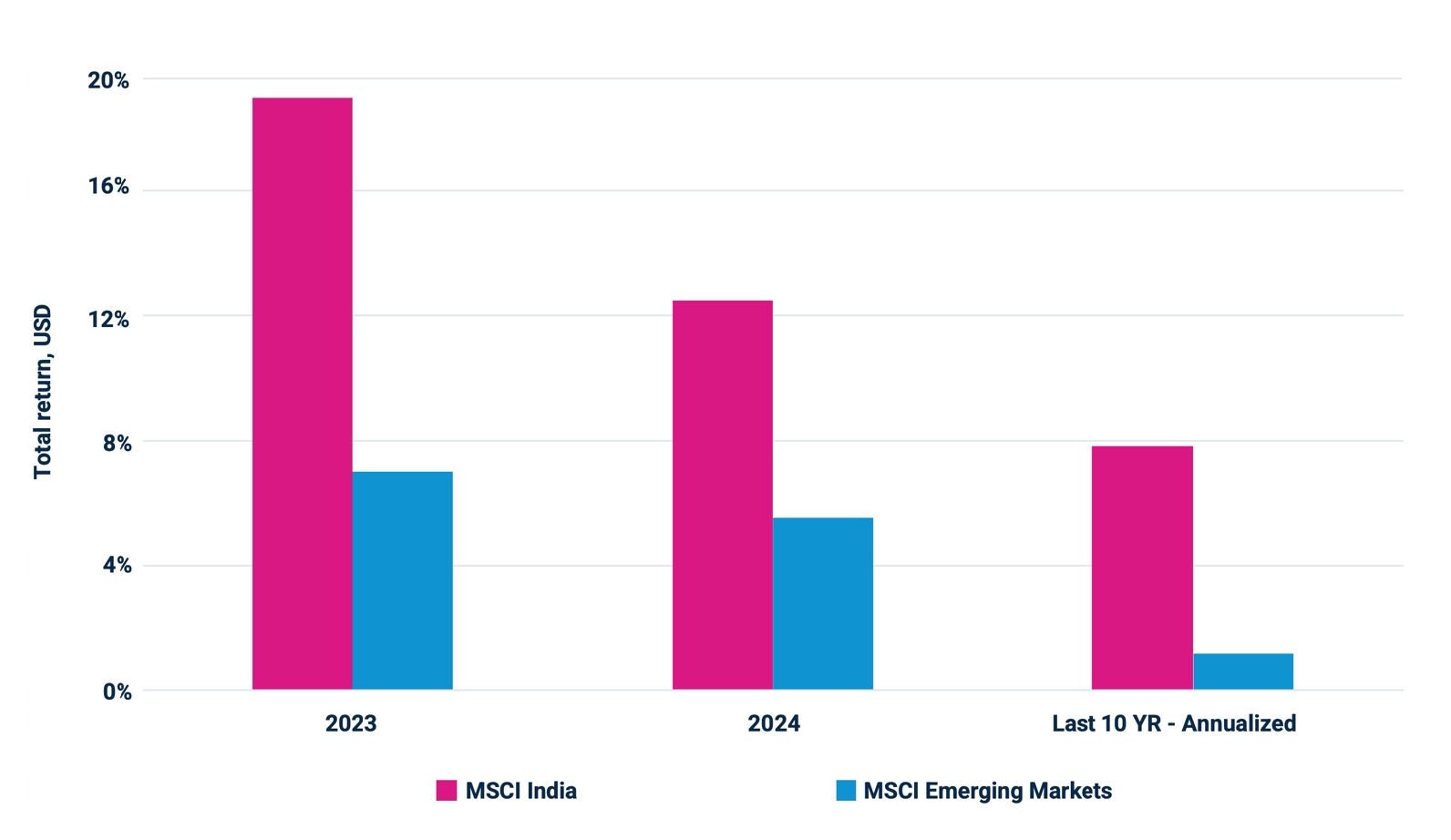
According to C WorldWide as of March 2025, over the last 30 years, the Indian equity market has historically delivered close to a 9% compounded annual return in dollar terms, making it the second‑best performing equity market globally after the U.S.. Despite recent corrections, which began in September 2024 and have continued into the start of 2025, Indian markets have outperformed other emerging markets, supported by structural growth drivers. They delivered double‑digit returns in 2023 and also tracked even better in 2024 before the correction. As shown in Figure 1 below, the Indian market has delivered better returns over the last 10 years than emerging markets.
The current correction of the Indian markets has created an opportunity for long‑term investors as valuations have become less stretched. Structurally, we believe the Indian equity market is one of the most interesting opportunities for the next five to 10 years.
Figure 1: Indian Stock Market Performance
Source: Bloomberg, December 31, 2024
Past performance is not necessarily indicative of future results.
Economic Rebound Could Be Supported by Renewed Government Spending
The recent economic slowdown in India, particularly in the quarter ending September 2024, may be attributed to the extended election cycle in the spring. During election years, government spending on new projects tends to slow down due to the “moral code of conduct,” which historically has restricted the incumbent government from announcing new initiatives. This often leads to a decline in capital expenditure (capex) in the first seven months of the financial year (April 2024 to October 2024). However, as seen in previous election cycles, we expect a sharp uptick in government spending in the coming months and years, with the government likely to achieve its ambitious capex targets.
Economic indicators like the PMI indicate that the economy is likely to remain in expansionary mode, particularly in the services sector, which accounts for over 50% of GDP. Consumption‑related data also shows a recovery and growth ahead.
Domestic Investor Interest Dominating Foreign Flows
Foreign institutional investors have historically played a significant role in driving Indian equity markets. However, domestic institutional investors, backed by retail investors, have become more influential in recent years. In 2024, domestic institutions invested nearly USD 58 billion in Indian equities, while foreign investors sold around USD one billion. Foreign ownership of Indian equities is at a decade‑low of 16.5%, making India, in our view, less dependent on foreign flows than other emerging markets like Brazil, Indonesia, and Taiwan.
Investment Themes
We see four key investment themes in India:
Financial Inclusion
The rise of formal employment and income, likely driven by reforms like GST, has led to potential greater financialization and expansion of credit.
Housing
The housing sector could benefit from rising incomes and urbanization.
Formalization
The shift from informal to formal sectors may create opportunities in branded consumption and discretionary spending.
Capex Cycle
The recovery of capital expenditures, driven by government and private sector investments, could boost economic growth.
These themes may likely grow faster than India’s overall GDP, which is projected to grow 6.5‑7.5% annually over the next decade, according to C WorldWide. Corporate balance sheets are strong with low debt, and corporate profitability has improved, which could support investments in capacity expansion.
Valuation and Risks
The Indian market is valued at a premium compared to other emerging markets, with a forward P/E ratio of 19.5x. We believe India’s structural growth, improved capital efficiency, and lower costs justify the premium. We also note that according to our data India’s return on equity is 300 basis points higher than the emerging market average, further supporting the premium valuation.
Risks include geopolitical tensions, domestic political risks, liquidity constraints, and resource scarcity.
India’s reliance on oil imports (85% of consumption) and limited freshwater resources poses challenges for sustained growth. Additionally, although corporate governance remains a concern, we see improvements as companies increasingly emphasize aligning management interests with those of minority shareholders.
We Believe the Growth Outlook is Strong
There are now over 550 companies in India with a market cap of over a billion dollars and a daily liquidity of over one million dollars. This is higher than the combined markets of Southeast Asia, the Middle East, and Latin America.
Around the global financial crisis in 2007‑2009, nearly 200 companies in India found their way into institutional investors’ portfolios. Today, that number is upwards of 800. To invest in such a large market, institutional investors need the help of research analysts, and India has the best analyst coverage across emerging markets. Today, the Indian equity market contains over 270 companies, and each has analyst coverage greater than ten. This creates a virtuous circle, attracting more attention from institutional investors with the economy’s size, and the structural growth story is a catalyst.
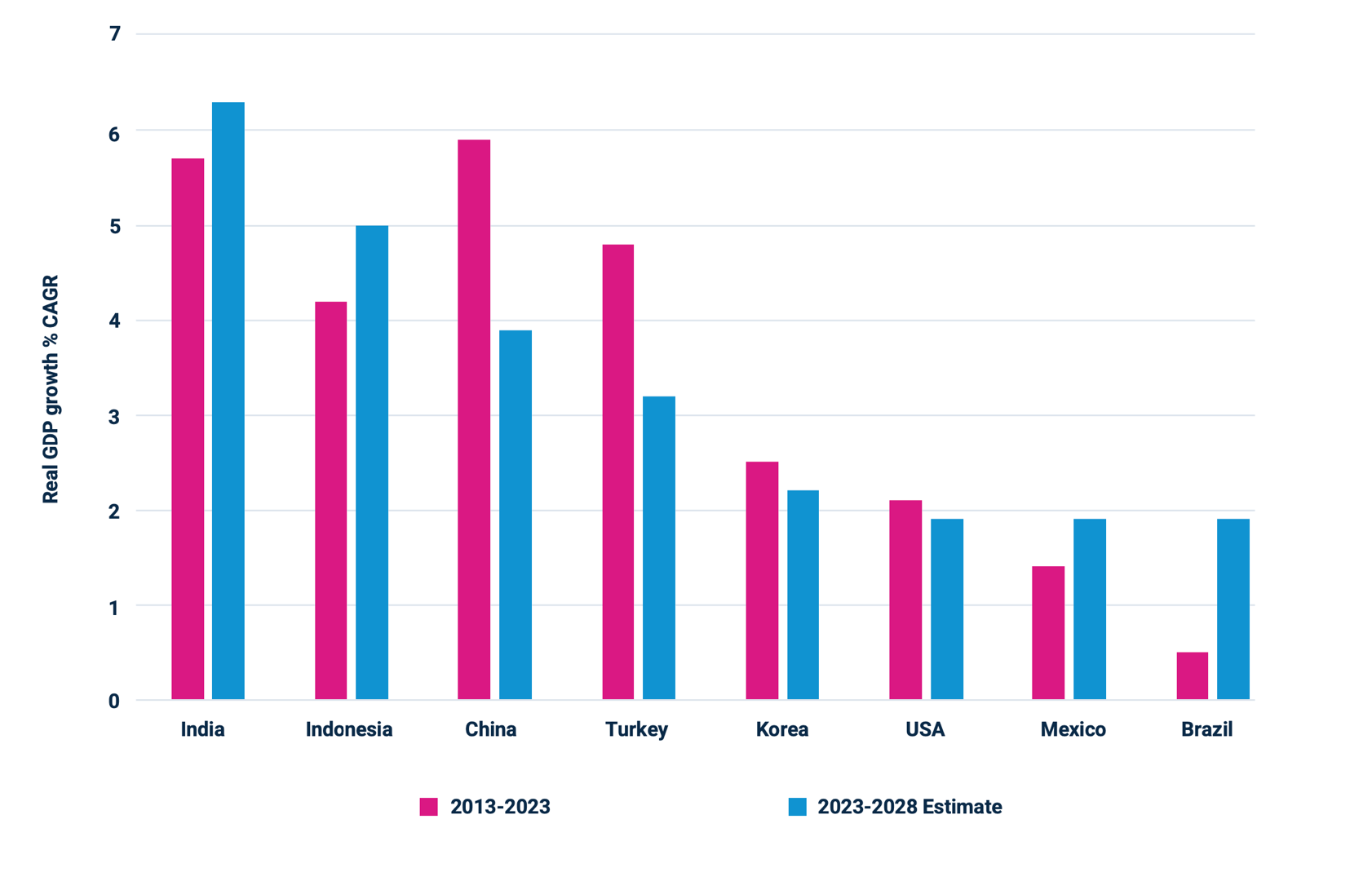
As shown in Figure 2, over the past 10 years (blue bars), the Indian economy has been one of the fastest‑growing among the major economies. Over the next 10 years, we believe India’s growth rate in real GDP terms may be projected to be 6.5‑ 7.5%. This translates into a nominal annual GDP growth rate of up to 11% in dollar terms. As can also be seen, we feel this is expected to support some of the highest corporate earnings growth rates.
Source: IMF, Jefferies, Bloomberg, 2024
Past performance is not necessarily indicative of future results.
Conclusions
We believe India’s recent market weakness is mainly cyclical, while its structural growth story remains intact. As macroeconomic conditions stabilize and sentiment improves, the stage is set for a potential recovery. In our view, India could remain the fastest‑growing major economy over the next decade and is on track to emerge as the third‑largest economy, overtaking Japan and Germany over the next three years.
Our investment approach continues to focus on supportive themes and identifying high‑quality, well‑governed companies that may not always be included in major indices. We aim to deliver sustainable long‑term returns by seeking to avoid companies with weak governance and focusing on those with strong growth potential.
Important Information
This information has been provided by C WorldWide and was published in February 2025 for informational purposes only. It does not constitute or form part of any offer to issue or sell, or any solicitation of any offer to subscribe or to purchase, shares, units or other interests in investments that may be referred to herein and must not be construed as investment or financial product advice. Harbor nor C WorldWide has not considered any reader’s financial situation, objective or needs in providing the relevant information.
Investing entails risks and there can be no assurance that any investment will achieve profits or avoid incurring losses. International investing involves risks, including risks related to foreign currency, limited liquidity, less government regulation and the possibility of substantial volatility due to adverse political, economic or other developments. These risks often are heightened for investments in emerging/developing markets or in concentrations of single countries.
Past performance is not necessarily a guide to future performance or returns. C WorldWide has taken all reasonable care to ensure that the information contained in this material is accurate at the time of its distribution, no representation or warranty, express or implied, is made as to the accuracy, reliability or completeness of such information.
The MSCI India Index is designed to measure the performance of the large and mid cap segments of the Indian market. The index covers approximately 85% of the Indian equity universe. The MSCI Emerging Markets Index captures large and mid cap representation across Emerging Markets countries. The index covers approximately 85% of the free float‑adjusted market capitalization in each country. Indices listed are unmanaged and do not reflect fees and expenses and are not available for direct investment.
The views expressed herein may not be reflective of current opinions, are subject to change without prior notice. This material does not constitute investment advice and should not be viewed as a current or past recommendation or a solicitation of an offer to buy or sell any securities or to adopt any investment strategy.
This material may contain forward‑looking information that is not purely historical in nature. Such information may include, among other things, projections and forecasts. There is no guarantee that any of these views will come to pass.
A basis point is one hundredth of 1 percentage point.
Copyright © (2025) Harbor Capital Advisors, Inc. All Rights Reserved.
4494182