


.webp)
Please note: This content was initially published in October 2025, and Harbor and Westfield believe it is still very appropriate.
A Note from Harbor
Westfield Capital Management, longtime strategic partner with Harbor Capital, believes that the area of health care currently offers some of the most attractive secular growth opportunities in U.S. equities, particularly given low absolute and relative valuations. Nowhere, they believe, is this more evident than in the Biotech sector, which Westfield views as the most compelling subsector given its innovation, valuation reset, and renewed growth outlook following a multi‑year bear market.
Introduction: Health Care’s Underperformance Sets the Stage
According to Westfield’s research and discussions with clients, over the past year plus some, generalist investors used Health Care as a funding source to chase the AI (Artificial Intelligence) ‑driven technology boom and more cyclical sectors, leaving the group as the worst‑performing sector year‑to‑date. In Westfield’s view, the pendulum has swung too far, and they are now finding opportunities to own some of the most innovative growth companies at appealing entry points.
Westfield sees Health Care as a prime candidate for rotation, offering one of the largest potential recovery opportunities across equities. While Westfield does not expect a sharp V‑bottom recovery, they anticipate a steady grind higher as investors climb the “walls of worry,” or continue to have concerns around recovery. Should leadership in other market winners fade, Westfield believes Health Care could surprise to the upside. Importantly, even in a protracted recovery, they continue to find compelling opportunities across subsectors, a backdrop that they think favors active management.
Health Care Stocks are Trading at Compelling Valuations
Health Care vs. S&P 500 – PE NTM
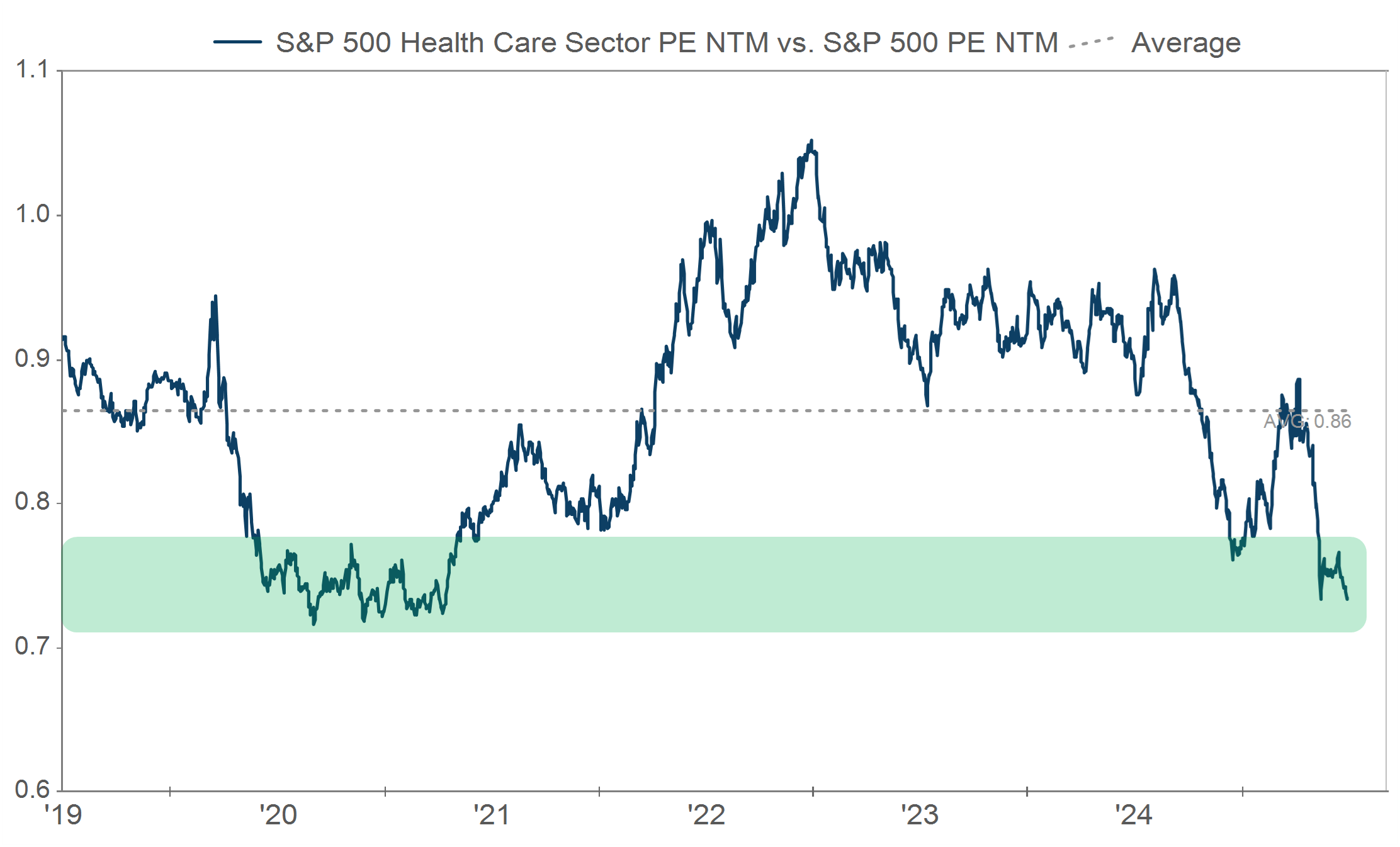
Source: Westfield, FactSet, based on data for trailing 5-years ending 6/30/2025. For illustrative purposes. Performance data shown represents past performance and is no guarantee of future results.
Health Care May Be Positioned for Recovery
Throughout 2025, Westfield saw signs of life. On the back of a few M&A (Merger & Acquisition) deals and outsized clinical readouts, it initially appeared that Biotech was beginning to emerge from a four‑year bear market. Yet enthusiasm quickly faded as macro pressures and micro concerns resurfaced. A “higher‑for‑longer” rates mentality weighed on sentiment, and a perception of disruption at the FDA exacerbated uncertainty. Westfield believes these issues do not materially change asset intrinsic value, but they contributed to renewed outflows in a fragile liquidity environment.
Concerns escalated in the spring of 2025 around tariff and “Most Favored Nation” (MFN) rhetoric from Washington. MFN has long been a fear for investors, but in Westfield’s view, it remains highly complex to implement and unlikely to materially alter near‑term valuations.
Across subsectors, performance diverged:
- Biotech: Fundamentals appear to be improving, with well-capitalized companies advancing to late-stage trials, yet valuations remain depressed.
- Pharma: Tariff/MFN fears and concerns of a price war in obesity drugs dampened sentiment.
- Services: Sentiment weakened around managed care, particularly following utilization spikes and pricing missteps, while distributors provided relative stability.
- Tools & Diagnostics: NIH funding cuts and a slow biopharma funding cycle constrained recovery.
- Medtech: The group held up better but faced tariff concerns tied to non-U.S. supply chains.
Innovation as a Catalyst
Westfield believes innovation is the lifeblood of Health Care, and the sector is at an inflection point. Winners, in our opinion, may be those delivering measurable improvements in patient outcomes, provider efficiency, and system‑wide cost savings.
One of the most exciting areas, in our view, is AI in drug development. The benefits appear to be multi‑dimensional:
- Improved Probability of Success: AI can help design best-in-class and first-in-class molecules.
- Time Savings: Early studies suggest up to a 30% reduction in development timelines.
- Cost Savings: Preclinical cost reductions of 60–65% could be possible; even a conservative 10% savings on ~$260B in R&D may lift sector ROE by ~50bps.
- Increased Approvals: A 2.5% improvement in preclinical success could mean 30+ new drug approvals over 10 years (Morgan Stanley Research, 9/4/25).
AI’s Impact on Drug Development
Reported Benefits to Date from Leveraging AI Have Shown Reduced Cost and Time Associated with the Early Stages of Drug Development by 60%+ vs. Industry Standards
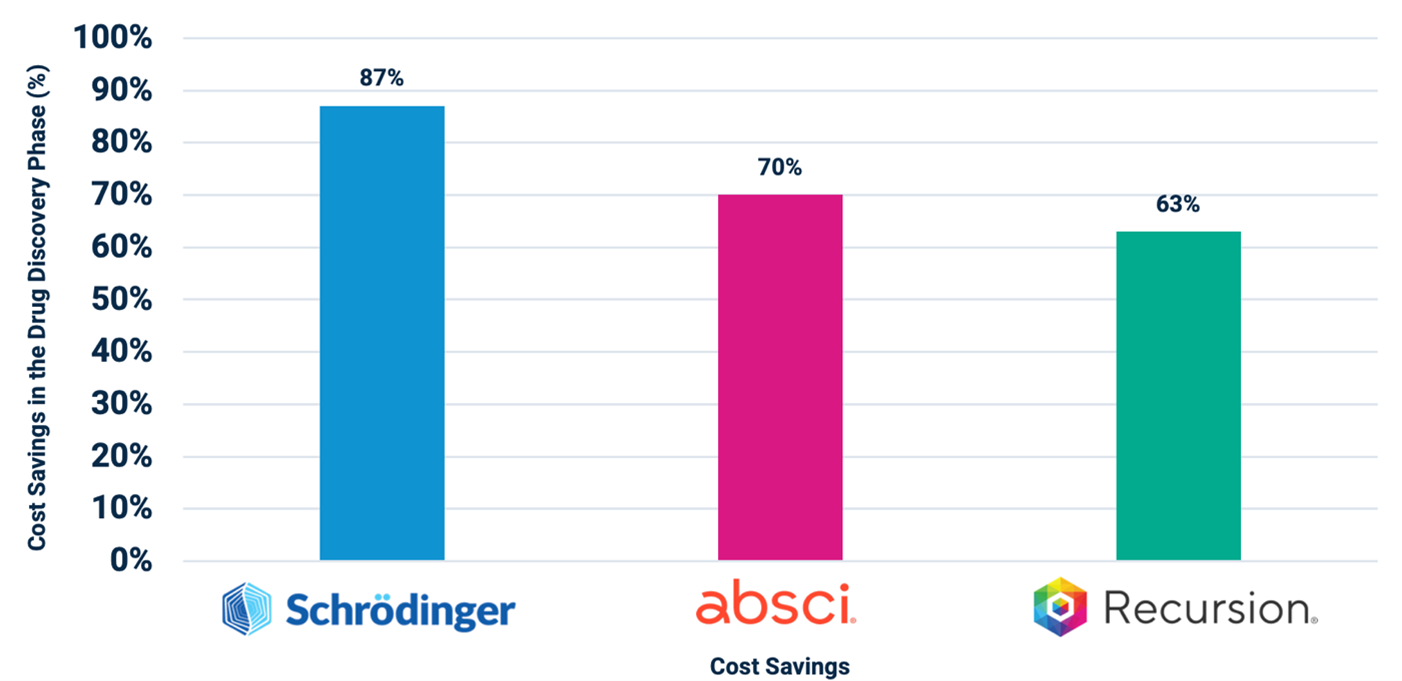
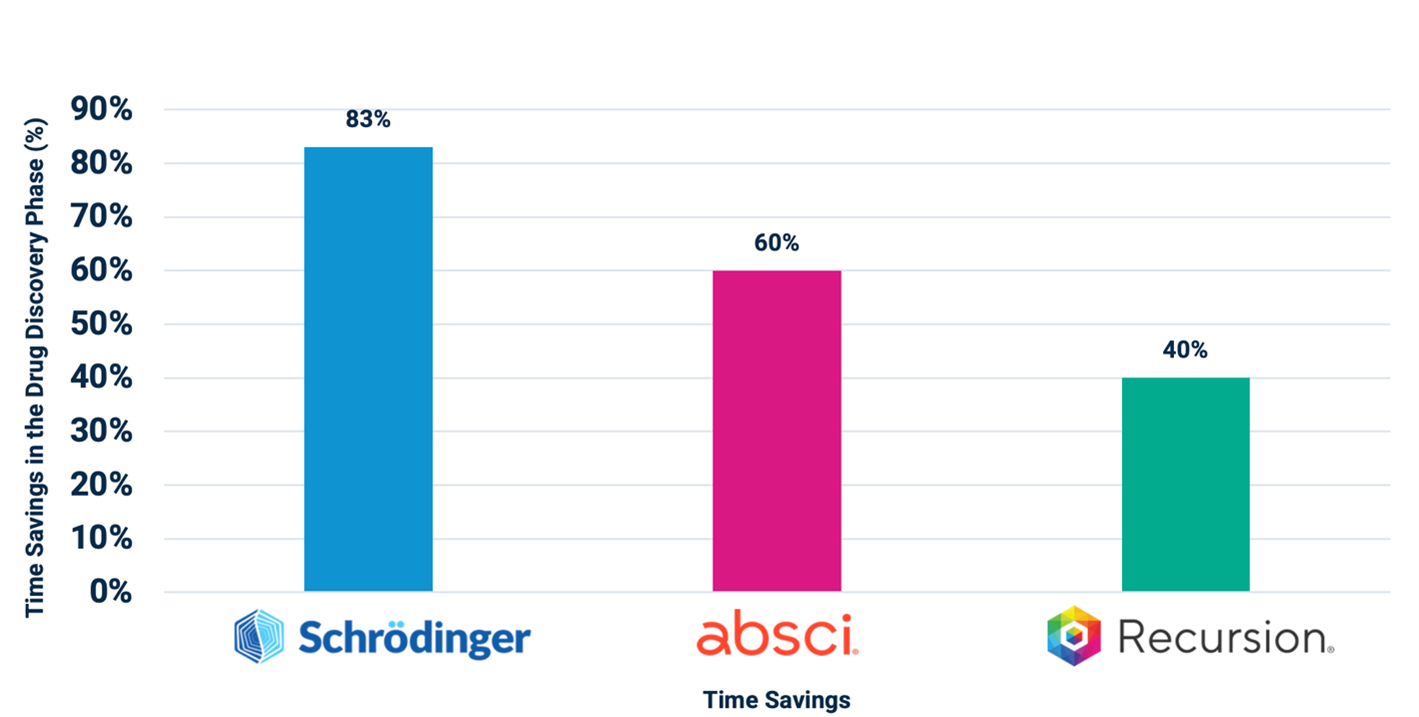
Source: Westfield, Morgan Stanley Research, as of 9/4/2025.
Demographics Create Structural Tailwinds
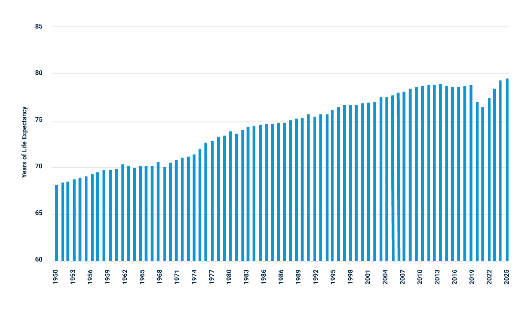
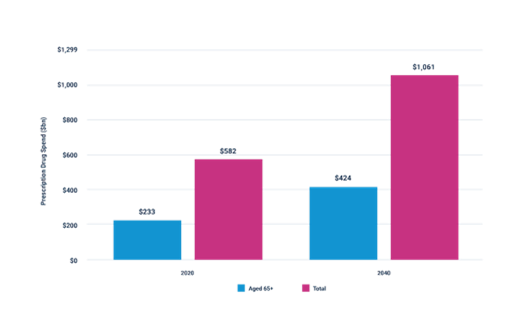
Westfield believes demographics represent one of the most powerful secular drivers of Health Care. The U.S. population is aging, living longer, and consuming more health care. Costs are projected to reach $8.6 trillion by 2033 (Westfield, September 2025), intensifying pressure on an already strained system.
This trend, in Westfield’s view, makes innovation not optional but necessary. Solutions must seek to improve outcomes while lowering costs across the ecosystem. When evaluating opportunities, Westfield focus on two key questions:
- What unmet need is being addressed?
- How much of an advancement over the current standard of care does the solution provide?
If those answers are compelling, Westfield believes the downstream benefits — for patients, providers, payors, and investors — appear to often be significant.
Rising U.S. Health Care Costs May Require Innovative Solutions
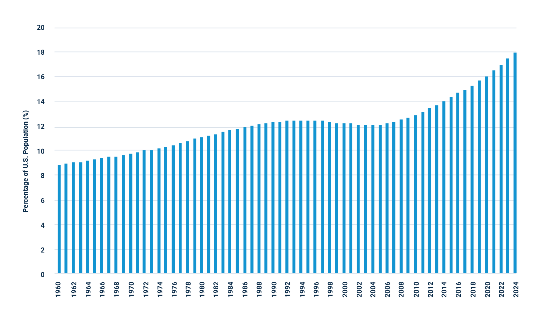
Aging Population
Percentage of U.S. Population that is 65+ (1920 ‑ 2020)

Increasing Lifespan
U.S. Life Expectancy (1950 – 2025)
Increasing Drug Spending
Est. Prescription Drug Spend for Americans 65+ (2020 & 2040)
Source: Westfield, Morgan Stanley Research, as of 9/4/2025.
Biotech and Medtech Lead the Way
Westfield believes Biotech could be the most attractive subsector within Health Care, supported by innovation, strategic relevance, and valuations that remain at multi‑decade lows. Medtech also may provide complementary long‑term growth opportunities, though on a smaller scale. In contrast, concerns around policy changes, site‑of‑care costs, and Medicaid redeterminations have Westfield more cautious on Health Care Providers and hospitals.
Biotech: Positioned for Leadership
Westfield views Biotech as the most attractive area of Health Care over the next 5–10 years. It combines innovation, growth, attractive valuations, and tariff insulation. Most importantly, Westfield believes strategic buyers may increasingly turn to Biotech for acquisitions as large Pharma faces acute patent expirations and a less supportive U.S. policy environment, creating, what they view, as one of the most favorable M&A backdrops in years.
Innovation & Clinical Progress
- During the biotech drawdown that began in early 2021, many companies were sufficiently capitalized to potentially make tremendous progress in the clinic.
- High-quality assets moved from Phase 1 through Phase 3, successfully navigated the regulatory landscape, and have resulted in new product launches that appear to be exceeding investor expectations.
- Westfield believes the space is much more mature today than it was four years ago, and many valuations (although improving) are not yet reflecting the transformation of these companies.
- In their view, newly commercial names that are approaching or already generating profits remain significantly undervalued, with Street estimates underappreciating the long-term trajectory of their launches.
Insulation: Tariff‑Resistant & Strategic Priority
- Drugs and biologics are largely exempt from tariffs, and U.S.-based IP and manufacturing have the potential to provide structural advantages.
- Biotech is increasingly seen as a national security asset, which has historically resulted in strong policy support for onshoring and R&D investment.
Opportunities: M&A, Interest Rates & Valuations
- Global M&A Magnet: Large Pharma’s revenue needs may be becoming more acute, and with a valuation reset in high-quality assets, Westfield believes M&A activity could accelerate. The perception of a more lenient FTC has further supported deal flow.
- Rate-Sensitive Rebound: Westfield also believes biotech may benefit disproportionately from lower rates given its financing sensitivity, making it a likely beneficiary of any rotation into high-duration innovation.
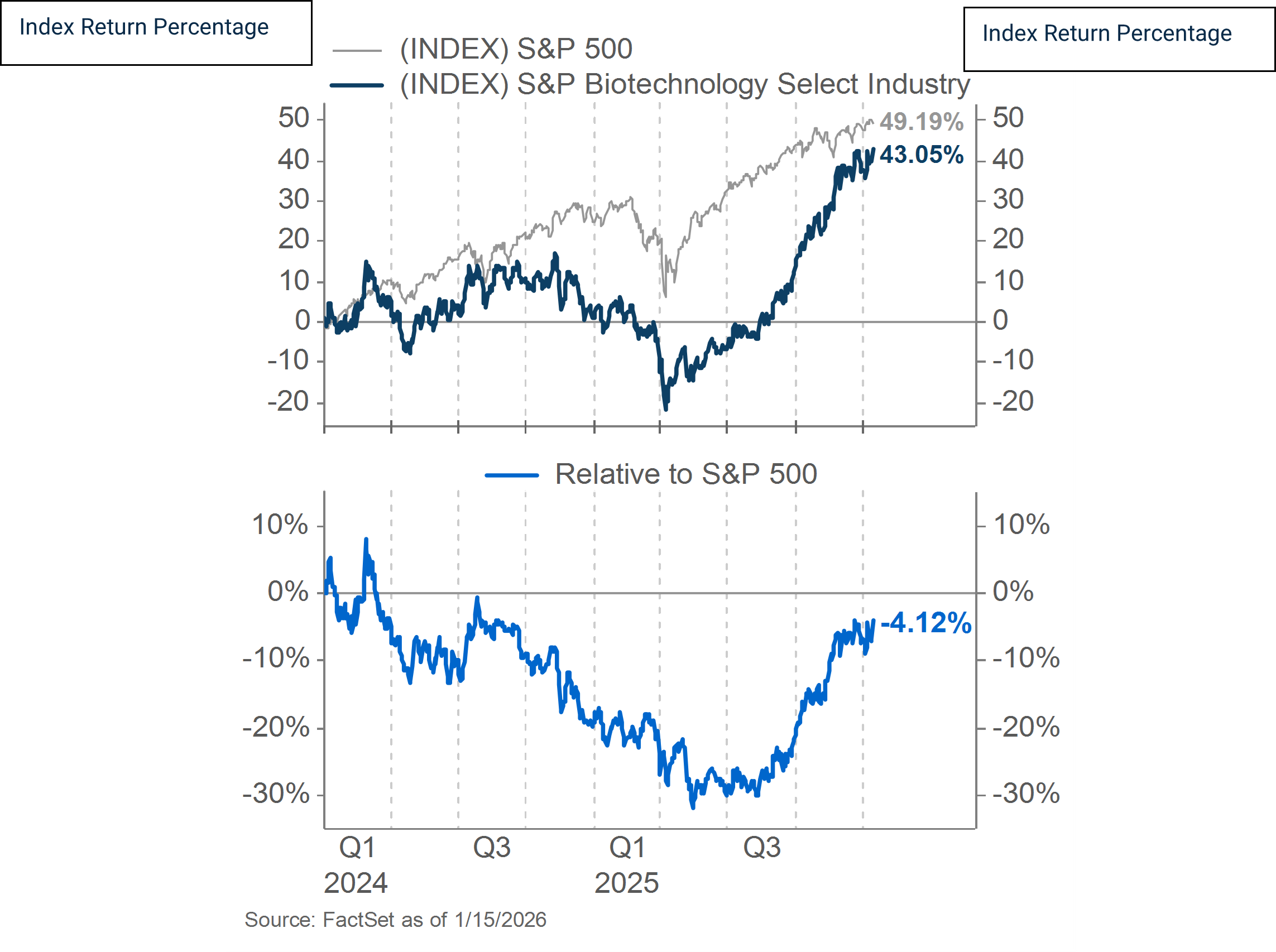
- Alpha in Mispriced Assets: Biotech has lagged badly in recent years, leaving valuations at multi-decade lows. Westfield sees meaningful catch-up potential as investor flows rotate back into under-owned segments of the sector.
Medtech
As it relates to Medtech, Westfield views this subsector as being comprised of high‑growth companies with large total addressable markets.
- Westfield favors high-margin, high-growth leaders targeting large, underpenetrated markets.
- Key focus areas include minimally invasive surgery, GLP-1, and obesity/diabetes therapies.
- Companies in diabetes care, patient monitoring, and connected devices highlight the innovation Westfield believes could expand both access and profitability in the years ahead. For example, AI-driven platforms in patient monitoring are beginning to show how technology can materially expand margins while improving outcomes.
Biotech Weakness May Set the Stage for Catch‑Up
Biotech vs. S&P 500
Performance data shown represents past performance and is no guarantee of future results.
Policy & Regulation: Headline Risk vs. Reality
Policy risk appears to be a constant headline, but Westfield believes reality is more constructive than rhetoric suggests.
The FDA, in their view, has been efficient and transparent, with approvals largely on time and advisory panel counts at multi‑decade lows. In some cases, development pathways are even being streamlined — such as easing animal testing requirements.
According to Westfield, drug pricing remains a populist talking point, but implementation is complex. MFN rhetoric, while headline‑grabbing, remains more bark than bite. They also see potential for more upward pressure on ex‑U.S. pricing than downward pressure domestically.
Additional regulatory debates, such as limits on direct‑to‑consumer (DTC) advertising, may be worth watching. Westfield believes exposure is concentrated in markets with high competition and reliance on advertising, such as vertically integrated telehealth providers. By contrast, in their view, innovative assets in rare disease and specialty care appear to be less exposed.
Conclusion: From Laggard to Leader
Fear and rhetoric have historically weighed heavily on Health Care equities, but Westfield believes this has created a compelling entry point. With valuations at multi‑year lows, pipelines maturing, and secular drivers intact — demographics, innovation, and M&A — the sector appears, in Westfield’s view, positioned for a multi‑year recovery. They view Biotech as the most attractive subsector and expect it to likely lead this transition, supported by breakthrough innovation, tariff insulation, and robust strategic M&A as large Pharma addresses looming patent cliffs. They believe Medtech also offers compelling opportunities, particularly in obesity, diabetes, and patient monitoring. Taken together, Westfield believe Health Care could be poised to move from sector laggard to long‑term leader, offering investors a distinct combination of growth, defensiveness, and opportunity.
Important Information
This information has been provided by Westfield Capital Management and was published in October 2025 for informational purposes only. The opinions expressed are as of October 2025 and are subject to change. The opinions expressed by the speakers do not necessarily represent the views of Harbor Capital Advisors, Inc. The information and opinions contained in this material are derived from proprietary and non‑proprietary sources deemed by Harbor Capital Advisors, Inc. to be reliable and are not necessarily all‑inclusive and are not guaranteed as to accuracy. Harbor nor Westfield Capital Management has not considered any reader’s financial situation, objective or needs in providing the relevant information.
The views expressed are those of Westfield Capital Management Company, L.P., as of the date referenced and are subject to change at any time based on market or other conditions. These views are not intended to be and should not be relied upon as investment advice and are not intended to be a forecast of future events or a guarantee of future results. The information provided in this material is not intended to be and should not be considered to be a recommendation or suggestion to engage in or refrain from a particular course of action or to make or hold a particular investment or pursue a particular investment strategy, including whether or not to buy, sell, or hold any of the securities mentioned. It should not be assumed that investments in such securities have been or will be profitable.
Some of the content has been supplied by companies that are not affiliated with Westfield (“third‑party data”). Any third‑party data contained herein has been obtained from sources believed to be reliable, but the accuracy of the information cannot be guaranteed.
Performance data shown represents past performance and is not indicative of future results.
Investing entails risks, and there can be no assurance that any investment will achieve profits or avoid incurring losses.
Stock markets are volatile and equity values can decline significantly in response to adverse issuer, political, regulatory, market and economic conditions. The health care industry may be affected by any number of factors, including, but not limited to, lapsing patent protection, industry innovation, extensive government regulation, restrictions on government reimbursement for medical expenses, research and development costs, limited product lines, product liability litigation, an increased emphasis on outpatient services, and competitive forces.
The Standard & Poor's 500 Index is an unmanaged index generally representative of the U.S. market for large capitalization equities. These unmanaged indices do not reflect fees and expenses and are not available for direct investment.
The Standard & Poor's 500 Health Care Index is an unmanaged index that comprises those companies included in the S&P 500 that are classified as members of the GICS® health care sector.
The S&P Biotechnology Select Industry® represents the biotechnology segment of the S&P Total Market Index (“S&P TMI”). The S&P TMI is designed to track the broad U.S. equity market and is an unmanaged index. These unmanaged indices do not reflect fees and expenses and are not available for direct investment.
The views expressed herein may not be reflective of current opinions, are subject to change without prior notice, and should not be considered investment advice or a recommendation to purchase a particular security.
This material may contain forward‑looking information that is not purely historical in nature. Such information may include, among other things, projections and forecasts. There is no guarantee that any of these views will come to pass.
Copyright © 2025 Harbor Capital Advisors, Inc. All Rights Reserved.