


A Note from Harbor
C WorldWide has been in a strategic partnership with Harbor Capital for over three years. C WorldWide has published thought leadership on several relevant topics, including this piece, which focuses on four factors of change. Harbor is pleased to share C WorldWide’s thinking for your portfolio construction consideration.
Four Factors of Change
Equity markets have been in a phase where the magnitude of earnings growth has been rewarded over the sustainability of earnings growth. A phase where longer‑term company fundamentals have been less rewarded, resulting in valuation multiple compression.
As of December 2025, C WorldWide believes the latest period for active managers has been challenging. In 2024 and 2025, historic headwinds prevailed with the U.S. market driven by higher‑growth companies and strong value‑driven performance from the balance sheet heavy western banks.
However, C WorldWide sees signs of change emerging, the first silver linings in a while. Things could change quite dramatically within a short period of time, and C WorldWide has identified four pivotal changes that point to an emerging change in market trends with investors refocusing more on fundamental and structural growth. These four changes appear to be a revival of quality stocks, broadening out of the Artificial Intelligence (AI) theme, the rise of China and India and the peak of U.S. equity market capitalization dominance.
1. Revival of Quality Stocks
Quality stocks are defined as companies with higher operating margins, higher returns on capital, lower debt and a long‑term sustainable business model.
In the fourth quarter of 2025, C WorldWide witnessed the first signs of a revival in quality stocks. For example, the stock price of a luxury goods company rose more than 20% during the quarter and about 40% from early August to end of 2025 with very little positive news flow.
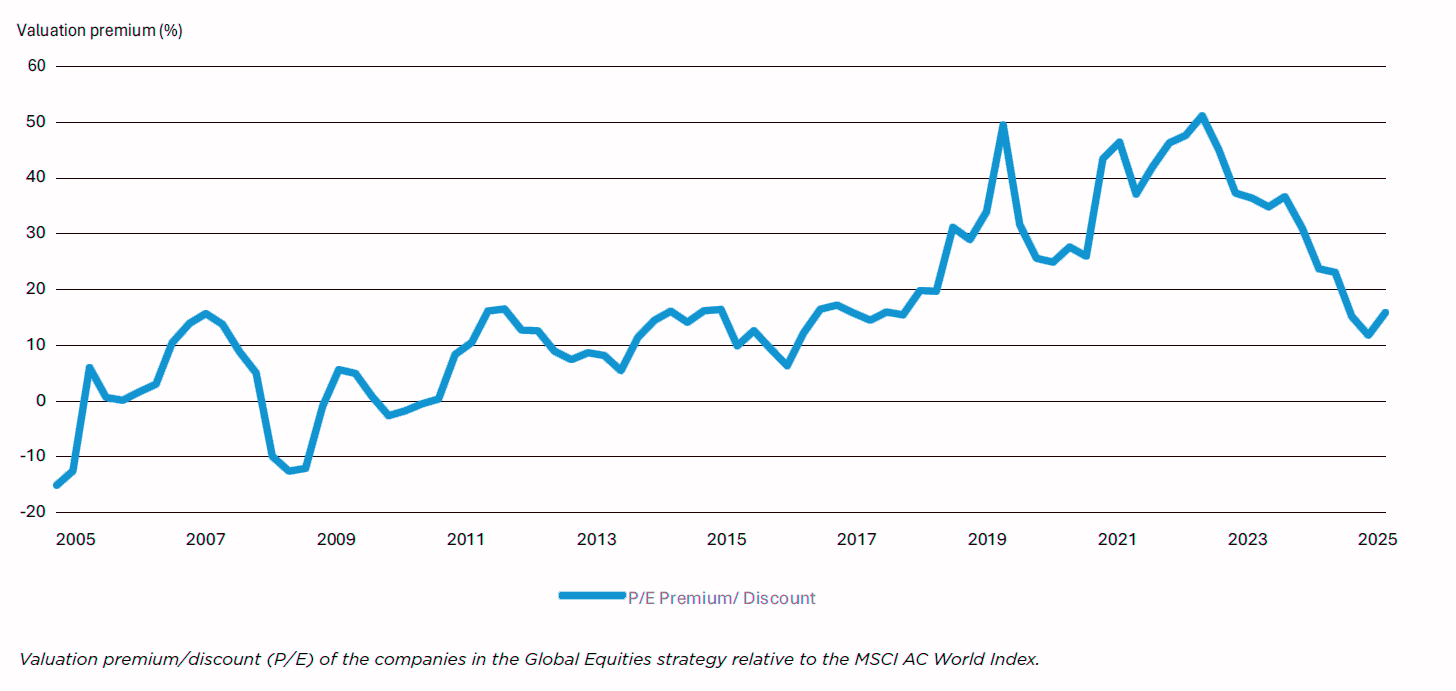
As shown in figure 1 below, these stocks are now trading at a reasonable valuation relative to the market compared to the past 20 years after a marked derating over the past three years. C WorldWide believes the scene is set for a potentially more sustainable comeback to fundamental quality as an anchor in global stock portfolios. C WorldWide continues to prefer companies with sustainable earnings growth rather than earnings growth characteristics of higher magnitude. C WorldWide favors allocating active capital to investments in companies that may be relevant for the coming decades, supported by thematic tailwinds.
Figure 1: Quality Companies at a Reasonable Multiple
Past performance is not indicative of future results.
2. Broadening of the AI Boom
The vulnerabilities in the AI theme have recently been clearly exposed. The world’s biggest company, Nvidia, has been at the top of the world since the launch of Chat GPT three years ago, but a narrow customer base with five clients estimated to make up more than 50% of their business is a fundamental risk. Especially as they are all trying to develop their own competing chipsets, and it has become clear that Alphabet (Google), in partnership with Broadcom, has a competitive AI solution based on an alternative TPU custom‑design chip. Alphabet has about 3 bn. clients across their products, including Search, Gemini AI, YouTube and Cloud. C WorldWide believes their vertically integrated model is a more robust business model.
C WorldWide believes in a broadening of the AI theme in 2026, where more companies could benefit. C WorldWide sees many great companies in Asia and Europe that stand to benefit as the economy moves into a new phase. The current phase of excitement could be replaced by a phase of realism. C WorldWide is seeking to become more cognizant of the limitations of AI and the physical dimension of AI and the digital world, where the roll‑out of data centers covering an area the size of Manhattan poses clear execution risks. Building complex energy infrastructures relying on a global supply chain under pressure is also a concern. C WorldWide has also reached a stage where the datacenter buildout is dependent on buoyant capital markets and where financial creativity is swelling to secure funding. The change of leadership at the Fed is a key development and thus a risk factor for the funding aspect of AI.
3. The Rise of China and India
While the more transactional geo‑political approach from the U.S. has stirred uncertainty, the tectonic plates of geopolitics may change with the age‑old forces of demographics and technology. India and China are a third of the world population with big domestic economies and on paths where they may become future superpowers and the biggest economies in the world. Technological skills are prioritized in their vast educational systems. C WorldWide is impressed by both countries’ rapid ascent up the value chain that they have witnessed firsthand during recent travels to these countries, especially in China.
China is positioning itself as a source of stability and power in communication and in action. In a rule‑based, borderless’ globalized world, you could safely depend on global supply chains, intellectual property rights and security guarantees. This is no longer the case. It appears to be about power in a multipolar world. Here, countries need their own defense, own manufacturing capabilities and ideally own and have access to processing facilities for energy and the critical rare earth minerals. In a sense, this is the revenge of the physical world.
The physical world is the foundation of the growing digital world, and according to C WorldWide, China has a significant lead when it comes to physical manufacturing capabilities, built over decades and very hard to catch up with.
The Chinese Language Learning Models (LLM’s) appear to be close to par with the U.S. in tests, with only 1/10 of the capex spending needed. Chinese universities are leading by a wide margin when it comes to AI and machine learning patents. C WorldWide recently met with SSE, a UK electricity utility that stressed that the opportunities to combine renewables and batteries may not happen without China.
Visit China, and you could experience the undervaluation of the Yuan. China’s monthly trade surplus is appx. 100 bn USD – an explosion from around 20bn before Covid. The Yuan and the Yen are undervalued against the USD, and with the present appetite for political intervention, something significant could happen. Perhaps a 2020s version of the old Plaza accord? Post the Plaza accord reached in 1985, the dollar fell 33% over the following 18 months.
Despite these positive structural trends, China (3%) and India (2%) only have single‑digit weighting in the global stock market benchmark (MSCI ACWI). There are recent silver linings in China when it comes to the importance of capital markets and technological progress. Jack Ma is back. President Xi needs technological leadership to “Make China great again.”
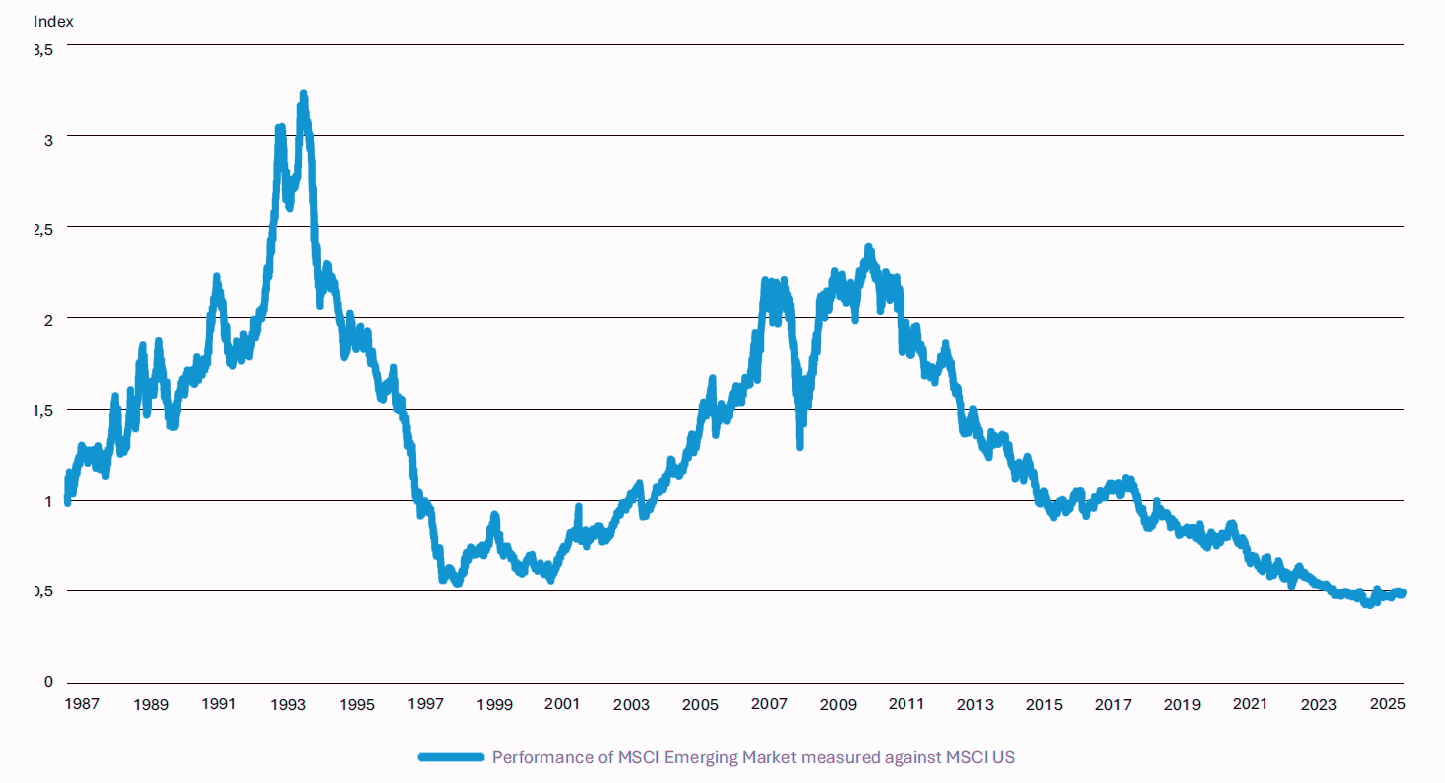
The underperformance of Emerging Markets has reached a historically low (figure 2 shows the performance since 1987). In C WorldWide’s opinion, it is long‑term unreasonable that China (and Emerging markets in general) play such a marginal role in global markets, and C WorldWide sees a higher future weighting in global equity benchmarks for China, India and Emerging markets in general. It could be key to benchmark towards the future rather than the past.
Figure 2: Emerging Markets at a 40‑year Low
C WorldWide Asset Management and MSCI, January 2026. Past performance is not indicative of future results.
4. Peak of U.S. Market Capitalization Dominance
Bo Knudsen, CEO and Portfolio Manager at C WorldWide, started his investment career in September 1989. The fall of the Berlin Wall on November 9, later that year, formed geopolitics and markets for more than 30 years. But for investors, there was a more immediate consideration in the 1990s: what to do with Japan?
After the Plaza Accord in September 1985, where the G5 countries agreed to address the U.S. current account deficit with Japan and Germany via currency interventions, the Japanese market doubled as a share of the global stock market index, as seen in figure 3.
The leading central banks sold U.S. dollars against yen and deutschmarks, and the dollar lost about 40% in value against the yen over the following three years.
Figure 3: The Rise and Fall of Regions
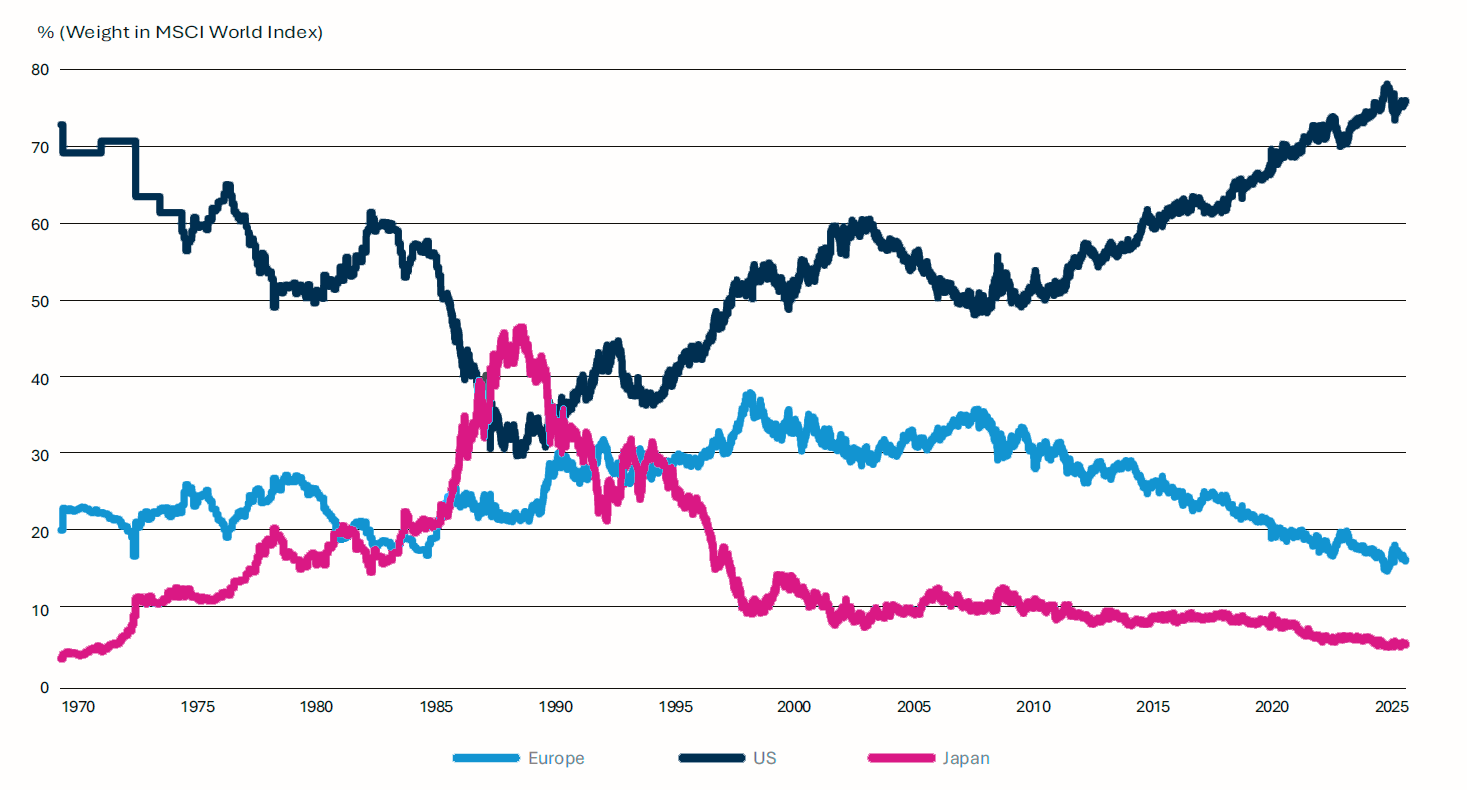
Percentage share of the global stock market
C WorldWide Asset Management and MSCI, 31 December 2025. Past performance is not indicative of future results.
Japan had built a formidable export machine after the Second World War, which was severely hit by the devaluation of the Yen. The policy response was to stimulate the economy with easy credit policies and low interest rates. However, this led to a speculative boom in real estate, land, and stock prices.
Measuring investment performance against a market benchmark started back then, and the big discussion at the end of the 80s and the 90s was: What investment weight should be allocated to Japanese equities?
Post the 90s over the following 35 years, the Japanese stock market share of global equity markets fell from appx. 40% to the present level of 5.5%. Although the trend is clear in hindsight, it was not always obvious during the transition.
Fast forward to today, where indexation has become the market, with 60% to 80% of flows on “autopilot”. When money is allocated to an index strategy, the autopilot dictates buying the index stocks at the weight of the index.
In the clear rear‑view mirror, markets were irrational by pushing Japanese equities to 40% of the world’s stock markets. Human feelings and short‑term greed and fear may rationalize irrationality for long periods of time.
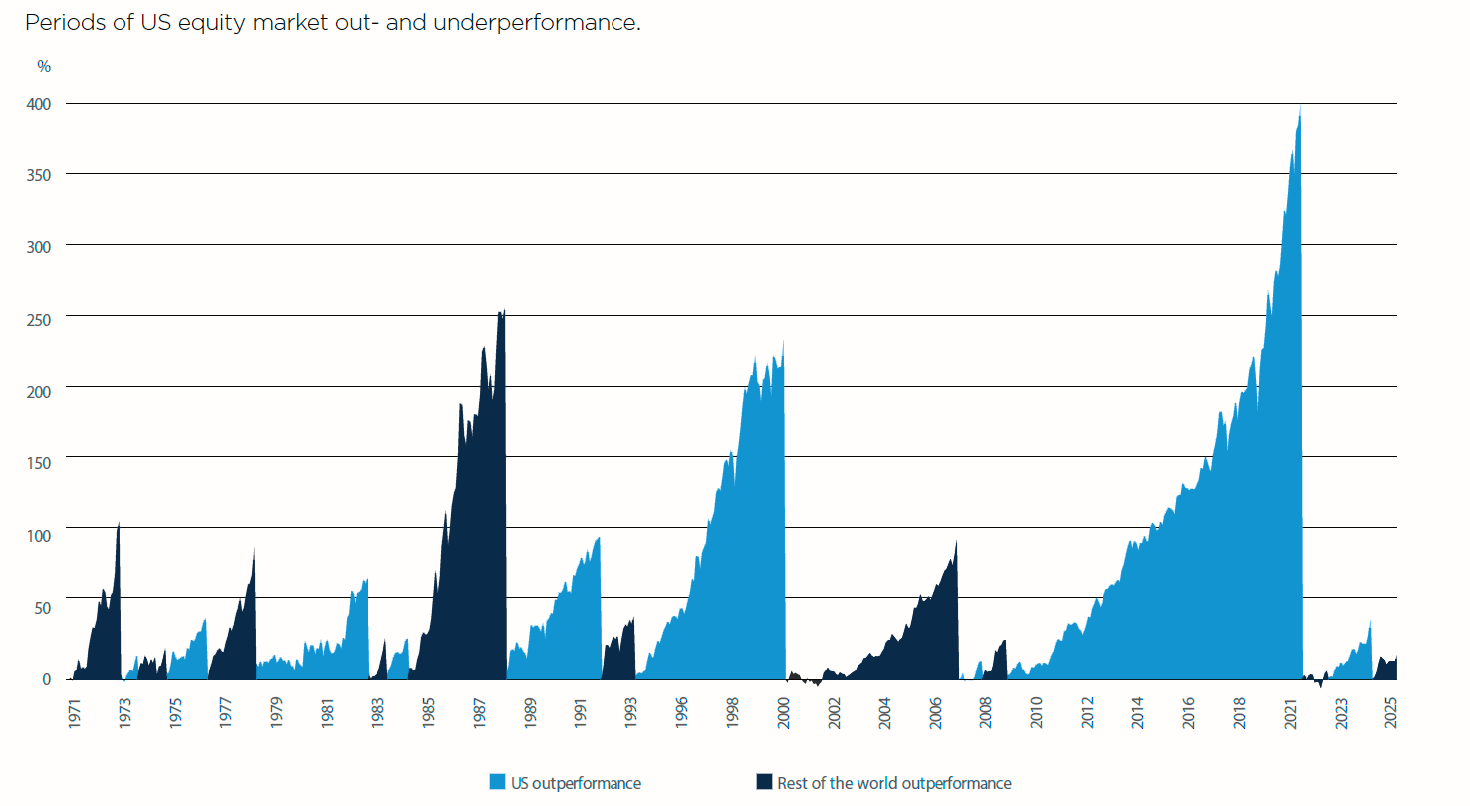
According to C WorldWide, the outperformance of the U.S. stock market over the past 15 years has been exceptional, as seen from figure 4, which shows periods of U.S. equity market outperformance and underperformance vis‑à‑vis the rest of the world. Although the significant value creation in the U.S. has been supported by compelling earnings growth, the critical allocation today is whether it is as extreme to allocate approx. 65% to U.S. equities (current weight as of December 31, 2025, in MSCI AC World Index), as allocating 40% to Japanese equities in 1989?
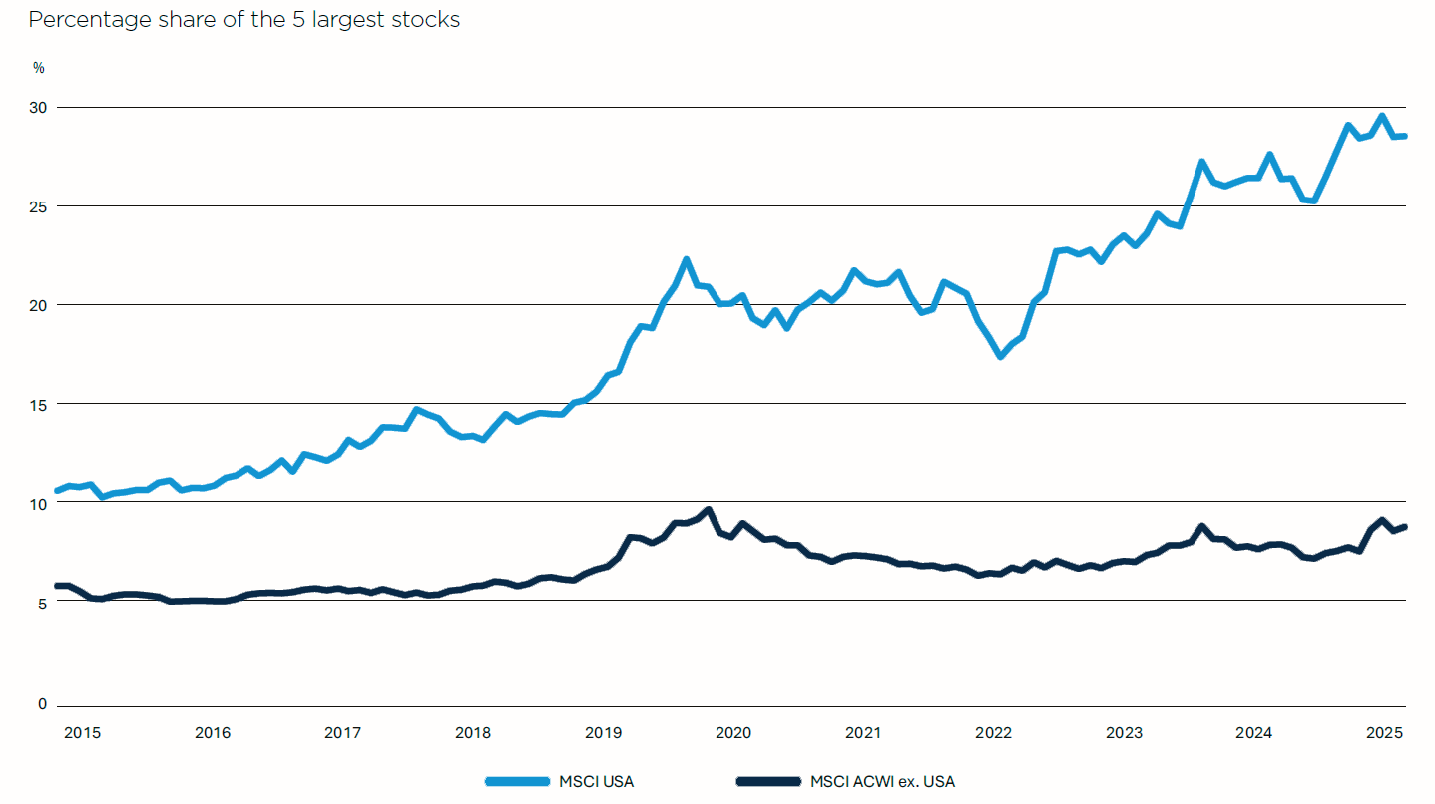
A significant risk factor specifically for the U.S. stock market is the historically narrow leadership where the five largest stocks in the MSCI USA now account for approx. 30% of the index, as shown in figure 5. And all five of these stocks are dependent upon the AI investment boom. As mentioned earlier, C WorldWide is concerned that investors may be disappointed given the high expectations for generative AI over the next 12‑18 months.
Fast forward to today, where indexation has become the market, with 60% to 80% of flows on “autopilot”. When money is allocated to an index strategy, the autopilot dictates buying the index stocks at the weight of the index.
In the clear rear‑view mirror, markets were irrational by pushing Japanese equities to 40% of the world’s stock markets. Human feelings and short‑term greed and fear may rationalize irrationality for long periods of time.
According to C WorldWide, the outperformance of the U.S. stock market over the past 15 years has been exceptional, as seen from figure 4, which shows periods of U.S. equity market outperformance and underperformance vis‑à‑vis the rest of the world. Although the significant value creation in the U.S. has been supported by compelling earnings growth, the critical allocation today is whether it is as extreme to allocate approx. 65% to U.S. equities (current weight as of December 31, 2025, in MSCI AC World Index), as allocating 40% to Japanese equities in 1989?
A significant risk factor specifically for the U.S. stock market is the historically narrow leadership where the five largest stocks in the MSCI USA now account for approx. 30% of the index, as shown in figure 5. And all five of these stocks are dependent upon the AI investment boom. As mentioned earlier, C WorldWide is concerned that investors may be disappointed given the high expectations for generative AI over the next 12‑18 months.
Figure 4: The U.S. Market has Dominated Since 2010
C WorldWide Asset Management and MSCI, 31 December 2025. Past performance is not indicative of future results.
Market Trends for 2026 — The Year of Realization
C WorldWide is confident that 2026 is likely going to be dominated by these four factors of change. As unconstrained active investment managers, C WorldWide advocates being positioned for the future, not by looking in the rear mirror of the global benchmark, but through the lens of fundamental analysis and understanding of the drivers of change.
2026 could be a year of realization. The realization that C WorldWide believes fundamental earnings and fundamental qualities matter. The good news is that you could buy quality companies at reasonable prices. High quality companies that may help to build the necessary physical infrastructure are often based in Europe and Asia, and C WorldWide sees this as a source of potential returns and alpha in the coming quarters and years.
At the same time, C WorldWide sees a broadening of the market leadership, where the narrow leadership may be replaced by a more broad‑based market recovery.
C WorldWide expects that the leadership of the U.S. equity market over the past 15 years could gradually erode, while equity markets in China and India may, over time, constitute a larger share of the global market. In the end, there are no shortcuts to investment returns – only long‑term grinding.
Figure 5: A Narrower U.S. Equity Market than Ever Before
MSCI and FactSet, 31 December 2025. Past performance is not indicative of future results.
Important Information
This information has been provided by C WorldWide and was published in January 2026 for informational purposes only. The opinions expressed are as of January 2026 and are subject to change. The opinions expressed by the speakers do not necessarily represent the views of Harbor Capital Advisors, Inc. The information and opinions contained in this material are derived from proprietary and non‑proprietary sources deemed by Harbor Capital Advisors, Inc. to be reliable and are not necessarily all‑inclusive and are not guaranteed as to accuracy. Harbor nor C WorldWide has not considered any reader’s financial situation, objective or needs in providing the relevant information.
Performance data shown represents past performance and is not indicative of future results.
Investing entails risks, and there can be no assurance that any investment will achieve profits or avoid incurring losses.
International investing involves risks, including risks related to foreign currency, limited liquidity, less government regulation, and the possibility of substantial volatility due to adverse political, economic, or other developments. These risks are often heightened for investments in emerging/developing markets or in concentrations of single countries. Stock markets are volatile, and equity values can decline significantly in response to adverse issuer, political, regulatory, market, and economic conditions.
The views expressed herein may not be reflective of current opinions, are subject to change without prior notice, and should not be considered investment advice or a recommendation to purchase a particular security.
MSCI AC World Index (ACWI) captures large and mid‑cap representation across Developed Markets (DM) and Emerging Markets (EM) countries. The MSCI USA Index is designed to measure the performance of the large and mid‑cap segments of the U.S. market. These indices are unmanaged and do not reflect fees and expenses and are not available for direct investment.
Alpha is a measure of risk (beta)‑adjusted return.
This material may contain forward‑looking information that is not purely historical in nature. Such information may include, among other things, projections and forecasts. There is no guarantee that any of these views will come to pass.
Copyright © 2026 Harbor Capital Advisors, Inc. All Rights Reserved.