


Introduction
C WorldWide has been in a strategic partnership with Harbor Capital, Inc. for almost three years. C WorldWide has published thought leadership on several relevant topics, including this piece focusing on the U.S. global‑led order of Pax Americana, or a state of relative international peace regarded as overseen by the U.S. Harbor is pleased to share C WorldWide’s thinking for your portfolio construction consideration.
“How did you go bankrupt?” Bill asked. “Two ways,” Mike said. “Gradually and then suddenly.”
Ernest Hemingway, The Sun Also Rises, 1926
Key Insights, According to C WorldWide
- The U.S.-led global order of Pax Americana appears to be being rebooted by the Trump Administration and replaced by a multipolar world.
- Tariffs, transactional foreign policy, and abandonment of multilateral commitments have recently weakened alliances, fractured global trade, and undermined the dollar’s credibility as a global currency anchor.
- The U.S.’s twin deficits and China’s trade surplus could be symptoms of structural flaws: suppressed consumption and inequality in China, and debt-driven overconsumption and deindustrialization in the U.S. Sustainable rebalancing may require wealth redistribution, higher consumption in surplus nations, weakening of the U.S. dollar and lower consumption, and strategic industrial policies in the U.S. — tariffs alone may not achieve the needed rebalance.
- As globalization goes into reverse, the winners from globalization — potentially platform companies — could face headwinds, while national champions may be favored because of their more defendable business models.
- The U.S. may go from being a destination for capital to becoming a source of capital. For investors, C WorldWide believes now is the time to allocate to international equities.
The U.S.‑led global order, Pax Americana, built after World War II on military dominance, trade interdependence, and the dollar’s reserve status, appears to be disintegrating due to unilateralism, institutional withdrawal, and economic nationalism.
The Control, Alt, Delete metaphor for Pax Americana captures the ongoing rebooting of a global system C WorldWide thinks is paralyzed by dysfunction and conflict. Why is this happening now, and why did so few people see this only a few months ago? The brief yet poignant exchange referenced from Ernest Hemingway’s 1926 novel, “The Sun Also Rises,” C WorldWide believes captures a fundamental truth about the nature of change and transformation in our lives and the world around us.
The idea that major shifts happen “slowly at first, and then all at once” has historically resonated across literature, economics, relationships, and nearly every facet of human experience.
At its core, Hemingway’s observation speaks to the nonlinear nature of how complex systems often evolve. Whether it’s technological progress, societal upheaval, or the decline of civilizations, the most consequential changes tend to follow a similar pattern — a long, gradual buildup typically followed by a sudden and dramatic tipping point few saw coming.
The post‑World War II Pax Americana — a U.S.‑created and ‑led order built on military dominance, alliances, and economic interdependence through trade — may be rapidly being dismantled by the U.S.
Key symptoms include:
- Debt explosion and economic fragmentation: Aggressive U.S. tariffs have been initiated as a solution, but may accelerate decoupling and regional trade realignments instead.
- Erosion of consensus: Traditional allies appear to be increasingly questioning U.S. reliability amid Trump’s “America First” policies, while rivals like China and Russia exploit power vacuums.
- Institutional collapse: Withdrawal from multilateral agreements [Paris Accords, an international treaty on climate change that was signed in 2016, World Health Organization (WHO), unprecedented threats of annexation of Canada, Panama, and Greenland, and attacks on the North Atlantic Treaty Organization (NATO)] are seen as weakening the rules-based order.
This sudden “freeze” mirrors a personal computer crash: the system cannot function without intervention. C worldwide believes a reboot is inevitable, but unlike in the case of a personal computer, where one would expect the old operating system to reappear, the ongoing reboot of our economic system could likely guarantee returning to a new operating system.
C WorldWide examines the potential consequences following the current system’s reset. Many observers argue that predicting Donald Trump’s actions tends to be almost impossible, given his historically highly transactional and unpredictable way of dealing with opponents. Therefore, C WorldWide believes attempting to forecast developments over several years is challenging and fraught with the risk of major misjudgments.
Nevertheless, C WorldWide contends that several underlying “certainties” may shape the direction of travel, and that recent events may not easily be rolled back, most likely having permanent consequences.
The emerging world could be profoundly different from the one we have grown accustomed to over recent decades, with established narratives fundamentally altered by this new era of the Rise of the Nation State, or a sovereign state whose citizens or subjects are relatively homogeneous in factors such as language or common descent. To identify the “certainties,” it’s important to seek to understand the current system’s flaws.
From Bretton Woods to Control, Alt, Delete Pax Americana
The Pax Americana, anchored by the U.S. dollar’s reserve currency status, was born in the ashes of World War II at the Bretton Woods meetings in 1944. As warned by John Maynard Keynes at the time, and later by Robert Triffin, the system has historically fostered a self‑reinforcing cycle of imbalances that could threaten the long‑term stability at the center of our economic system.
By enabling structural overvaluation of the dollar, C WorldWide believes the system has eroded U.S. manufacturing competitiveness and fueled overconsumption, resulting in a debt‑driven model reliant on foreign capital to finance growing deficits.
Service Economy and Overconsumption
The hollowing out of manufacturing historically coincided with a shift to a service‑driven economy, which as of June 2025 constitutes almost 80% of U.S. Gross Domestic Product, GDP.1 This transition prioritized sectors like finance and healthcare over the production of goods. Cheaper imports fueled consumer spending, widening the current account deficit to $1.1 trillion (3.9% of GDP) in 2024.2 The U.S. net international investment position, the difference between U.S. residents’ foreign financial assets and liabilities, was –$26.23 trillion or 93% of GDP at the end of 2024,3 as foreign investors financed deficits through purchases of U.S. assets like treasuries and equities. Low interest rates, sustained by capital inflows, further inflated asset prices and encouraged debt‑fueled consumption, likely creating a feedback loop.
The Platform Economy and Tax Avoidance
C WorldWide believes the rise of the platform production model — R&D in the U.S., manufacturing in China, global sales, and tax booking in low‑rate jurisdictions like Ireland — exacerbated these imbalances. This model sought to maximize corporate profits and shareholder value while undermining domestic tax bases and labor markets. Ireland’s role as a “center of corporate tax avoidance” historically allowed firms to pay effective rates as low as single‑digit percentages. This forced governments to seek alternative revenue sources, such as tariffs, which are now being implemented. It may be argued that the trade deficits result from U.S. corporations taking advantage of what globalization offers regarding tax arbitrage and maximizing shareholder value by outsourcing low‑value‑added processes to low‑cost countries.
C WorldWide Defines the “Certainties”
Michael Pettis, a prominent China‑focused economist, analyzes the U.S.‑China trade imbalance through structural savings‑investment mismatches, arguing that both countries’ current account positions appear to be inextricably linked and rooted in domestic economic policies.
China’s persistent surplus seems to be driven by excessive savings, which may be driven by income inequality and suppressed household consumption. This forces the economy to rely on production exceeding domestic consumption, externalized as trade surpluses. Post‑2008, China addressed falling external demand by ramping up debt‑fueled infrastructure and real estate investment, which worsened overcapacity and savings‑investment gaps in the past. By 2024, China’s debt‑to‑GDP ratio reached more than 300%.
The U.S. deficit mirrors the policies of surplus nations. Surplus countries like China seek to channel excess savings into U.S. assets, likely suppressing interest rates and inflating asset prices. This has historically fostered overconsumption and deindustrialization, as manufacturing shifts to surplus economies. By 2025, U.S. net foreign liabilities reached 93% of GDP, sustained by foreign demand for dollar‑denominated assets.
This has created a feedback loop: cheap capital fuels consumption, widening the deficit further.
U.S. tariffs alone have not been able to resolve deficits. C WorldWide believes China must address its internal imbalances by boosting household income and consumption through wealth redistribution (e.g., higher wages, social safety nets) to reduce savings and rebalance growth from exports and debt‑driven investment. C WorldWide also feels that the United States needs to address low savings rates and industrial policy gaps. Tariffs may be counterproductive. Instead, C WorldWide believes, multilateral coordination is necessary.
Resolving this requires addressing the root causes — exchange rates, income inequality in China, and fiscal profligacy in the U.S. — rather than resorting to tariffs or protectionism.
Lower Consumption in the U.S. and Higher Consumption in the Rest of the World
The macro impact of this rebalancing could lower consumption in the U.S., which may meaningfully impact U.S. corporate profitability. This could, at least in the mid‑term, further handicap the narrative around U.S. Exceptionalism. Companies exposed to private consumption in China may flourish if the needed rebalancing of growth away from exports and investments towards consumption happens. The Chinese government is fiscally stimulating the economy, but more could be required to drive structural change.
In some ways, Europe appears to be in the same situation as China. Europe has too low consumption and a high dependency on external demand via exports to China and the U.S. In a fragmenting world economy, Europe needs to develop a new growth model that may be more internally demand‑driven. After 15 years of austerity since the Global Financial Crisis (GFC), Southern European countries have rebalanced and, according to C WorldWide, have started to show robust growth. Furthermore, the U.S. administration’s falling commitment to NATO and aggressive tariff initiatives may have focused the minds of politicians and populations. In a televised debate following his recent election victory, the German chancellor, Friedrich Merz, spoke of the need to “strengthen Europe as quickly as possible so that we can be independent of the United States of America.”
As of June 2025, China’s, Germany’s, and the U.S.’s consumption shares of GDP are around 40%, 50%, and 70%, respectively. These levels may have to converge to rebalance the world economy, likely in a more fragmented global economy going forward.
The Dollar Could Weaken
It is incongruous to have both large trade and capital imbalances in a deglobalizing world where the major players can’t trust that the other major players won’t cut them off from the items they need or pay them the money they are owed. The old monetary/economic order, in which countries like China manufacture inexpensively, sell to Americans, acquire American assets, and Americans borrow money from countries like China to make those purchases and build up huge debt liabilities, will have to change. These unsustainable circumstances are made even more so because they have historically led to a deterioration in American manufacturing, requiring America to import needed items from a country it increasingly sees as an enemy. These significant trade and capital imbalances may need to shrink in an era of deglobalization.
A single dominant currency may not be the only possible outcome; scenarios involving multiple leading currencies remain plausible. Today, the core structures of the new trade architecture are beginning to appear, likely allowing trade between two countries without any requirement for U.S. dollars. All that is needed is bilateral agreements between central banks. In this world, C WorldWide believes there is no need for a global currency. Instead, each country appears to have credit lines in the currencies of its trading partners. In short, the centralized system based on the world currency is replaced by a decentralized system based on a series of bilateral agreements between central banks.
These bilateral agreements appear to be rapidly proliferating. For example, the People’s Bank of China has around 40 such agreements.
It is not just China opening swap lines. For example, Japan has signed a $75 billion swap denominated in U.S. dollars with India to insulate India from a future U.S. dollar liquidity crisis without relying on the Federal Reserve.
What Ernest Hemingway said in the quote above about bankruptcy applies here, too: change is likely to come gradually, and then suddenly.
The U.S. administration’s policies are rapidly undermining the foundations of the dollar’s global dominance. The U.S. withdrawal from international organizations and agreements, could cut foreign aid, weaponization of the dollar against numerous countries, threats against the Fed’s independence, and the transactional approach to U.S. security commitments have unsettled investors, allies, and rivals alike. At the same time, fiscal dysfunction in Congress appears to have reached new heights, and markets appear to be taking notice.
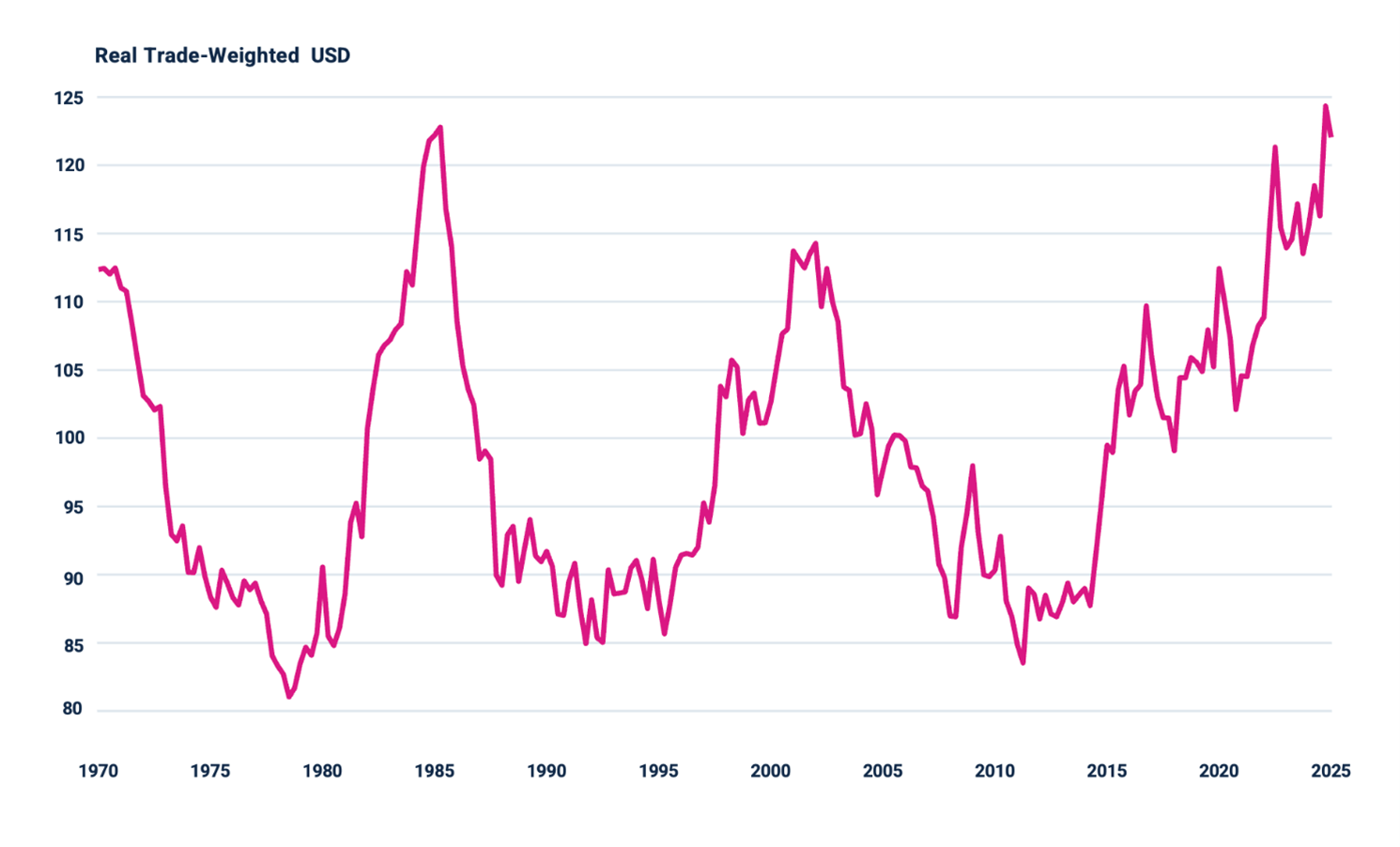
The current U.S. administration’s term started with the USD (on a trade‑weighted basis) trading at its most expensive level ever, as seen in Figure 1 below. So far in 2025, the dollar has depreciated by 5%. Perhaps, downgrading the dollar’s status is the real goal, as Stephen Miran, chair of Trump’s Council of Economic Advisers, has argued.4 Rebalancing trade with dollar depreciation will require a much bigger move than what has been seen so far in 2025 and would have to be on a scale last seen in the aftermath of the Plaza Accord in 1985 to make a real difference.
Figure 1: U.S. Real Trade‑Weighted U.S. Dollar
Past performance is not indicative of future results.
Source: Bloomberg, March 31, 2025
U.S. fiscal room for maneuverability is rapidly diminishing, and what matters for debt sustainability is a country’s reliance on foreign financing, reflected in the tight correlation between global bond yields and current account deficits. The U.S. has historically been the exception to this rule, securing funding for its extreme twin deficits thanks to the dollar’s exceptional status. However, the steady‑state level of sustainable U.S. fiscal deficits is decreasing due to recent policy disruptions. This has historically reduced the flexibility of the U.S. administration in pursuing an expansionary fiscal policy to support growth, much like when the UK had its Liz Truss moment in September 2022. U.S. policy flexibility could become a lot more constrained going forward.
It is an oft‑repeated phrase that a twin deficit country depends on the “kindness of strangers“. C WorldWide believes this now applies to the U.S., but by extension, it may make the stability of U.S. markets more dependent on non‑confrontational foreign and economic policy to ensure their funding. This is at odds with the administration’s new publicly stated “foreigners will pay” attitude, which C WorldWide believes drives foreign investors away. The U.S. administration will have to adopt a more conciliatory stance in international relations to maintain stability in the bond markets.
Ultimately, C WorldWide Believes It Is All About Valuations
Recent price action in the U.S. has resembled Emerging Markets‑like characteristics, with a falling currency, bond market, and equity market. However, unlike emerging economies, the U.S. has had no significant foreign currency liabilities that have led to explosive debt dynamics. In contrast, currency and bond market weakness could lead to cheaper valuations and a new asset pricing equilibrium that becomes attractive for foreigners to invest. The dollar’s biggest challenge may be its starting point of high valuation and high foreign asset allocations. U.S. equity markets recently peaked at nearly 70% of global equity markets in June 2025, which has recently been called into question due to a confrontational foreign policy approach. C WorldWide thinks this, on balance, significantly raises the valuation adjustments needed to make U.S. assets attractive again.
While it is premature to speculate what new international currency regime could eventually replace the current system, it may be fair to say that the dollar system is losing share because of a loss of confidence, which could be challenging to rebuild.
Regional Security in the Broadest Form
The fracturing of globalization could reshape trade flows, military alliances, and energy flows, potentially ushering in a tri‑polar world order with competing spheres of influence, as seen in Figure 2 below.
- U.S. Bloc: This bloc is anchored by the United States-Mexico-Canada Agreement’s (USMCA’s) tightened rules and 40% intra-bloc trade. Time may tell whether this could develop into a modern version of the Monroe Doctrine, where the U.S. retreats to its hemisphere, or whether the U.S. wants to deepen engagement with Asian countries to try to contain China.
- EU Bloc: Intra-EU trade accounts for 66% of total trade according to C WordWide as of June 2025. European manufacturing appears larger than U.S. manufacturing, second only to China in absolute terms, and highly specialized. Europe dominates in capital goods like jet engines, elevators, gas turbines, and mining equipment, so contrary to popular belief, Europe may not be “industrially dead” but specializes in high-quality manufacturing.
- China Bloc: Through Regional Comprehensive Economic Partnership (RCEP) and Belt and Road infrastructure, China could consolidate Asian manufacturing, with 60% of trade being intra-Asian, while deepening ties with Russia, Belt and Road countries, and the Global South. China’s massive manufacturing scale advantage in dual-use technologies challenges U.S. extended deterrence and influence in Asia.
Considering the world’s dependency on China’s manufacturing capacity, an alternative scenario might be that the fallout from tariffs on countries like Canada, Mexico, and the European Union could present an unexpected opportunity for China. As these countries face challenges from the U.S.’s disruptive trade policies, they may look to strengthen trade relations with China. This could lead to a closer alignment with China, as the restructuring of global trade may make it more advantageous for these nations to partner with China in certain areas, such as technology, manufacturing, and critical raw materials. In that case, instead of a tri‑polar trade system, the new system design would be more or less free trade between countries, except for the U.S., which would be “protected” behind steep tariff walls. The fault lines in this system would be Mexico and Canada, being part of the North American trade area, USMCA. Today, it is difficult to say which side of the fault line these two countries could fall on over the coming years.
Figure 2: A World of Three Loosely Integrated Economic Blocks Could Emerge
U.S., Europe in separate economic blocks? U.S. tariffs seem to target global supply chains.
For illustrative purposes only.
NATO Sclerosis and Military Realignments
U.S. NATO skepticism may be an existential threat to Europe. Explicit doubts about Article 5 commitments undermine deterrence, and there could be a fear of Russia exploiting gaps through hybrid threats in the Baltic. Europe has been jolted into action, fundamentally altering its fiscal policy, defense spending, and economic growth approach. A European Security arrangement may have to be developed.
Europe is now in a wartime economy, which Ursula von der Leyen has described as “a new era of rearmament.” War economies fundamentally reshape national priorities, redirecting resources from civilian consumption to military needs and trashing economic orthodoxy.
According to C WorldWide, war economies typically see an increase in centralized government control over industries and resource distribution to manage resource allocation effectively. This stage has not yet been reached, but governments are calling for consolidation amongst private sector defense contractors, and there have been calls for European capital to be invested in European defense and related businesses at the expense of products for private consumption and exports. One example is the uncompetitive European auto industry, which risks being hard hit by tariffs and competition from China. We could now be on the verge of seeing this capacity shift as auto companies contemplate moving available industrial capacity to the European defense sector.5
Energy Security is Central to Europe’s Path to Independence
C WorldWide doesn’t think decarbonization policies are working. While $9 trillion has been spent on the energy transition, global emissions reached an all‑time high of 54 gigatons per annum (GTpa) in 2024. Cheap domestic energy has been prioritized for security and growth over decarbonization. Europe could be directly threatened on both sides, with the relationship between Trump and Putin reminding some of 1939’s Molotov‑Ribbentrop pact.6 Meanwhile, Chinese manufacturing prowess and low energy costs could be a fundamental threat to European competitiveness. Europe is now in a fight for survival. C WorldWide thinks Europe must consider why it enters this fight as the only fighter with one hand tied behind its back. Its industrial policies over the past decade have been riddled with contradictions, which somehow get justified via EU double‑speak: “We are going to become competitive by decarbonizing”, while adding €44 billion in direct costs to the domestic industry in 2023 via EU Emissions Trading System (EU ETS) carbon taxes. Either Europe will decarbonize, or it will become more competitive.
C WorldWide believes it is probable that Europe could backtrack on its ineffective energy policies. Why pursue expensive7 “100% renewable energy”, leading to blackouts due to a lack of spinning baseload capacity, as recently seen in the Iberian Peninsula? Why have a moratorium on new oil and gas licenses in the North Sea when Europe could need more natural gas in the decades to come to back up renewables? Energy policy may have to become more pragmatic. Renewable energy, nuclear power, and electrification could be core to the strategy. However, a new energy policy may also mean accepting that fossil energy sources could be central to a secure and reliable energy system for decades.
Conclusion: Fragmented Interdependence
When the dust settles after a chaotic and disruptive period, the likely new operating system of the world, replacing Pax Americana, could be a multi‑polar system, with regional trade and security arrangements. The world is coalescing into three competing blocks, but not hermetically sealed. The emerging order resembles “fragmented interdependence” — less globalized than the 1990s/2000s, but more connected than the Cold War, and with a reduced role for the U.S. dollar.
The dollar may continue to lose share, both as a settlement currency and as a reserve asset. However, there is no single alternative to the dollar, and a multipolar settlement and reserve system could emerge, including gold playing a larger role as a reserve asset.
The corporate platform model may face headwinds. Companies could want to reduce their fragility after bad experiences from disrupted supply chains in recent years, and therefore, at the margin, may move towards verticalization of production to improve resilience. Furthermore, countries could want a larger piece of the value creation through taxes. This may come at the expense of shareholders.
C WorldWide began this paper quoting Hemingway. The idea that major shifts happen “slowly at first, and then all at once” resonates a lot with C WorldWide’s investment philosophy, because of its relationship with the concept of compounding. C WorldWide believes Hemingway’s insight could serve as a reminder of the power of compound growth and the importance of patience and persistence. The key, per C WorldWide, is to stay attuned to the gradual shifts happening beneath the surface and to take proactive steps to prepare for the changes that may eventually shape the new operating system.
This means cultivating a long‑term mindset and a tolerance for delayed gratification. It means building strong foundations and resilient portfolios with companies that have the potential to compound earnings through the changes that appear to be coming. Platform companies may be less favored, and national champions, like recent additions to our global strategy, Republic Services and Progressive, could have more defendable business models. The importance of international diversification may grow as transition occur further and further away from Pax Americana into a multi‑polar world, where the growth baton no longer resides in the hands of the U.S. economy. The U.S. could go from being a destination for capital to becoming a source of capital. For investors, C WorldWide believes now is the time to allocate to international equities.
Important Information
1 USA Share of services – data, chart; The GlobalEconomy,com, June 2025
2, 3 United States Current Account, June 2025
4 CEA Chairman Steve Miran Hudson Institute Event Remarks – The White House
5 Volkswagen Willing to Re‑Open Military Equipment Production for Germany
6 Trump’s secret pact with Putin: A warning from Lithuania
7 The Struggle to Achieve Net Zero Emissions’
This information has been provided by C WorldWide and was published in June 2025 for informational purposes only. The opinions expressed are as of June 2025 and are subject to change. The opinions expressed by the speakers do not necessarily represent the views of Harbor Capital Advisors, Inc. The information and opinions contained in this material are derived from proprietary and non‑proprietary sources deemed by Harbor Capital Advisors, Inc. to be reliable and are not necessarily all‑inclusive and are not guaranteed as to accuracy. Harbor nor C WorldWide has not considered any reader’s financial situation, objective or needs in providing the relevant information.
Performance data shown represents past performance and is no guarantee of future results.
Investing entails risks and there can be no assurance that any investment will achieve profits or avoid incurring losses.
International investing involves risks, including risks related to foreign currency, limited liquidity, less government regulation and the possibility of substantial volatility due to adverse political, economic or other developments. These risks often are heightened for investments in emerging/developing markets or in concentrations of single countries. Stock markets are volatile and equity values can decline significantly in response to adverse issuer, political, regulatory, market and economic conditions
The views expressed herein may not be reflective of current opinions, are subject to change without prior notice, and should not be considered investment advice or a recommendation to purchase a particular security.
This material may contain forward‑looking information that is not purely historical in nature. Such information may include, among other things, projections and forecasts. There is no guarantee that any of these views will come to pass.
Diversification does not assure a profit or protect against a loss.
Copyright © (2025) Harbor Capital Advisors, Inc. All Rights Reserved.
4645099