


A Note From Harbor
C WorldWide has been in a strategic partnership with Harbor Capital for over three years. C WorldWide has published thought leadership on several relevant topics, including this piece, which focuses on the case for refocusing on emerging market equities. Harbor is pleased to share C WorldWide’s thinking for your portfolio construction consideration.
Introduction
According to C WorldWide’s research, emerging markets (EM) equities have historically faced more than a decade of relative underperformance against developed market (DM) counterparts. However, they believe the global, economic, and geopolitical landscapes appear to be undergoing a profound transformation, likely creating a compelling and differentiated investment opportunity in EM equities today. C WorldWide believes that investors should critically re‑evaluate their allocations to emerging markets, driven by a powerful confluence of enduring secular tailwinds, including financial inclusion and a burgeoning middle class. Related to the latter, the center of the well‑known Valerie Pieris circle — the smallest circle that can be drawn on Earth to include more than half of the world's population — is firmly located in Asia. There are a lot of people within this part of the world, and C WorldWide sees it as becoming increasingly well‑integrated from an economic perspective. In many respects, it continues to represent, in their view, the fastest‑growing economic area in the coming decades.
There are more people living inside this circle than outside of it
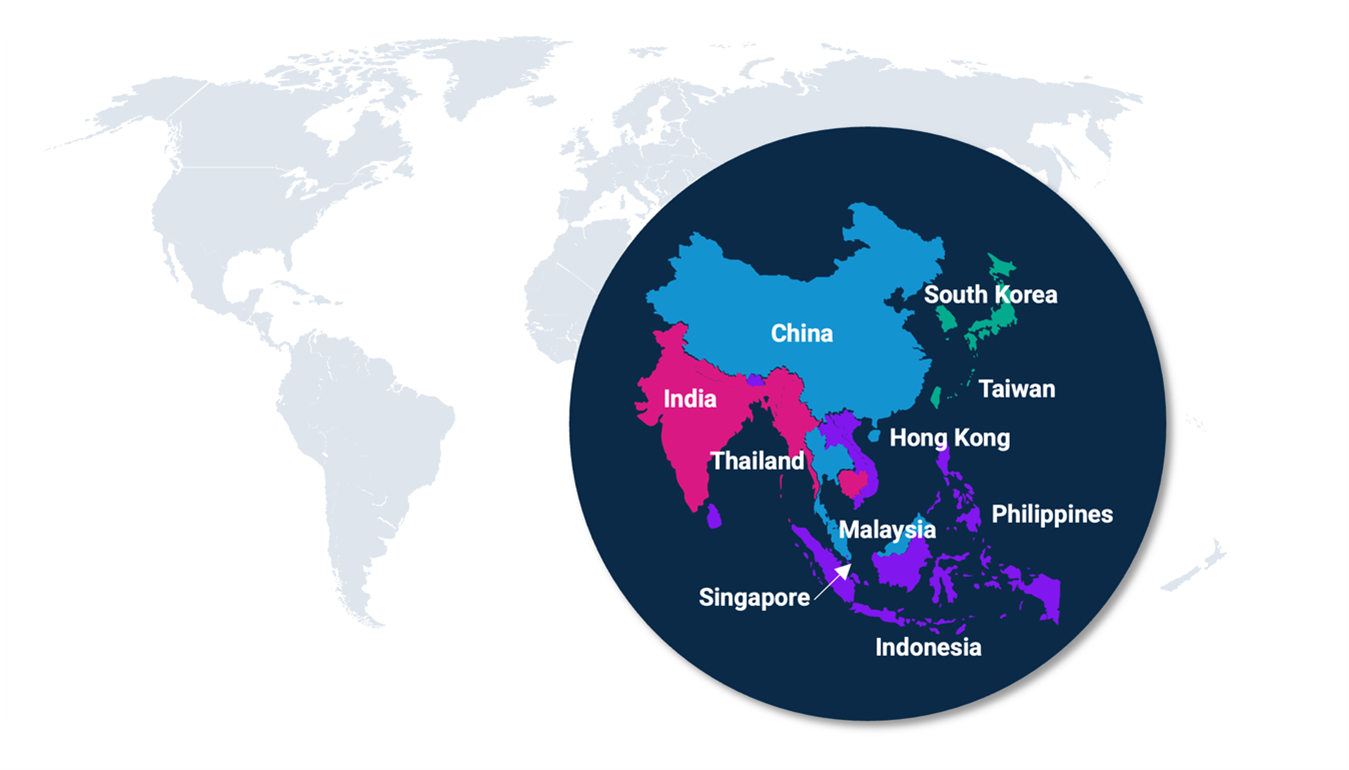
Source: IMF & World Economic Forum, December 2020
Added to the more familiar structural story of EM are several recent developments and new, decisive catalysts. These catalysts, C WorldWide believes, include a strengthened macroeconomic foundation, an increasingly positive political environment marked by reform‑focused governments, accelerating geopolitical shifts toward multipolarity that benefit EM economies, and the remarkable ascent of EM companies up the global value chain.
Improved Macroeconomic Fundamentals and Policies
C WorldWide thinks emerging markets stand on a much sounder macroeconomic footing today than in prior eras. Many EM countries have learned hard lessons from past crises and have markedly strengthened their external balances and policy frameworks. According to C WorldWide’s research, unlike earlier periods of fiscal waste in the use of resources, high inflation, and debt of the 1980s‑90s, most large EMs now exhibit healthier current accounts, ample foreign reserves, and more orthodox fiscal and monetary policies. As a group, EM economies have been proactive in stabilizing their finances. In fact, during the recent global monetary tightening cycle, central banks in many EM countries moved early — hiking interest rates well before the U.S. Federal Reserve — and generally exercised fiscal discipline, which, C WorldWide believes, helped insulate their economies. This was a notable contrast to past cycles, and it paid off: from early 2022 to mid‑20231, EM currencies depreciated only modestly on a trade‑weighted basis (with some, like the Mexican peso, appreciating against the U.S. dollar), as opposed to prior Fed tightening episodes, where EM currencies suffered severe devaluations. Also, inflation was contained, which allowed EM central banks to embark on easing cycles prior to the Fed. Post‑COVID, for the first time ever, policy rates in EM converged with those of developed markets. These developments could show that, generally, public sector institutions in EM, including central banks, have grown up and become more responsible and mature.
With what C WorldWide sees as stars aligning from a macroeconomic perspective, EMs may be currently well‑positioned in terms of what GaveKal Research2 refers to as ”the triple merit scenario,” in which one could expect to see currency appreciation, falling real interest rates, and a sustained rise in asset prices in the coming years. In essence, it appears to be a great macroeconomic backdrop for investors.
Political Stability and Pro‑Reform Governance
Hand‑in‑hand with what appears to be better economics, the political environment in many emerging markets has also improved, seemingly more conducive to investment. Notably, a number of EM nations have undertaken significant reforms in recent years to seek to bolster long‑term growth. The poster child in this regard is India, which has implemented a slew of major reforms since 2014 under the helm of Prime Minister Modi. Even in countries that have historically witnessed a fair share of political unrest, policymakers increasingly recognize that attracting capital and achieving sustainable development require a stable, reform‑oriented approach rather than short‑term populism. For example, in South Africa, which has historically witnessed a turbulent political environment in the past decade, the recent transition to coalition rule appears to have created momentum for economic policy reform. Even in Latin America – historically left‑leaning – there could be a shift towards more market‑friendly, reform‑oriented governments in certain countries, notably Argentina. Even where political cycles brought populists or non‑traditional leaders, democratic institutions have generally deepened, and there has often been relative continuity in core economic policies. For example, in the case of Brazil, with a fiscally wasteful Lula currently in power, the central bank (and financial markets) has served as a strong backstop to anchor inflation expectations until a more cautious fiscal approach is employed.
The overall macro and political picture could indicate that emerging markets may be better managed at the macro level than in decades past — a potentially positive backdrop for equity investors who in earlier times had to worry about recurring booms and busts. Political regimes across the emerging world appear to be, on average, more stable and reform‑focused than investors might assume based on outdated stereotypes. The combination of what C WorldWide sees as better governance and economic reforms may strengthen the investment climate and reduce the risk premia associated with EM equities. Investors could take some confidence that many EM leaders today share a commitment to growth and integration into the global economy, aligning their policies accordingly.
Geopolitical Shifts: A Multipolar World Could Benefit EM
The turbulent geopolitics of recent years — from trade wars to great‑power rivalry — ironically appear to be catalyzing opportunities for emerging markets. C WorldWide believes we are moving toward a more multipolar world, and EM economies may be poised to benefit from this realignment. U.S.‑China trade tensions seem to have accelerated the reorganization of supply chains, potentially benefiting a slew of other EMs, including India, Indonesia, and Mexico. Another tangible outcome of this multipolar shift could be the surge in intra‑EM trade and investment. EM nations may trade more with each other and rely less on Western markets — according to data from Gavekal, intra‑EM trade accounts for approximately 50% of the total EM trade. Previously, the nature of trade was typically that goods were designed in the West and made in the East for the West. Today, given the move up the value chain of EM companies and the growth of the consumer classes in EM, the playbook appears to be, to a greater extent, that goods are being designed and manufactured in the East for the East (or for the Global South, to be more exact). According to BCG3, trade between China and the rest of the Global South is projected to grow about 5.9% annually for the next decade — a robust pace that highlights the strengthening links among EMs.
Overall, a fragmented world with multiple power centers could give emerging markets more leverage and new avenues for growth. The evolving multipolar world order — while introducing new uncertainties — may in many ways elevate the strategic importance of EMs. Investors should recognize that EMs may not just be passive recipients of global trends but increasingly central players shaping the next phase of globalization.
As the U.S. may exercise its strength and put pressure on countries to align with U.S. interests, C WorldWide sees increased evidence of the opposite occurring, namely, further cooperation amongst Ems — importantly amongst the BRICS, or Brazil, Russia, India, China, and South Africa, as well as five new members — an informal grouping of emerging economies that hope to increase their sway in the global order. In fact, C WorldWide sees a thawing of relations between India and China, as India gets hit by the U.S. tariff hammer in response to the country’s purchase of Russian oil. There may be clear geopolitical shifts occurring at the moment. The shifting world order could create investment opportunities, including such areas as the development of technological self‑sufficiency within individual EM countries.
Reduced U.S. Dollar (USD)‑Reliance
A related geopolitical development may be the gradual challenge to U.S. dollar dominance in international finance. The “weaponization” of the USD in recent years, as well as long‑term concerns around the public finances of the U.S., appear to have, at the margin, eroded some trust in the long‑run stability of the USD and thus the USD‑centric global system. It has prompted many countries to rethink their heavy reliance on the USD. In practice, C WorldWide believes this has given momentum to trade in local currencies and new payment arrangements among EM countries. For example, according to Gavekal, China has actively been signing agreements to settle trade in renminbi and currently has credit lines open with 40 trading partners. Further, in 2023, the first‑ever Chinese renminbi‑settled Liquefied Natural Gas trade between China’s National Offshore Oil Corporation and France’s TotalEnergies, which would have been almost unthinkable a few years ago. C WorldWide sees all these as early signals of a world where trade could be becoming slightly more currency‑diverse.
To be clear, C WorldWide believes a complete replacement of the U.S. dollar does not appear imminent. However, the trend of marginal de‑dollarization may be notable. For EM investors, a gradual diversification away from the USD could weaken one headwind that has hurt EM assets historically: dollar strength. Periods of a surging USD have historically tended to tighten financial conditions for EMs, but if more trade is settled in local currencies and reserves are more diversified, the impact of U.S. policy on EM could soften at the margins. Per C WorldWide, year‑to‑date, the DXY index has weakened, but the USD still remains significantly overvalued vs. its long‑term average in purchasing power parity terms. There appears to be scope to believe that the USD could structurally weaken in the coming years, which may bode well for EM, like the 2000s, where per C WorldWide’s research, USD weakness coincided with EM outperformance.
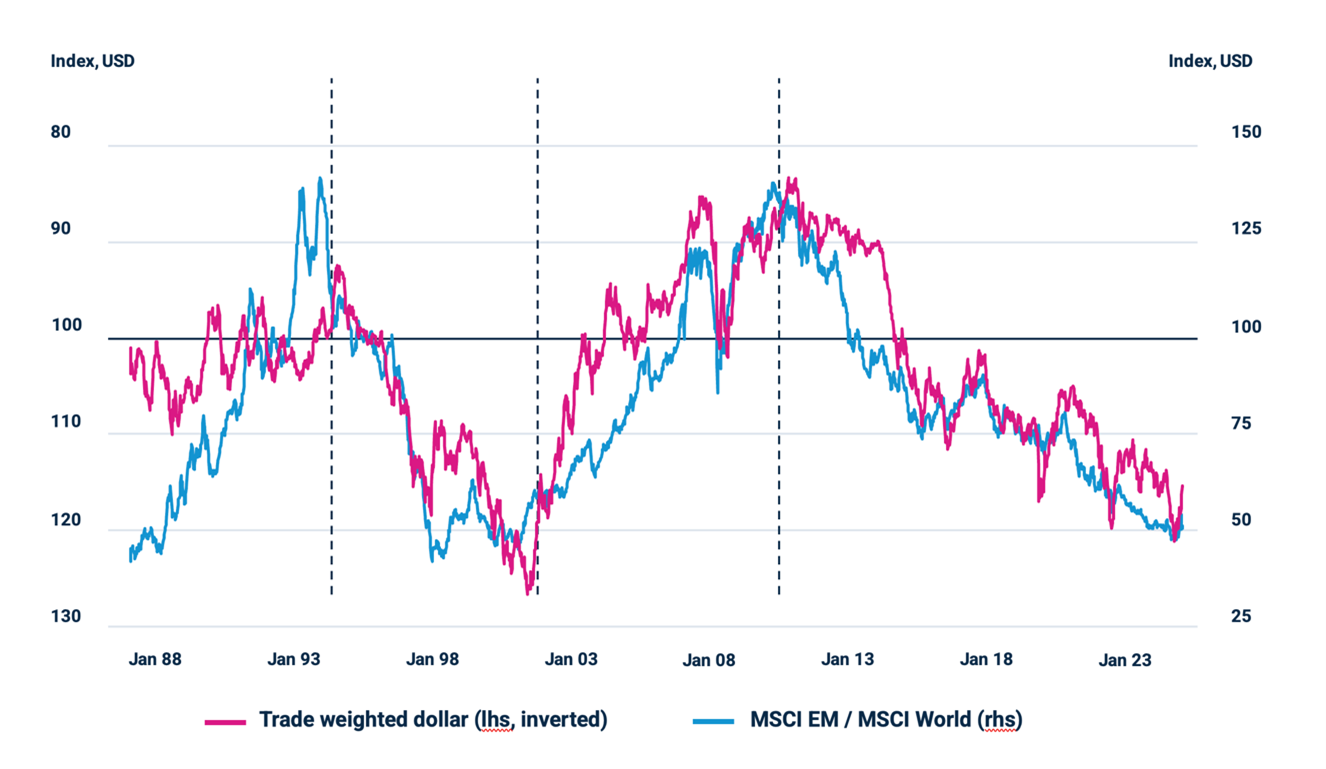
Past performance is not indicative of future results.
Source: CLSA, Oxford Economics, Refinitiv, April 2025
EM Companies: C WorldWide Believes Dominating Domestically and Growing Globally
It is not only governments and macro indicators that C WorldWide sees have improved in emerging markets — EM companies themselves have transformed, moving up the value chain and becoming globally competitive across a range of industries. No longer are EMs solely focused on low‑cost manufacturing or commodity exports. Consider the realm of high‑tech manufacturing and clean technology. In the automotive and renewable energy revolution, the Chinese company, CATL, appears to have become the world’s largest producer of electric‑vehicle (EV) batteries, commanding more than 1/3rd of the global EV battery market as of 2024 per C WorldWide. Even Brazil is home to several companies, including WEG Industries and Embraer, which appear to be developing into global leaders within their niches. In fact, per C WorldWide, WEG remains one of the few industrial companies globally that has also historically delivered return on invested capital in excess of 25%, which they see as a testament to the well‑managed and high‑quality nature of the company. This corporate evolution could provide another strong underpinning for EM equities as an asset class, as investors may now tap into home‑grown winners with both domestic dominance and a growing global presence.
While C WorldWide thinks the evolution of EM corporates within the areas of manufacturing and semiconductors has become increasingly clear in recent years, the progress within the consumer space is less well understood. The historical excitement around the burgeoning EM middle class remains relevant today. According to Future Agenda4, Asia‑Pacific’s share of the global middle class is projected to rise from 28% in 2009 to about 66% by 2030, and, in absolute terms, EM regions (Asia, Africa, Latin America) may be expected to add on the order of 3 billion new middle‑class consumers by 2030. However, while it was arguably earlier more attractive to get exposure to the EM consumer through developed market companies, that appears to no longer necessarily be the case in many countries. Domestic EM companies may increasingly thrive in consumer and brand‑driven sectors by leveraging their local insights and scale. For instance, Proya is a cosmetics company that has historically outmaneuvered the international players to reach the top position in the mass market in China. The premium space within consumer categories has, to date, remained more difficult for local companies to penetrate, but that too is gradually occurring; by catering to Chinese consumers’ tastes and leveraging nationalist pride in homegrown brands, Mao Geping has successfully penetrated the premium cosmetics space. Beyond China, one could find more examples of emergent EM brands and multinationals. C WorldWide firmly believes that the emergence of even more EM companies in the premium consumer space may continue in the coming decade, presenting potentially exciting investment opportunities for investors.
The overarching point appears to be that the corporate landscape in emerging markets has matured and diversified significantly. Investors in EM equities today appear to be buying into companies that often have robust earnings, improving corporate governance, and competitive moats in growth industries. It seems to not just be about state‑owned banks and oil companies anymore (the traditional EM index staples); it could also be about electric vehicle supply chains, digital economy plays, advanced manufacturers, and rising consumer brands. In many cases, these companies may dominate their domestic markets and could expand regionally or globally, supported by economies of scale and home‑market advantages.
How Do We Navigate This Evolving World?
C WorldWide believes navigating the shifting landscape of EM equities today may require an adaptable, forward‑thinking framework that integrates both top‑down, thematic views and disciplined bottom‑up analysis. Considering rapidly evolving geopolitical, economic, and regulatory environments, investors may remain vigilant, focusing on a selective, high‑conviction approach that seeks to go beyond traditional country or sector allocations.
As highlighted above, C WorldWide thinks the longer‑term investment landscape could be favorable for EMs. However, the state of flux in the global macro and geopolitical environment in recent years has historically resulted in incredibly myopic and volatile equity markets, with the market reacting to every social media post and macro datapoint. Given our long‑term focus on growth‑oriented, high‑quality franchises, this period of upheaval could create uncertainty and is particularly challenging. C WorldWide remains focused on identifying and seeking to back high‑quality franchises that appear to be positioned to benefit from the secular growth opportunities across emerging markets. As a result of the current geopolitical upheaval, these secular growth opportunities appear to be crystallizing. One such example, as mentioned, appears to be both India’s and China’s self‑sufficiency push and move up the value chain, which has historically created and may continue to create exciting investment opportunities in the coming years. C WorldWide remains vigilant about these opportunities and, through their rigorous value chain analysis, works hard to identify businesses with respect to these opportunities — businesses that seek durable competitive advantages, strong governance, and financial strengths.
By maintaining this disciplined focus, C WorldWide believes they seek to capture the outsized opportunities that the transformation of emerging markets presents, while mitigating the cyclical and political risks often associated with the asset class.
Conclusion
In summary, emerging markets appear to be entering a new era defined by multiple, mutually reinforcing tailwinds — including stronger macro fundamentals, increased political stability, a growing middle class, and ascendant domestic corporates. Amid firmer policy frameworks and improving valuations, these markets appear to offer not only diversification but potential for exposure to the next generation of global growth and innovation drivers.
C WorldWide firmly believes that successful navigation and capital allocation in Emerging Markets today could hinge on a combination of discipline, selectivity, and an unwavering focus on quality and long‑term compounders. By integrating rigorous fundamental and thematic research, robust risk management, and active sustainability engagement into every stage of the investment process, C WorldWide positions themselves — and their clients — to potentially capture the outsized opportunities that the transformation of EM equities could present in the decade ahead.
Demographic advantages and an emerging middle class may promise to drive consumption growth at an unprecedented scale in EM economies, while technological leapfrogging and innovation could present new investment opportunities. Meanwhile, macroeconomic frameworks appear to have been fortified — as many EM countries today may enjoy stronger balance sheets, more orthodox policies, and greater resilience to shocks than in decades past. C WorldWide believes political conditions have also become more supportive of investment, with more reform‑minded leadership and a general trend toward stability and pragmatism in economic management. At the same time, global geopolitical shifts could stand to benefit EM nations going forward, whether through increased intra‑EM trade or gradually reduced reliance on the USD. Finally, on the ground, EM companies appear to be climbing the value chain and capturing market share across industries from clean energy to semiconductors to consumer goods.
Per C WorldWide, the case for EM equities rests not on any one factor, but on a confluence of structural positives that are distinct to the current moment. In 2025 and beyond, focusing on EM equities appears to not just be about diversification, but about positioning for where the growth and innovation of the future could likely increasingly be found.
Important Information
1 Bloomberg data, 2025
2 Gavekal Research – Independent Macro Research, 2025
3 In a Multipolar World, Global South Finds Its Moment, BCG, 2025
4 Shrinking Middle – Future Agenda, 2025
This information has been provided by C WorldWide and was published in September 2025 for informational purposes only. The opinions expressed are as of September 2025 and are subject to change. The opinions expressed by the speakers do not necessarily represent the views of Harbor Capital Advisors, Inc. The information and opinions contained in this material are derived from proprietary and non‑proprietary sources deemed by Harbor Capital Advisors, Inc. to be reliable and are not necessarily all‑inclusive and are not guaranteed as to accuracy. Harbor nor C WorldWide has not considered any reader’s financial situation, objective or needs in providing the relevant information.
Performance data shown represents past performance and is no guarantee of future results.
Investing entails risks, and there can be no assurance that any investment will achieve profits or avoid incurring losses.
International investing involves risks, including risks related to foreign currency, limited liquidity, less government regulation, and the possibility of substantial volatility due to adverse political, economic, or other developments. These risks are often heightened for investments in emerging/developing markets or in concentrations of single countries. Stock markets are volatile, and equity values can decline significantly in response to adverse issuer, political, regulatory, market, and economic conditions.
The views expressed herein may not be reflective of current opinions, are subject to change without prior notice, and should not be considered investment advice or a recommendation to purchase a particular security.
This material may contain forward‑looking information that is not purely historical in nature. Such information may include, among other things, projections and forecasts. There is no guarantee that any of these views will come to pass.
The U.S. Dollar (DXY) Index is an index measuring the U.S. dollar’s strength relative to other currencies. The MSCI Emerging Markets (ND) Index captures large and mid cap representation across Emerging Markets countries. The index covers approximately 85% of the free float‑adjusted market capitalization in each country. The MSCI World Index is a global stock market index that tracks the performance of approximately 1,500 large and mid‑cap companies across 23 developed countries. These indices are unmanaged and do not reflect fees and expenses and is not available for direct investment.
Diversification does not assure a profit or protect against a loss.
Copyright © 2025 Harbor Capital Advisors, Inc. All Rights Reserved.
4881306